
Introduction
Data analytics for marketing is the backbone of every high-performance campaign running in Canada’s most competitive digital markets — and the brands that treat it as a strategic priority rather than a reporting afterthought are the ones consistently outperforming their competitors on every measurable dimension. In 2026, marketing without data is not bold or intuitive — it is expensive guesswork. Every dollar spent on paid media, content production, and campaign execution without a rigorous data analytics for marketing framework behind it is a dollar spent without accountability, without learning, and without the compounding intelligence that turns good campaigns into great ones.
“Have you noticed how digital advertising keeps growing year after year? By 2026, it’s projected to hit a whopping $786.2 billion, up from $733 billion in 2023.(Medium)”Canadian businesses across Vancouver, Toronto, and Calgary are navigating digital marketing environments of extraordinary complexity. Multiple channels, fragmented audiences, rising acquisition costs, and increasingly sophisticated competitors make intuition-based marketing decisions progressively more costly. The brands that win consistently are those that have replaced opinion with evidence building data analytics for marketing systems that capture performance data across every touchpoint, synthesize it into actionable intelligence, and translate that intelligence into campaign decisions faster than their competitors can respond.
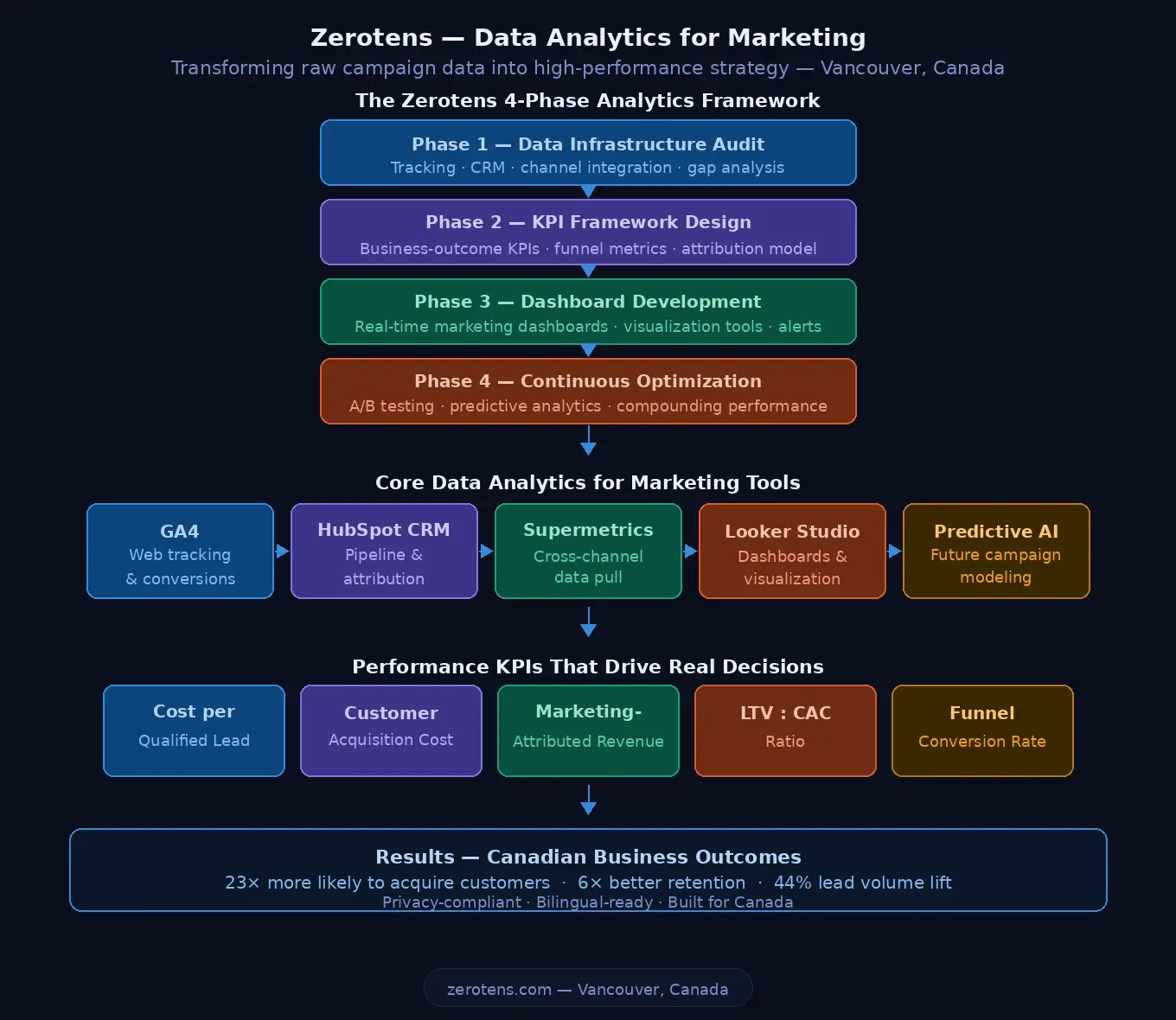
The numbers make the case unambiguously. McKinsey research confirms that data-driven organizations are 23 times more likely to acquire customers, 6 times more likely to retain them, and 19 times more likely to achieve above-average profitability than those operating without structured analytics frameworks. For Canadian businesses investing significant budgets in digital marketing, these multipliers are not theoretical benchmarks — they are the difference between campaigns that scale and campaigns that stall.
This article breaks down exactly how data analytics for marketing works, why it matters more in 2026 than ever before, and how Zerotens builds data-driven marketing intelligence systems for Canadian businesses that convert raw performance data into sustainable competitive advantage.

Data Analytics for Marketing — Transforming Insights into Impact
Data analytics for marketing operates at the intersection of technology, strategy, and creative execution — transforming the raw performance signals that every digital campaign generates into the structured intelligence that drives better decisions at every level of marketing investment. Every click, impression, conversion, session duration, and scroll depth is a data point. Data analytics for marketing is the discipline that turns those data points into patterns, patterns into insights, and insights into decisions that improve campaign performance compounding over time.
The transformation from data to impact is not automatic. Raw marketing data without analytical structure is noise — overwhelming in volume, contradictory in signal, and paralyzing in its demand for interpretation. The data analytics for marketing systems that Zerotens builds for Canadian clients are designed to eliminate this paralysis — filtering, organizing, and visualizing performance data in ways that make the right decision obvious rather than obscured.
Marketing dashboards are the primary interface through which this transformation becomes operationally accessible. A well-designed marketing dashboard does not simply display data — it answers questions. Which channels are generating the highest quality leads? Which campaigns are producing the lowest cost per acquisition? Where in the funnel are the most significant drop-off points? Which audience segments are converting at rates that justify increased investment? Data analytics for marketing at the dashboard level transforms these questions from analytical exercises into real-time operational intelligence.

The Data Behind Every Marketing Decision
Every marketing decision that Zerotens makes for its Canadian clients is grounded in data analytics for marketing evidence — not channel preference, creative intuition, or competitive imitation. This discipline begins before a single campaign element is produced, with a data audit that establishes the baseline performance metrics against which every future decision will be evaluated.
The baseline audit examines historical campaign performance across all active channels — paid search, paid social, organic search, email, content, and direct — identifying the performance patterns that reveal where the marketing budget is generating its highest and lowest returns. For a Vancouver-based B2B technology company recently onboarded by Zerotens, this audit revealed that 67% of qualified leads were originating from 2 content pieces representing less than 8% of the total content investment. Data analytics for marketing made the reallocation decision obvious — and the subsequent 90-day campaign produced a 44% improvement in qualified lead volume without a budget increase.
This pattern repeats consistently across Zerotens’ Canadian client portfolio. The most impactful marketing decisions are almost never the most creative or the most expensive — they are the most analytically informed. Data analytics for marketing provides the informational foundation for these decisions, ensuring that every dollar of marketing investment is deployed with the intelligence of cumulative performance learning rather than the uncertainty of fresh assumption.
How Marketing Dashboards Power Real-Time Decisions
Marketing dashboards transform data analytics for marketing from a periodic reporting exercise into a continuous operational capability. The distinction matters enormously. A marketing team that reviews performance monthly is operating with data that is 30 days stale — making decisions based on campaign conditions that may have changed significantly since the data was captured. A marketing team operating with real-time marketing dashboards is making decisions in the same time dimension as the campaigns they are managing.
Zerotens builds marketing dashboards for Canadian clients using a stack that integrates Google Looker Studio, Supermetrics, and custom API connections to pull live performance data from every active marketing channel into a single unified view. These dashboards are designed around decision architecture rather than data completeness — displaying the specific performance KPIs that drive the most significant marketing decisions, in the visual format that makes their implications most immediately actionable.
For a Calgary-based e-commerce brand managing simultaneous campaigns across Google Ads, Meta, TikTok, and email, real-time marketing dashboards allow the Zerotens team to identify and respond to performance signals — a cost-per-click spike, a conversion rate drop, an email open rate anomaly — within hours rather than weeks. Data analytics for marketing at this speed is not just more accurate than periodic reporting — it is categorically more valuable, because it operates in time to influence outcomes rather than simply document them.

Why Data Analytics for Marketing Is the Foundation of Success
Data analytics for marketing is not one component of a successful marketing strategy — it is the foundation on which every other component depends. Creative execution without analytical guidance produces beautiful campaigns that may or may not work. Channel strategy without performance data produces budget allocations based on assumption rather than evidence. Campaign optimization without data analytics for marketing produces incremental adjustments disconnected from the performance patterns that would reveal the most impactful opportunities.
The Canadian digital marketing landscape makes this foundational role of data analytics for marketing particularly consequential. Canada’s market combines the linguistic complexity of bilingual audiences, the geographic diversity of a country spanning 6 time zones, the cultural diversity of Metro Vancouver and Toronto’s multicultural demographics, and the behavioral distinctiveness of Canadian consumers whose digital engagement patterns differ measurably from their American counterparts. Navigating this complexity without robust data analytics for marketing infrastructure is not merely suboptimal — it is commercially reckless.
When Campaigns Fail Without Data
The failure modes of marketing campaigns that operate without data analytics for marketing are consistent and predictable. Budget concentrates in channels that feel productive rather than those that demonstrably are. Creative fatigue goes undetected until conversion rates have collapsed. Audience segments that convert at premium rates receive the same investment as those that rarely convert at all. Seasonal performance patterns are missed because there is no historical data framework to identify them. Competitor movements that shift the performance landscape go unrecognized until their impact is already embedded in declining results.
For Canadian businesses operating in sectors where marketing budgets represent significant operational expenditure — professional services, technology, real estate, retail — these failure modes translate directly into material financial consequences. A Toronto professional services firm spending $25,000 per month on paid media without data analytics for marketing infrastructure is not simply leaving optimization opportunities on the table. It is actively funding waste at a rate that a properly instrumented analytics system would identify and eliminate within the first reporting cycle.
Zerotens has conducted marketing analytics audits for Canadian businesses across every major sector — and the consistent finding is that organizations operating without structured data analytics for marketing systems are typically generating 40 to 60% of the performance available from their existing budget and channels. The opportunity is not in spending more. It is in understanding more — and data analytics for marketing is the instrument that converts understanding into performance.
Predictive Analytics and the Future of Campaign Planning
Predictive analytics represents the frontier of data analytics for marketing — moving from the analysis of historical performance to the modeling of future outcomes. Where traditional marketing analytics answers the question “what happened?”, predictive analytics answers “what will happen if we do this?” — enabling Canadian businesses to make campaign decisions based on modeled outcomes rather than historical patterns alone.
Zerotens integrates predictive analytics capabilities into its data analytics for marketing engagements for clients with sufficient historical data to support modeling. Machine learning models trained on 12 to 24 months of campaign performance data can predict with measurable accuracy which audience segments are most likely to convert in the next campaign cycle, which creative formats will produce the highest engagement rates for a specific product category, and which budget allocation across channels will generate the optimal blended return on ad spend.
For Vancouver technology companies managing complex multi-channel marketing ecosystems with significant budget investments, these predictive capabilities transform campaign planning from an educated estimate into a data-informed projection — reducing the uncertainty that makes large marketing investments difficult to justify and the waste that makes them difficult to sustain.
The Core Elements of a Data-Driven Marketing Stack
Data analytics for marketing requires a technology infrastructure — a marketing stack — that captures, integrates, and analyzes performance data across every channel and touchpoint in the marketing ecosystem. Zerotens builds and configures these stacks for Canadian clients as a standard component of every data analytics for marketing engagement, ensuring that the data infrastructure matches the analytical ambition of the strategy it is designed to support.
The 4 core elements of every Zerotens data analytics for marketing stack are data capture, data integration, visualization tools, and performance KPI frameworks. Each element must function correctly and connect to the others for the stack to deliver its full analytical value — because data analytics for marketing is only as powerful as the completeness and accuracy of the data flowing through its infrastructure.
Performance KPIs That Actually Matter
The performance KPI landscape for data analytics for marketing is vast — and most of it is noise. Vanity metrics — impressions, follower counts, page views without engagement context — consume analytical attention without informing decisions. Zerotens designs data analytics for marketing KPI frameworks around the metrics that connect directly to business outcomes: cost per qualified lead, customer acquisition cost by channel, lifetime value to acquisition cost ratio, marketing-attributed revenue, and funnel conversion rates at each stage of the buyer journey.
For Canadian B2B companies where the sales cycle spans multiple months and multiple decision-makers, the most critical data analytics for marketing KPIs are those that measure pipeline contribution rather than surface-level engagement. Marketing-sourced pipeline value, marketing-influenced opportunity rate, and content-to-meeting conversion rate are the metrics that connect marketing performance directly to revenue outcomes — and they are the metrics that Zerotens prioritizes in every data analytics for marketing dashboard it builds for Canadian business clients.
For Canadian B2C brands where purchase frequency and customer lifetime value are the primary commercial drivers, the KPI architecture shifts toward repeat purchase rate, cohort retention curves, and channel-specific return on ad spend — each calibrated to the specific margin structure and growth model of the business. Data analytics for marketing KPI design is not universal — it is a strategic exercise that begins with the business outcome and works backward to the metrics that most reliably predict it.
Visualization Tools That Turn Numbers into Strategy
Visualization tools are where data analytics for marketing becomes operationally accessible to the marketing teams, senior leaders, and business owners who must act on analytical intelligence without necessarily being data specialists themselves. The most sophisticated analytical model produces zero business value if its outputs cannot be comprehended and acted upon by the people responsible for making decisions.
Zerotens designs visualization tools with this accessibility imperative as a primary design constraint — building marketing dashboards and analytical interfaces that communicate performance insights in the visual language of business rather than the technical language of data science. Trend lines replace data tables. Traffic light indicators replace percentage calculations. Opportunity identification replaces anomaly detection. The result is data analytics for marketing infrastructure that empowers marketing teams to make better decisions faster — without requiring data science expertise to extract the intelligence it contains.
For Vancouver businesses with marketing teams of varying analytical sophistication — from data-native performance marketers to brand-focused creative directors — this accessibility design approach ensures that data analytics for marketing intelligence reaches every decision-maker in a format they can use, rather than remaining siloed within the analytics function that produces it.
How Zerotens Converts Raw Data into Marketing Strategies
Zerotens’ approach to data analytics for marketing follows a structured 4-phase framework that takes Canadian businesses from data infrastructure assessment through to continuous performance optimization — ensuring that analytical capability translates directly into campaign performance improvement rather than remaining an impressive but commercially inert reporting system.
Phase 1 is data infrastructure audit — assessing the completeness, accuracy, and integration of existing tracking, CRM, and analytics tools to identify gaps that would compromise analytical reliability. Phase 2 is KPI framework design — establishing the specific performance metrics that will govern marketing decisions across every channel and campaign type. Phase 3 is dashboard development — building the marketing dashboards and visualization tools that make data analytics for marketing intelligence operationally accessible to every relevant stakeholder. Phase 4 is continuous optimization — the ongoing cycle of performance review, hypothesis formation, campaign testing, and data-driven decision-making that compounds analytical learning into sustained performance improvement.
Top Tools and KPIs for Measuring Campaign Success
The data analytics for marketing technology stack Zerotens deploys for Canadian clients is selected based on the specific channels, data volumes, and analytical requirements of each engagement — but the core tools appear consistently across most configurations.
Google Analytics 4 provides the foundational web and conversion tracking layer — capturing user behavior, traffic source attribution, and funnel performance data with the event-based architecture that supports sophisticated data analytics for marketing modeling. Google Search Console adds organic search performance intelligence — keyword position tracking, click-through rate analysis, and search demand trend monitoring that informs both SEO and paid search strategy. Meta Ads Manager and Google Ads provide channel-specific campaign performance KPIs — cost per click, quality scores, conversion rates, and audience performance data that feed into cross-channel data analytics for marketing analysis.
HubSpot CRM connects marketing performance data to sales pipeline outcomes — enabling the marketing-to-revenue attribution that transforms data analytics for marketing from a marketing department reporting tool into a board-level business intelligence asset. Supermetrics aggregates data from all active channels into unified marketing dashboards — eliminating the manual data assembly that consumes analytical capacity without producing analytical value. And Google Looker Studio renders this aggregated data into the visualization tools and interactive dashboards that make data analytics for marketing intelligence accessible to every stakeholder who needs it.

Data Analytics for Marketing Applied to Canadian Businesses
Data analytics for marketing in the Canadian context requires specific calibrations that generic frameworks overlook. Canada’s Privacy Act and provincial privacy legislation — particularly Quebec’s Law 25, which imposes requirements significantly more stringent than federal PIPEDA standards — create a compliance dimension for data analytics for marketing data collection and storage that must be addressed at the infrastructure level.
Zerotens builds privacy-compliant data analytics for marketing infrastructure as a standard requirement for every Canadian client — implementing consent management platforms, server-side tracking configurations, and data residency controls that maintain analytical capability within the boundaries of applicable privacy regulation. For Canadian businesses in regulated sectors — healthcare, financial services, legal — this compliance architecture is not optional. It is the prerequisite that makes data analytics for marketing legally defensible as well as commercially valuable.
Canada’s bilingual market also creates specific analytical requirements for data analytics for marketing segmentation. English and French Canadian audience segments demonstrate measurably different digital behavior patterns — different content consumption preferences, different social platform usage, different email engagement rhythms, and different search query formulations for equivalent informational intent. Zerotens designs data analytics for marketing segmentation frameworks that account for these linguistic behavioral differences — ensuring that analytical insights reflect Canadian market reality rather than North American averages that obscure the specific patterns of the audiences being served.
FAQ — Data Analytics for Marketing Explained
1. What is data analytics for marketing? Data analytics for marketing is the systematic collection, analysis, and application of campaign performance data to improve marketing decisions and outcomes. It encompasses marketing dashboards, performance KPIs, predictive analytics, and visualization tools — transforming raw campaign data into the actionable intelligence that drives measurably better results for Canadian businesses.
2. How does data improve campaign results? Data eliminates the guesswork from marketing decisions — identifying which channels, audiences, and creative approaches produce the highest returns and which are consuming budget without generating proportional results. Data analytics for marketing compounds this intelligence over time, producing campaigns that become progressively more efficient and effective with each optimization cycle.
3. What KPIs matter most in analytics? The most valuable performance KPIs connect marketing activity directly to business outcomes: cost per qualified lead, customer acquisition cost by channel, marketing-attributed revenue, and lifetime value to acquisition cost ratio. Data analytics for marketing KPI frameworks are designed around business objectives — not channel vanity metrics — to ensure analytical intelligence drives commercial decisions.
4. How does Zerotens analyze marketing performance? Zerotens follows a 4-phase process: data infrastructure audit, KPI framework design, dashboard development, and continuous optimization. Every data analytics for marketing engagement produces a unified analytics environment — real-time marketing dashboards, cross-channel attribution, and predictive analytics modeling — calibrated to the specific business model and Canadian market context of each client.
5. What tools provide real-time insights? The core Zerotens data analytics for marketing stack includes Google Analytics 4, Google Search Console, HubSpot CRM, Supermetrics, and Google Looker Studio — integrated into unified marketing dashboards that deliver real-time performance KPIs across every active channel, enabling Canadian businesses to make data-driven decisions at campaign speed rather than reporting speed.
Conclusion
Data analytics for marketing is not a competitive advantage that some Canadian businesses have and others do not — it is the operational foundation that determines whether marketing investment compounds into sustainable growth or dissipates into unmeasured expenditure. In 2026, the gap between data-driven marketing organizations and those still operating on intuition and assumption is widening at a rate that makes the choice increasingly consequential.
Zerotens builds data analytics for marketing systems that give Canadian businesses the analytical infrastructure, the visualization tools, the performance KPI frameworks, and the predictive analytics capability to make every marketing dollar work harder than the one before it. From marketing dashboards that deliver real-time campaign intelligence to privacy-compliant data architectures built for Canada’s specific regulatory environment, every Zerotens data analytics for marketing engagement is designed to transform raw performance data into the strategic intelligence that drives measurable, compounding commercial results.
If your marketing campaigns are generating activity but not the clarity to optimize it, the missing element is data analytics for marketing — and that is exactly what Zerotens delivers.
Let’s Build Something Smarter Together → zerotens.com/contact-us