
Introduction
Enterprise automation solutions are the operational backbone that separates Canadian businesses that scale efficiently from those that scale by adding proportional headcount and administrative complexity to every new level of revenue they achieve. As organizations grow, the manual processes, disconnected systems, and departmental silos that were tolerable at smaller scale become measurable liabilities — generating data inconsistencies, reporting delays, coordination failures, and compounding operational costs that quietly consume the profitability that growth is supposed to create. The organizations that recognize and act on this inflection point early build structural advantages that compound through every subsequent growth stage.
The business case for investing in intelligent automation has never been more compelling for Canadian organizations. Labor costs across every skilled professional category continue rising, while the technology required to automate high-volume, rules-based operational processes has become dramatically more accessible and more capable than it was even 3 years ago. AI-enhanced workflow automation platforms now handle process categories that previously required genuine human judgment at every step — extending the reach of automation into document processing, contextual decision-making, and adaptive workflow orchestration that earlier automation technology could not reliably manage.
For Vancouver businesses navigating growth across increasingly competitive markets, enterprise automation solutions represent one of the highest-leverage operational investments available — delivering measurable efficiency gains, compounding cost advantages, and organizational scalability that manual operations cannot match. This article examines why these systems have become essential for modern organizations, the specific operational benefits they deliver across every department, and how Zerotens builds enterprise automation solutions that generate measurable, compounding results for Canadian businesses across British Columbia and throughout North America.

Why Enterprise Automation Solutions Are Essential
Enterprise automation solutions have become essential not because technology has made them fashionable but because the operational mathematics of scaling a modern Canadian business without them has become increasingly unfavourable. Every organization accumulates administrative overhead as it grows — the coordination tasks, approval workflows, data entry requirements, status reporting cycles, and compliance documentation that multiply with every new employee, customer, supplier, and regulatory requirement added to the organizational footprint. Without automation, this overhead scales proportionally with revenue, consuming an increasing share of organizational capacity as growth continues.
The compounding cost of maintaining unautomated operations is rarely visible in a single budget line but accumulates across payroll, error correction, and the opportunity cost of skilled staff spending significant portions of their working weeks on tasks that deliver no strategic value and require no professional judgment. A senior finance analyst who spends 10 hours per week on manual reconciliation, report generation, and approval routing is delivering approximately 25% of their potential organizational contribution — the remaining 75% of their fully loaded compensation is purchasing output that properly designed automation handles at a fraction of the cost, and handles more accurately and consistently than human execution under workload pressure.
The Competitive Pressure From Automation-Enabled Organizations
Beyond the internal cost argument, enterprise automation solutions have become essential because of the competitive pressure generated by organizations that have already made this investment. A competitor that automated its core operational processes 18 months ago is now operating those processes at a fraction of the per-transaction cost of an organization still relying on manual execution — and that structural cost advantage is not static. It compounds with every additional transaction processed through the automated system, widening the gap between the automated and manual operator with every quarter of operational activity.
For Canadian businesses competing against both domestic rivals and better-resourced US organizations, this cost structure gap carries particular commercial significance. An organization operating manual processes across finance, operations, customer service, and sales coordination faces a structural disadvantage that cannot be overcome through hiring better talent or working harder — it can only be closed by building the automation infrastructure that eliminates the manual overhead advantage competitors with enterprise technology already in place are exploiting.
Decoupling Revenue Growth From Administrative Headcount
The most strategically significant argument for enterprise automation solutions is the ability to decouple revenue growth from proportional administrative headcount expansion — allowing organizations to scale revenue substantially without the corresponding increase in overhead cost that manual operations would otherwise require. A Vancouver business growing 35% annually without automation must typically expand its administrative and operational headcount at a similar rate to maintain service and compliance standards, consuming most of that revenue growth in salary, benefits, and management overhead before it flows through to margin or investment capacity.
Automation breaks this coupling fundamentally. Organizations that have systematically automated their core operational processes can typically grow 2 to 3 times their current revenue before needing to add significant administrative headcount — a compounding efficiency advantage that becomes one of the most powerful levers of margin improvement available to scaling Canadian businesses. The businesses that build this operational leverage through enterprise automation solutions early establish financial structures that become increasingly difficult for slower-moving competitors to replicate.

The Benefits of Enterprise Automation Solutions
Enterprise automation solutions deliver benefits across 4 dimensions simultaneously — operational efficiency, cost reduction, quality consistency, and organizational scalability — and these dimensions compound in value as the depth and breadth of automation coverage across the organization expands. Early implementations deliver immediate efficiency gains on the specific processes they target. Mature automation programs deliver structural cost advantages that reshape the organization’s competitive economics, quality consistency that manual operations cannot sustain under growth pressure, and scalability that allows the business to grow without proportional cost increases across the entire operational infrastructure.
The operational efficiency gains from enterprise automation solutions are most immediately visible in the high-volume, rules-based processes that consume the most human capacity without requiring genuine professional judgment — invoice processing and approval routing, purchase order management, customer onboarding documentation, status reporting cycles, data entry and reconciliation across disconnected systems, and compliance documentation generation. These processes share the characteristics that make them ideal automation targets: high transaction volumes that justify implementation investment, consistent decision logic that rules-based systems can replicate reliably, and high error costs that make accuracy improvement commercially significant.
Quality Consistency and Error Reduction
Quality consistency represents one of the most commercially significant benefits of enterprise automation solutions that is frequently underweighted in ROI calculations that focus primarily on labor cost reduction. Manual processes operating under volume pressure or across multiple staff members with varying skill levels and workload conditions produce quality variation that generates downstream costs — rework, customer remediation, compliance penalties, and reputational damage — that significantly exceed the direct labor cost of the processes generating the errors. Automation applies identical standards to every transaction, regardless of volume, deadline pressure, or the experience level of the staff who previously handled the work manually.
Zerotens has documented error rate reductions of 60% to 80% in high-volume operational processes following structured automation implementation for Canadian clients across professional services, distribution, and technology sectors. The downstream cost savings from this error reduction — in rework time, customer issue remediation, and compliance risk reduction — consistently exceed the direct labor savings from automation in the first year of operation, making quality improvement the strongest single argument for enterprise automation solutions in organizations where process error rates are currently generating significant operational and reputational cost.
Organizational Scalability and Digital Operations
The scalability dimension of enterprise automation solutions is the benefit that grows most dramatically in commercial significance as an organization expands. Digital operations infrastructure that handles 1,000 transactions per month handles 10,000 transactions per month at essentially the same per-transaction cost, with no degradation in quality, speed, or accuracy regardless of volume increase. This scalability is structurally impossible to replicate through manual operations at any staffing level — the only way to achieve it is by automating the processes that generate the volume.
For Vancouver businesses with strong growth trajectories across British Columbia and broader Canadian markets, this scalability advantage translates directly into the ability to capture market opportunities that require rapid operational expansion without the hiring, training, and management overhead that building equivalent manual capacity would require. A business whose operational infrastructure scales automatically with demand can respond to growth opportunities faster and at lower cost than a business whose operational capacity is bounded by its headcount.
ZEROTENS INSIGHT
Let’s Build Something Smarter Together
ERP Software Development: The Smartest Investment for Faster, More Efficient Operations

How Enterprise Automation Solutions Reduce Operational Costs
Enterprise automation solutions reduce operational costs through 3 primary mechanisms that compound as transaction volume and organizational complexity grow simultaneously. The first mechanism is direct labor cost avoidance — tasks that no longer require manual execution free staff capacity that can be redeployed toward higher-value work or avoided entirely through natural attrition as the organization scales. The second is error-related cost elimination — the rework, remediation, and compliance costs generated by manual process errors that automation’s consistent quality standard prevents. The third is coordination overhead reduction — the administrative time consumed by managing, tracking, and reconciling manual processes across multiple people, departments, and systems that automation eliminates by creating a single, automatically coordinated operational flow.
Zerotens observes consistently across its Canadian client base that well-implemented automation delivers operational cost reductions of 20% to 35% on targeted processes within the first 12 months of deployment — driven by the combination of all 3 cost reduction mechanisms operating simultaneously rather than sequentially. This figure represents an average across diverse process categories and organizational contexts; individual high-volume processes with high error rates and complex manual coordination requirements frequently deliver substantially stronger cost reductions, particularly in the first year when the contrast with the prior manual baseline is most visible in operational metrics and financial reporting.
Process Automation
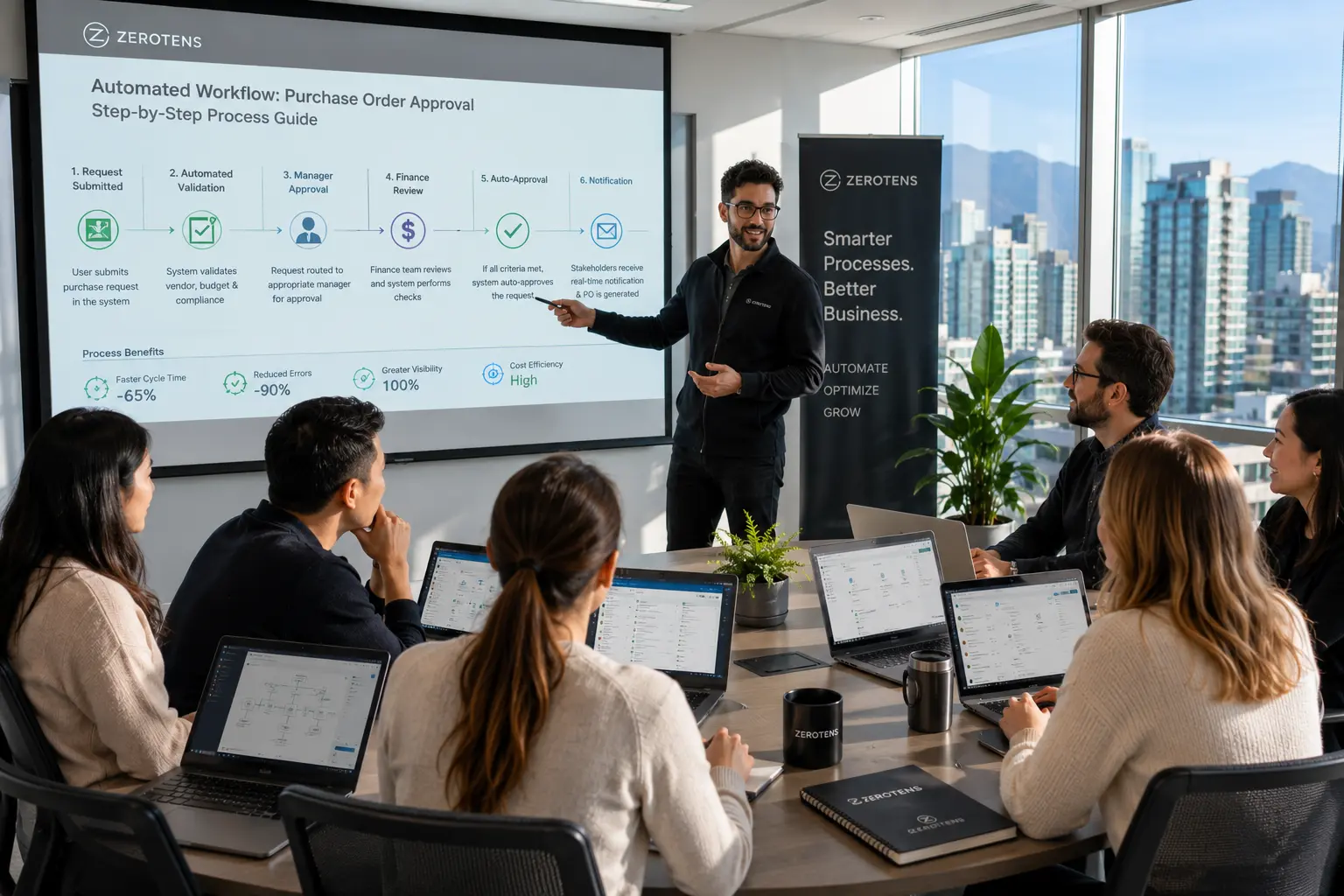
Process automation within enterprise systems targets the specific operational sequences that represent the highest per-transaction cost under manual execution — the approval workflows, data transformation steps, document generation requirements, and notification sequences that consume staff time on every individual transaction without adding commercial value to any of them. Business process automation at the enterprise level — a core pillar of enterprise automation solutions — connects these sequences into automated workflows that execute end-to-end without human involvement at each step, reducing the time and error cost of every transaction while freeing the staff previously required at each manual intervention point.
For Canadian organizations managing high transaction volumes across procurement, finance, human resources, and customer operations, the combined time savings from process automation across all operational sequences frequently exceed 30% of total administrative labor capacity in the first year — capacity that Zerotens helps clients systematically redirect toward the strategic, relationship-driven, and judgment-dependent work that drives commercial performance rather than the mechanical execution that enterprise automation solutions handle more accurately and more cost-effectively than human execution can achieve.
Workflow Optimization
Workflow optimization through intelligent automation extends beyond simply replacing manual task execution with automated equivalents, into redesigning the workflow architecture itself to eliminate structural inefficiencies that manual operation has normalized over time. Many established organizational workflows contain redundant approval steps that were designed for manual oversight environments and no longer add risk management value, sequential processes that could execute in parallel under automation, and data transformation requirements that exist only because different systems in the workflow use incompatible formats — inefficiencies that automation strategy work can identify and eliminate.
According to research from McKinsey and Company on digital operations, organizations that combine workflow automation with systematic workflow redesign consistently achieve 40% to 60% stronger cost reductions than those that automate existing workflows without redesigning them — because the redesign phase eliminates the structural inefficiencies that automation alone would simply execute more rapidly without addressing their underlying cost contribution to the organization’s operational overhead.
How Zerotens Delivers Enterprise Automation Solutions
Zerotens delivers enterprise automation solutions for Canadian businesses through a methodology that reflects everything these solutions require that begins with comprehensive operational discovery before any technology selection or development work begins. This discovery phase maps every significant manual process across the organization, quantifies the labor cost, error cost, and coordination overhead each process currently generates, and assesses each process against automation feasibility and commercial impact — producing a prioritized automation roadmap that sequences investment toward the highest-return opportunities first, rather than automating whatever happens to be most visible or most enthusiastically championed by any particular business unit.
This discovery-first approach is what most consistently separates automation implementations that deliver strong, measurable commercial results from those that achieve technical success without commercial impact. Organizations that begin automation programs by selecting platforms before defining the specific processes those platforms must serve frequently discover that the capabilities they have purchased address problems they do not actually have at scale, while the processes generating the most significant operational cost continue without the targeted automation investment they require. Zerotens prevents this misalignment by ensuring commercial impact quantification drives every technology recommendation.
Technology-Agnostic Platform Selection
Zerotens maintains technology-agnostic enterprise automation solutions recommendations, evaluating platforms against specific client requirements established during the discovery phase rather than defaulting to preferred vendor relationships or demonstrated capabilities that may not align with the client’s actual operational needs. The enterprise systems and enterprise technology landscape for automation includes platforms from Microsoft, Salesforce, ServiceNow, UiPath, Automation Anywhere, and a growing ecosystem of AI-enhanced workflow automation tools — and the right choice varies significantly based on existing system infrastructure, integration requirements, IT governance standards, and the specific process categories that represent the highest automation priorities for each organization.
For Canadian businesses already operating Microsoft 365, Salesforce, or other enterprise platforms, Zerotens identifies the automation capabilities embedded within existing licenses that organizations are frequently underutilizing — capturing automation value from investments already made before recommending additional platform purchases. This approach reduces implementation cost and timeline for many clients while delivering meaningful automation capability faster than a new platform deployment typically allows.
Change Management and Team Adoption
Change management is the dimension of enterprise automation solutions implementation that Zerotens treats as equal in importance to the technical implementation work — because automation that staff do not understand, trust, or know how to work alongside consistently underdelivers against its commercial potential regardless of its technical quality. Staff who have not been adequately prepared for automation changes in their workflows develop workarounds, maintain parallel manual processes as backup, and engage with automated systems at lower adoption rates — undermining the efficiency and cost reduction that the implementation was designed to deliver.
Zerotens structures every enterprise automation solutions engagement with explicit change management planning alongside technical implementation — identifying which teams will be most affected by each automation initiative, what training and process communication they require, and which individuals within each team are best positioned to serve as internal automation champions who support peer adoption throughout and beyond the initial deployment period. This structured approach to organizational change management has consistently produced higher adoption rates, faster time-to-value, and stronger long-term automation ROI across Zerotens’ Canadian client base.
LET’S CONNECT
Ready to Start a Project?
Tell us what you’re building,
and the ZEROTENS team will help
you shape the next step.
The Future of Enterprise Automation Solutions
The trajectory of enterprise automation solutions points toward increasingly intelligent, adaptive, and autonomous capability — driven by the integration of large language models, machine learning, and agentic AI into the core of enterprise workflow and process automation platforms. The automation systems of 2024 and 2025 are already substantially more capable than those of 2021, handling unstructured data processing, contextual decision-making, and exception management that earlier automation technology routed to human reviewers as a matter of necessity rather than design. This trajectory will continue, expanding the boundary of what automation can handle autonomously with each successive platform generation.
For Canadian businesses making automation investment decisions today, this trajectory carries important architectural implications. The integration layers, data infrastructure, and organizational governance frameworks built to support current-generation automation deployments are the same foundations that next-generation intelligent automation and agentic AI deployments will require. Organizations that build this infrastructure now — even for relatively straightforward initial automation applications — are simultaneously building the foundation for significantly more sophisticated automation capability as the technology matures and becomes commercially accessible.
Intelligent Automation and AI Integration
Intelligent automation — the combination of conventional workflow automation with AI-driven decision capability — is already delivering commercial value for Canadian organizations across document processing, customer interaction management, predictive operational triggering, and exception handling. The distinction between intelligent automation and conventional rules-based automation is practically significant: where rules-based systems fail on every transaction that deviates from anticipated patterns, intelligent automation systems apply pattern recognition and contextual reasoning to handle variation adaptively — dramatically reducing the exception volume that reaches human reviewers and extending autonomous resolution rates into the 70% to 85% range that rules-based systems cannot achieve.
Zerotens incorporates intelligent automation capability into enterprise automation solutions deployments where the process complexity and exception volume justify the additional implementation investment — identifying the specific workflows where AI-enhanced decision capability delivers meaningfully stronger commercial outcomes than conventional rules-based automation, and designing the system architecture to accommodate progressive AI capability expansion as both the technology and the organization’s AI maturity develop.
Automation Strategy for Long-Term Competitive Advantage
The organizations building the most durable competitive advantages through enterprise automation solutions are those that treat enterprise automation solutions as a strategic capability investment rather than a series of isolated efficiency projects — developing automation strategy as a formal organizational discipline, building center-of-excellence capability across North America and Canadian operations that accelerates successive automation deployments, and systematically expanding automation coverage across every operational domain where it can deliver measurable commercial value. This strategic orientation produces automation programs — the hallmark of mature enterprise automation solutions — whose ROI compounds across every successive deployment rather than simply delivering a one-time efficiency gain on a specific targeted process.
Zerotens works with Vancouver and Canadian clients to develop this automation strategy capability alongside the specific implementation work of individual automation deployments — building the organizational governance, measurement frameworks, and internal expertise that allow Canadian businesses to accelerate their automation programs progressively rather than treating each deployment as an independent project requiring the same foundational work to be repeated from scratch. The businesses that build this organizational automation capability now will be substantially better positioned to capture the next generation of intelligent automation and agentic AI capability as it becomes commercially accessible across North America and Canadian markets beyond Vancouver.

FAQ — Enterprise Automation Solutions
What are enterprise automation solutions?
Enterprise automation solutions are integrated technology systems that automate high-volume, rules-based operational processes — including workflow routing, document processing, data reconciliation, and compliance reporting — eliminating manual execution at each step and freeing organizational capacity for judgment-dependent, revenue-generating work.
How do enterprise automation solutions improve efficiency?
These systems improve efficiency by executing operational processes faster, more consistently, and at lower per-transaction cost than manual alternatives — while simultaneously reducing the error rates that generate expensive downstream rework, remediation, and compliance costs across finance, operations, customer service, and sales coordination functions.
What departments benefit from enterprise automation solutions?
Enterprise automation solutions deliver measurable benefits across finance and accounting, human resources, operations and procurement, customer service, and sales coordination — any department managing high volumes of structured, rules-based transactions — a classic target for business process automation — benefits from the consistency, speed, and cost reduction that well-designed operational efficiency systems provide.
How much do enterprise automation solutions cost?
Implementation costs vary based on process complexity, integration requirements, and the scope of organizational change management needed. Zerotens structures engagements to deliver measurable ROI from early phases, allowing Canadian organizations to validate automation value on high-priority processes before committing to broader program expansion.
How does Zerotens implement enterprise automation solutions?
Zerotens begins with comprehensive process discovery and commercial impact quantification, maintains technology-agnostic platform selection, builds change management planning alongside technical implementation, and establishes measurement frameworks that track automation ROI continuously — ensuring enterprise automation solutions deliver compounding commercial value from the first deployment forward.
Ready to eliminate repetitive work and build a business that scales without unnecessary overhead? Connect with Zerotens to design enterprise automation solutions tailored to your workflows—reducing operational costs, improving accuracy, and creating the foundation for long-term, AI-powered business growth.
Conclusion
Enterprise automation solutions are the operational investment that determines whether scaling a Canadian business creates compounding competitive advantage or compounding overhead cost — and the organizations that make this investment with strategic discipline and commercial focus consistently outperform those that delay or approach automation as a series of disconnected efficiency projects without a governing strategy. The combination of rising labor costs, improving automation technology accessibility, and increasingly capable AI integration makes the commercial case for acting on this investment stronger in 2026 than at any previous point in the history of enterprise operational technology.
Zerotens builds enterprise automation solutions for Vancouver and Canadian organizations through a structured, commercially focused methodology that begins with honest operational discovery and impact quantification, maintains technology-agnostic platform recommendations, and extends through change management and continuous post-deployment optimization to ensure every automation investment delivers measurable, compounding returns rather than technical achievement disconnected from commercial performance. Every engagement is built on the foundational conviction that automation is only valuable when it demonstrably improves the financial and operational performance of the specific Canadian business it was designed to serve.
If your organization is ready to build the operational efficiency and scalability that enterprise automation solutions deliver — without the proportional headcount expansion that manual operations would require — a structured automation program built with Zerotens is exactly where that competitive advantage begins.