
Introduction
CRM vs ERP is a comparison that growing Canadian businesses get wrong with surprising regularity, and the cost of that confusion compounds quietly until it becomes a genuine operational liability. Business leaders frequently treat these two categories of enterprise software as interchangeable, or worse, assume that purchasing one eliminates the need to ever consider the other — a misunderstanding that leads to fragmented data, duplicated effort, and operational blind spots that surface only once a company has scaled past the point where manual workarounds remain viable.
The confusion is understandable given how the two systems overlap in casual conversation. Both are described as the system that runs the business. Both involve significant investment, organizational change, and vendor evaluation. Both promise efficiency gains and better visibility into operations. But CRM and ERP solve fundamentally different problems, serve different organizational functions, and in most mature businesses, need to work together rather than compete for the same budget line.
For Vancouver businesses navigating this decision — often for the first time as they cross from startup into scale-up territory — getting the CRM vs ERP distinction right early prevents a costly correction later. This article breaks down exactly what separates these two categories of business systems, when each delivers the most value, and how Zerotens helps Canadian organizations choose the right combination for their specific growth stage and operational context.
CRM vs ERP — Understanding the Fundamental Difference
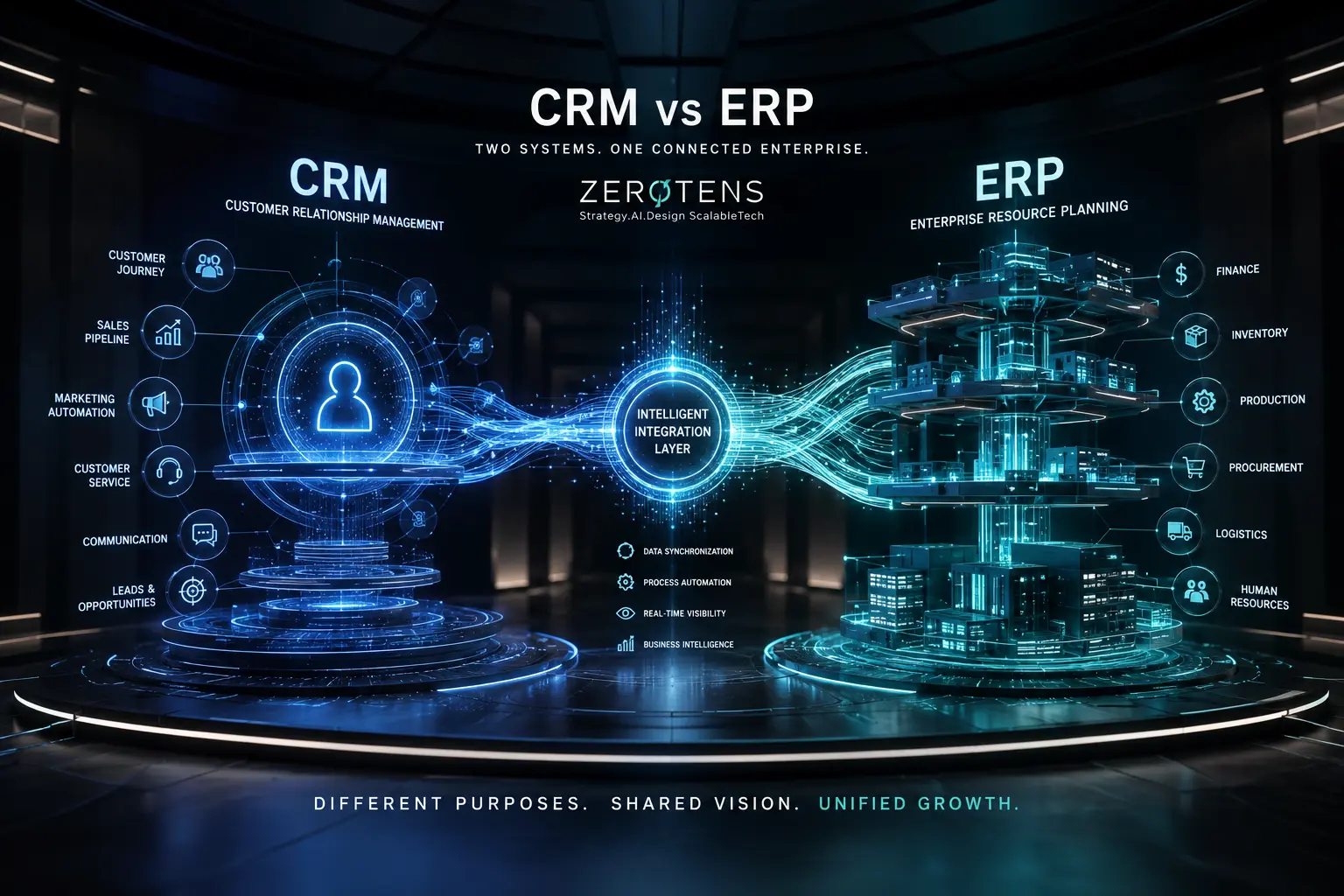
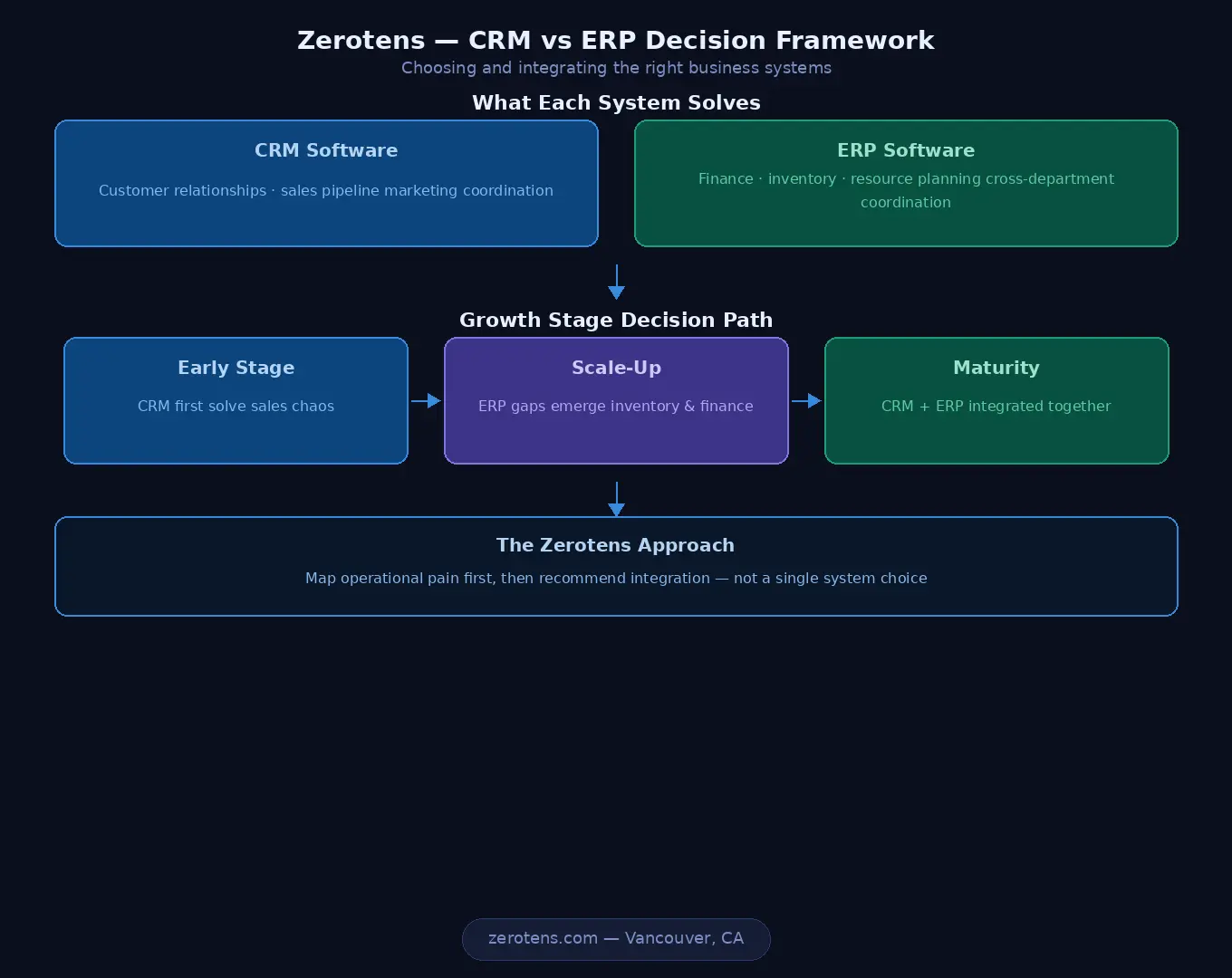
The most reliable way to understand the CRM vs ERP distinction is to focus on what each system is primarily designed to manage. CRM — Customer Relationship Management — is fundamentally a system for managing external relationships. It tracks every interaction a business has with its customers and prospects, organizing customer data, sales pipeline stages, communication history, and service records into a structured, accessible platform that every customer-facing team member can use.
ERP — Enterprise Resource Planning — “Enterprise Resource Planning (ERP) is a centralized software system organizations use to manage and integrate core business processes. It acts as an organization’s “central nervous system,” breaking down departmental data silos and linking functions like finance, HR, manufacturing, and supply chain into a single source of truth(Enterprise)” is fundamentally a system for managing internal operations. It tracks what happens inside the business: how resources are allocated, how inventory moves through a supply chain, how financial data is consolidated across departments, and how production capacity aligns with demand. Where CRM looks outward at the customer relationship, ERP looks inward at the operational machinery that fulfills the promises CRM helps a business make.
The Data Each System Manages
CRM software manages customer-specific data: contact records, interaction histories, deal stages, support tickets, marketing campaign responses, and customer satisfaction metrics. The users who benefit most from CRM are salespeople, account managers, marketing teams, and customer service representatives — anyone whose primary job involves managing relationships with customers.
ERP software manages operational data: inventory levels, purchase orders, production schedules, financial ledgers, human resource records, and supply chain transactions. The users who benefit most from ERP are finance teams, operations managers, warehouse staff, production planners, and executive leadership requiring consolidated organizational reporting. In most well-structured organizations, CRM and ERP users overlap only at the boundary where a customer order transitions from a sales commitment to an operational fulfillment task.
CRM vs ERP for Small Businesses
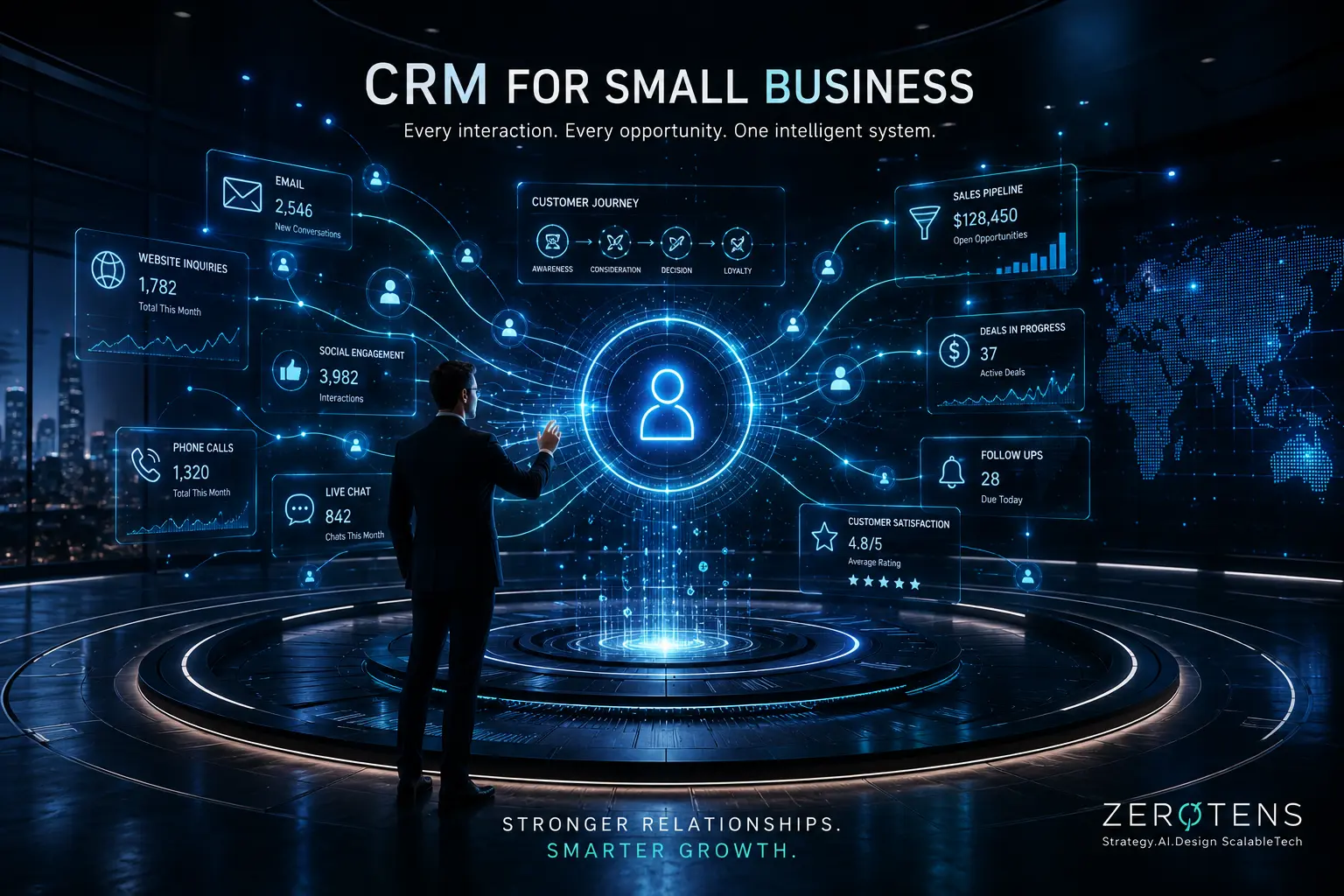
For small businesses just establishing repeatable sales and operational processes, the CRM vs ERP question often resolves itself naturally based on which function is creating the most immediate pain. A small business struggling to track leads, manage customer relationships, and maintain visibility into the sales pipeline typically needs CRM software first — a system built specifically to organize customer interactions, track deal progression, and ensure no opportunity falls through the cracks during the chaotic early growth phase.
CRM software at this stage delivers value almost immediately, because the core problem it solves — fragmented customer information scattered across spreadsheets, email threads, and individual memory — is acute and easily understood. A small Vancouver business adopting CRM software typically sees measurable improvement in sales follow-up consistency and customer retention within the first 90 days, without requiring significant organizational restructuring or extensive staff training.
When Small Businesses Actually Need ERP
ERP software addresses a different category of pain — typically one that small businesses have not yet encountered at meaningful scale. Inventory tracking across multiple locations, complex financial consolidation, multi-department resource planning, and manufacturing or supply chain coordination are operational challenges that most small businesses simply have not grown into yet. Implementing ERP software prematurely, before these operational complexities genuinely exist, frequently produces an expensive, over-engineered solution.
The exception to this guideline applies to small businesses in operationally complex industries from the outset — a small Vancouver manufacturer, for instance, may need basic ERP functionality even at 15 employees because production scheduling, raw material procurement, and inventory management are central to their operation from day one. Industry context matters significantly in the CRM vs ERP sequencing decision.
CRM vs ERP for Growing Organizations
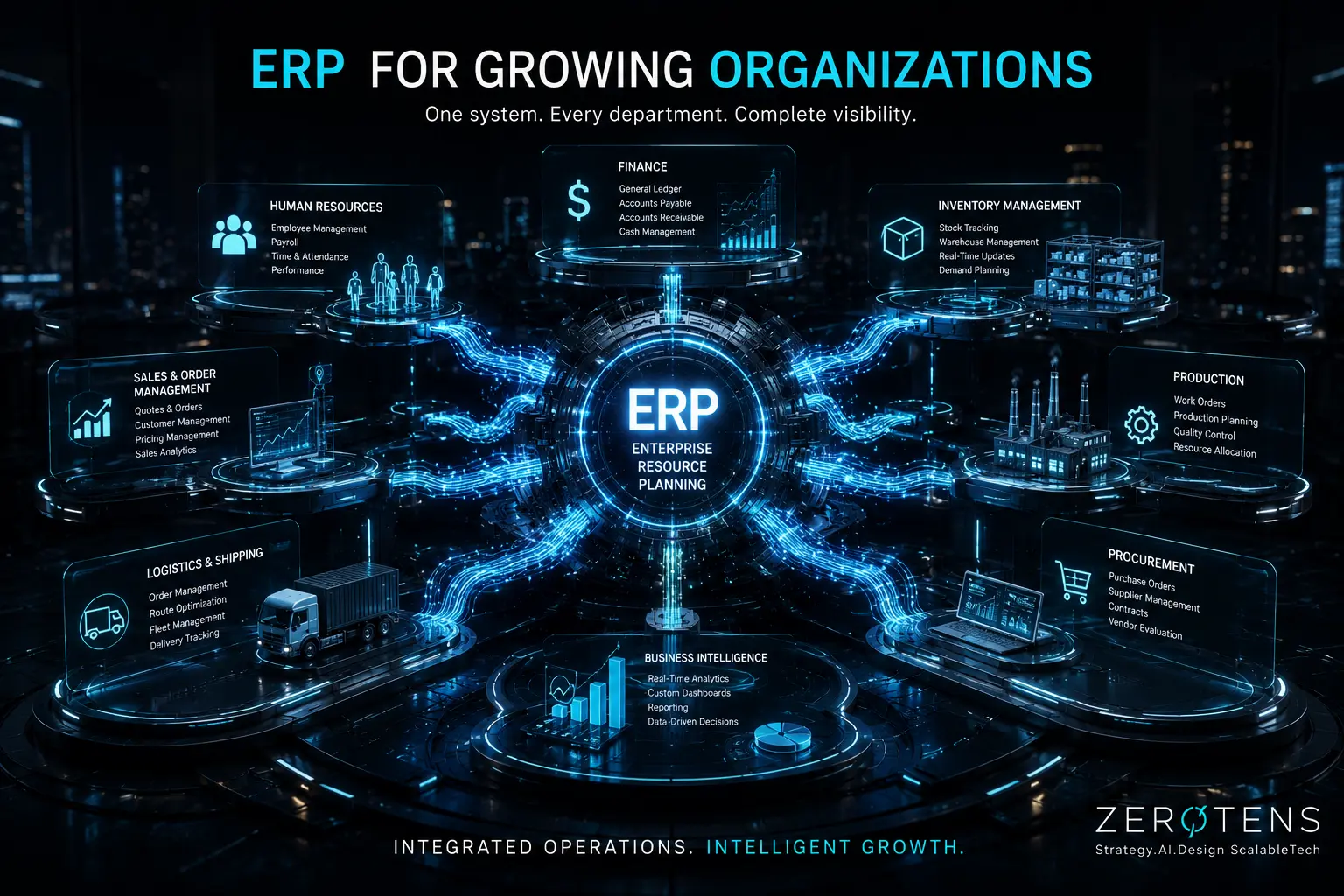
The CRM vs ERP calculation changes meaningfully once a business crosses into genuine growth-stage complexity — typically somewhere between $5 million and $20 million in annual revenue for most Canadian companies, though the specific threshold varies significantly by industry. At this stage, the operational gaps that ERP software addresses become increasingly visible and increasingly costly to ignore.
Growing organizations frequently discover that their CRM, however well implemented, cannot answer fundamental operational questions — what inventory is available across warehouses, how production capacity aligns with sales commitments, or how financial performance across departments rolls up into accurate, real-time reporting. These are not CRM problems. They are operational and financial coordination problems that ERP software is specifically designed to solve.
ZEROTENS INSIGHT
Let’s Build Something Smarter Together
Business Process Automation: The Complete Guide to AI-Driven Operational Excellence

The Integration Imperative
For Vancouver businesses experiencing this transition, the temptation to extend CRM functionality to cover these emerging ERP needs — adding custom fields, building workarounds, or layering additional tools on top of the existing CRM — typically creates more operational fragility than it resolves. Zerotens consistently advises growing clients that the right answer at this stage is rarely choosing CRM versus ERP, but rather implementing ERP software that integrates properly with existing CRM infrastructure, allowing each system to do what it does best.
A properly integrated CRM and ERP environment eliminates the most common operational inefficiency that businesses discover when operating both systems without integration — the need to manually re-enter customer and order data that exists in one system into the other. This double-entry problem consumes significant administrative time while simultaneously introducing data inconsistency between the two systems, corrupting the reporting accuracy that both are meant to provide.
When to Choose CRM vs ERP
The clearest way to resolve the CRM vs ERP decision is to map the specific operational pain a business is experiencing against what each system category is actually designed to solve, rather than evaluating the systems in the abstract or based on vendor marketing claims. Organizations that begin with pain identification rather than system comparison consistently make more appropriate technology investment decisions.
CRM Benefits
CRM vs ERP: CRM software delivers its strongest value for businesses where the primary operational challenge centers on customer relationship management, sales pipeline visibility, and marketing coordination. The core benefits include centralized customer data accessible across sales, marketing, and customer service teams, automated lead tracking and follow-up sequencing, sales forecasting based on pipeline data rather than guesswork, and customer service history that gives every team member full context for every interaction.
For Canadian businesses in professional services, e-commerce, and B2B sales-driven industries, CRM software typically delivers measurable ROI faster than ERP software, because the sales and customer relationship problems it solves are usually more acute and more immediately costly than the operational coordination problems ERP addresses. The speed of value realization is an important consideration for businesses with limited technology budgets that need to demonstrate ROI within specific financial periods.
ERP Benefits
CRM vs ERP: ERP software delivers its strongest value for businesses managing complex operational, financial, and supply chain coordination across multiple departments or locations. The core benefits include unified financial reporting across the entire organization, real-time inventory and resource visibility, production planning aligned with actual demand, and elimination of the duplicate data entry that occurs when separate departmental systems do not communicate with each other.
For Canadian manufacturers, distributors, and multi-location service businesses, ERP software development typically delivers its strongest ROI once operational complexity has genuinely outgrown manual coordination and spreadsheet-based workarounds — a threshold that, once crossed, makes ERP implementation a genuine operational necessity rather than a discretionary technology investment.
How Zerotens Helps Businesses Choose Between CRM vs ERP
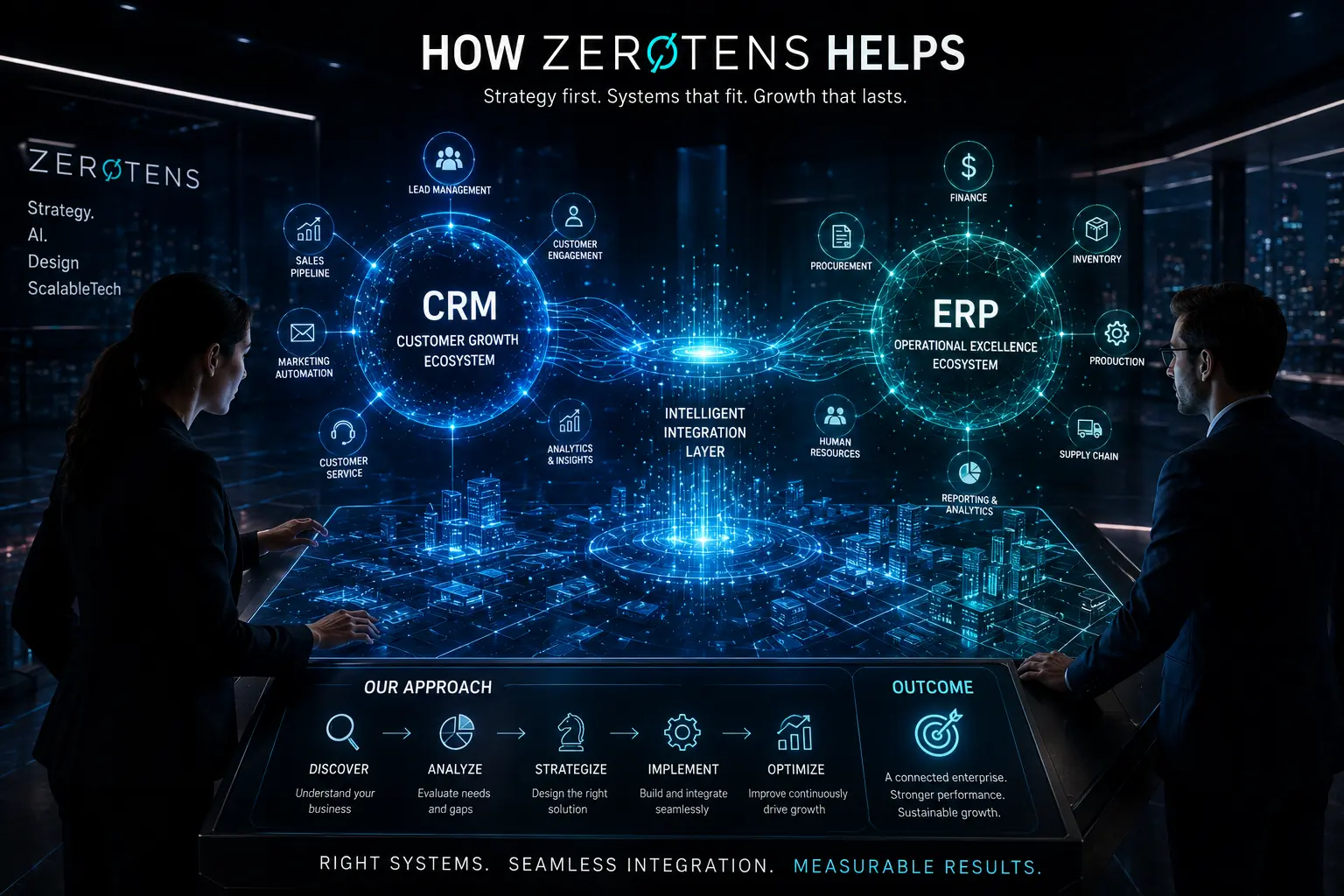
Zerotens approaches the CRM vs ERP decision through a structured assessment process that maps a client’s specific operational pain points against the capabilities each system category genuinely delivers, rather than defaulting to whichever system a particular vendor relationship happens to favor. This assessment examines current data fragmentation, departmental coordination gaps, and the specific business outcomes the client is trying to achieve before recommending a path forward.
For many Vancouver clients, this assessment reveals that the right answer is not CRM versus ERP, but a properly integrated combination of both — CRM software managing customer-facing sales and relationship data, ERP software managing internal operational and financial coordination, with clean data integration ensuring information flows accurately between the two rather than existing in isolated, conflicting silos.
The Zerotens Assessment Framework
The Zerotens CRM vs ERP assessment typically examines five dimensions: current data fragmentation across teams, the volume and cost of manual data re-entry, the accuracy and timeliness of management reporting, the specific operational bottlenecks limiting growth, and the technology investment budget available for addressing them. These five dimensions together produce a clear prioritization — revealing whether the most pressing and commercially significant pain points are customer relationship or operational coordination in nature.
According to research from Gartner, organizations that properly integrate CRM and ERP systems report significantly improved cross-functional visibility compared to those operating either system in isolation — a finding that aligns directly with what Zerotens observes across its Canadian client implementations, where the businesses extracting the most value are consistently those that stopped asking which system and started asking how these systems work together most effectively for their specific operational context.
FAQ — CRM vs ERP Explained
What is the difference between CRM vs ERP?
CRM software manages customer relationships, sales pipelines, and marketing data. ERP software manages internal operations, including finance, inventory, and resource planning across departments. The CRM vs ERP distinction comes down to customer-facing versus internal operational focus.
Which is better, CRM or ERP?
Neither is inherently better — the right choice depends on which operational pain is most acute. Businesses struggling with sales and customer tracking need CRM first. Businesses struggling with inventory, finance, or multi-department coordination need ERP. Most growing businesses eventually need both.
Can businesses use CRM and ERP together?
Yes — most growing organizations eventually need both, properly integrated so customer and operational data flow accurately between systems. This combination delivers far more value than either system operating in isolation, eliminating duplicate data entry and providing unified organizational visibility.
Is ERP more expensive than CRM?
ERP software development typically requires a larger investment than CRM due to its broader scope across finance, inventory, and operations. However, the right comparison is value delivered against operational pain solved, not raw cost alone.
How does Zerotens help companies select the right system?
Zerotens conducts a structured operational assessment, mapping specific business pain points against CRM and ERP capabilities before recommending a path — often resulting in a properly integrated combination rather than a single system choice.
Building Sustainable Competitive Advantage
For Canadian businesses across all sectors, the underlying theme connecting technology investment success and failure is consistent: investments grounded in specific business outcome definition consistently outperform investments driven by technology enthusiasm, vendor persuasion, or competitive imitation. Zerotens builds this outcome-first discipline into every engagement,CRM vs ERP, ensuring that the technology work it delivers is always in service of a specific, measurable commercial objective that the client has validated before investment begins.
The Canadian regulatory environment adds specific dimensions to technology investment decisions that businesses operating exclusively in the US market need not consider. PIPEDA compliance requirements for customer data handling, provincial employment standards that affect automation rollout decisions, and bilingual requirements in federally regulated industries all represent Canadian-specific constraints that technology investments must be designed to accommodate from the outset rather than retrofitted after implementation.
Zerotens’ Canadian market expertise means these regulatory and market-specific considerations are incorporated into every recommendation and implementation design rather than discovered as complicating factors after development has begun. For Vancouver businesses operating in British Columbia’s specific regulatory environment, this local expertise translates into implementations that work within Canadian legal and business context from day one.
The compounding nature of well-executed technology investment is among the most important concepts for Canadian business leaders to internalize when evaluating technology spending. A technology investment that delivers 20% operational cost reduction in year one does not simply save 20% per year indefinitely — it creates a cost structure advantage that compounds as the business grows, allowing it to scale to higher revenue levels before needing to add the administrative headcount that competitors without equivalent automation must hire to maintain the same operational capacity.
Building a coherent technology investment roadmap requires discipline across multiple organizational dimensions simultaneously — financial planning that allocates appropriate budget to technology investment without creating cash flow risk, talent development that builds internal capability to manage and optimize technology systems, change management that prepares the organization to adopt new approaches without productivity disruption, and governance that maintains strategic alignment between technology decisions and business objectives.
Understanding the commercial context in which technology investments are made is essential for ensuring that the resulting implementations deliver value rather than simply creating technical capability that the organization is not ready to use. The most sophisticated technology deployed in an organizationally unprepared environment consistently underdelivers against expectations, while well-planned technology deployed in an organizationally prepared environment consistently exceeds them. Preparation and planning are not optional components of technology investment — they are the primary determinants of whether the investment ultimately succeeds or fails to deliver its intended value.
The relationship between technology investment quality and business outcome quality is more direct and more measurable than most Canadian business leaders have historically appreciated. Organizations that invest in rigorous technology strategy, implementation planning, and change management before selecting and deploying technology systems consistently report stronger ROI, faster value realization, and higher sustained adoption rates than those that prioritize speed of deployment over quality of preparation.
Not sure whether your business needs a CRM, an ERP, or a connected combination of both? Connect with Zerotens to assess your operational needs and build the right system strategy for your current growth stage and long-term business goals.
Conclusion
CRM vs ERP is rarely a true either-or decision once a business reaches meaningful growth — it is a question of sequencing and integration. Businesses that understand this distinction early avoid the costly correction of implementing the wrong system first, or worse, stretching one system to cover problems it was never designed to solve. The organizations that navigate this decision most effectively are those that begin with honest operational assessment rather than technology preference or vendor persuasion.
Zerotens helps Canadian businesses navigate the CRM vs ERP decision with a clear-eyed assessment of actual operational needs rather than vendor-driven assumptions. From Vancouver startups choosing their first CRM to established Canadian enterprises integrating CRM and ERP into a unified operational backbone, the right system strategy compounds in value as the business scales. Getting the CRM vs ERP decision right from the start protects that growth trajectory rather than constraining it.