
Introduction:
AI sales automation is transforming how Canadian businesses find, qualify, and close customers — shifting the work that once consumed 40% or more of a sales representative’s week into automated workflows that run continuously without human involvement at each step. Lead routing, follow-up sequencing, CRM data entry, meeting scheduling, and pipeline reporting are no longer tasks that require a sales team member to execute manually. They are tasks that well-designed automation handles more quickly, more consistently, and at a fraction of the per-interaction cost of human execution — freeing sales professionals to spend their time on the work that actually drives revenue: building relationships, understanding buyer needs, and closing deals.
The commercial consequence of this shift is significant and growing. Sales teams that have not adopted intelligent automation are increasingly competing against teams that have — and the operational disadvantage compounds with every quarter. A sales representative whose CRM updates automatically, whose follow-up sequences run without manual intervention, and whose leads arrive pre-qualified by an AI sales assistant can focus the entirety of their working hours on revenue-generating conversations. A representative without these capabilities spends a meaningful portion of every week on administrative execution that never directly produces a single dollar of revenue for the business they serve.
For Vancouver B2B businesses navigating competitive sales environments across Canada and North America, AI sales automation represents one of the highest-leverage investments available to sales organizations — delivering measurable improvements in pipeline velocity, lead conversion rates, and per-representative revenue output that compound across every growth stage the business moves through. This article examines why AI sales automation is changing B2B sales, the specific revenue outcomes it delivers, the best practices that determine whether implementations succeed or underdeliver, and how Zerotens builds these systems for Canadian businesses.
Why AI Sales Automation Is Changing B2B Sales
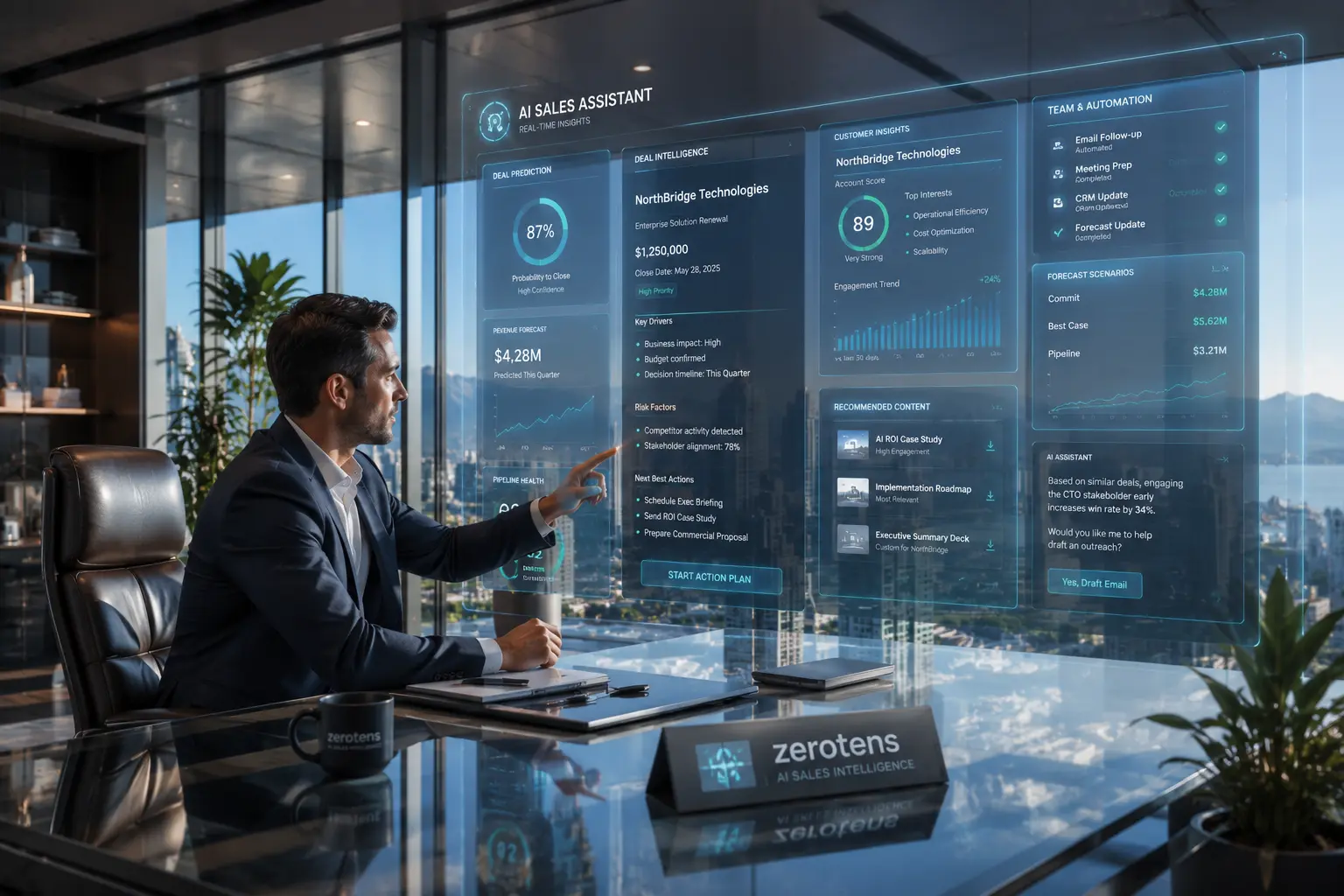
AI sales automation is changing B2B sales by fundamentally altering the economics of customer acquisition — reducing the per-lead cost, per-conversation cost, and per-close cost of the entire sales process through automation of every step that does not require the relationship intelligence and contextual judgment that human sales professionals genuinely provide. The steps that do require those qualities — understanding a buyer’s specific situation, building the trust that precedes a significant purchasing commitment, navigating the complexities of a multi-stakeholder enterprise sale — remain fundamentally human activities. Everything else is a candidate for automation.
The pace of this shift has accelerated dramatically as the underlying AI capability powering sales automation software has advanced from simple rules-based workflow tools into genuine AI systems capable of contextual decision-making, natural language processing, and adaptive behaviour based on accumulated pattern recognition. The best AI sales automation platforms available to Canadian businesses today bear little resemblance to the marketing automation tools of 5 years ago — they engage prospects through genuinely contextual conversations, prioritize leads based on behavioural signals rather than static demographics, and adjust their outreach cadence and messaging based on individual prospect response patterns that human sales teams could never monitor at scale.
ZEROTENS INSIGHT
Let’s Build Something Smarter Together
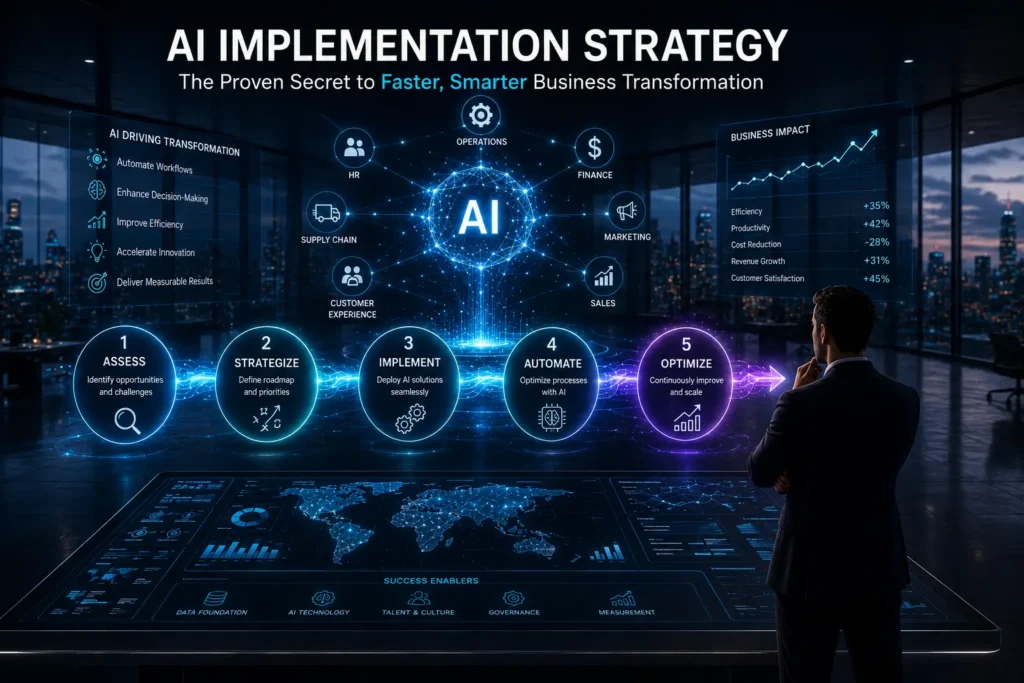
AI Implementation Strategy: The Proven Secret to Faster, Smarter Business Transformation
The Gap Between Automated and Manual Sales Teams
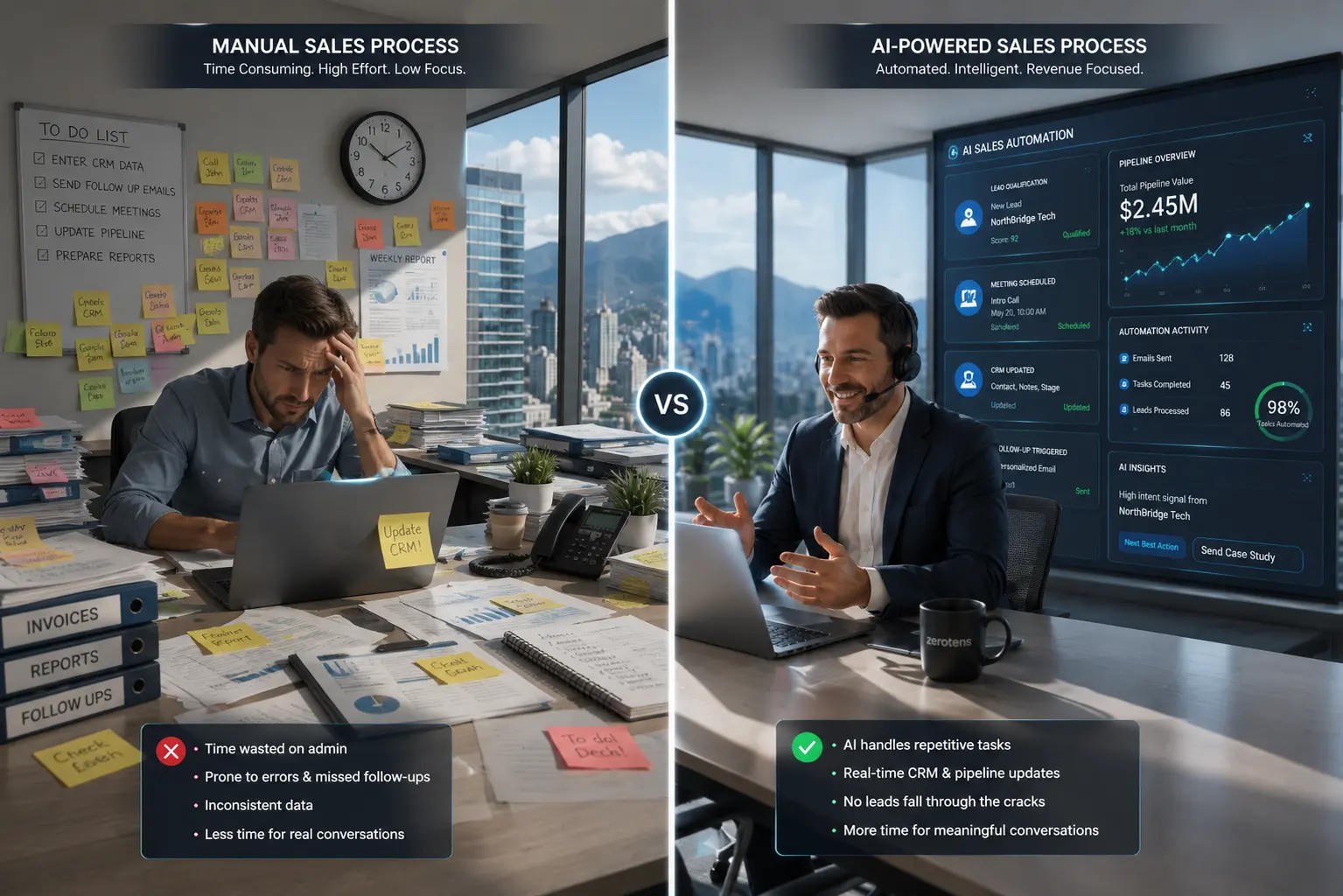
The performance gap between sales teams that have deployed AI sales automation and those still relying primarily on manual execution is measurable across every key sales metric — and it is widening. Automated teams respond to inbound leads faster, maintain more consistent follow-up cadences, lose fewer qualified prospects to competitive engagement during gaps in human availability, and produce more reliable pipeline forecasts because their sales pipeline automation maintains accurate, real-time CRM data rather than depending on sales representative self-reporting that is inevitably incomplete and inconsistently timed.
For Vancouver B2B businesses where the sales team is a primary growth driver, this performance gap translates directly into competitive market share movement. Buyers who receive an automated, contextually intelligent response within minutes of expressing interest are significantly more likely to remain engaged through the sales process than buyers whose inquiry sits in a sales representative’s queue until the next working day — and in competitive B2B sales environments across Canada and North America, that engagement window frequently determines which vendor earns the relationship.
What AI Sales Automation Replaces — and What It Does Not
Understanding what AI sales automation effectively replaces — and what it does not — is essential for deploying it in a way that improves sales performance rather than undermining the relationship qualities that drive revenue in B2B contexts. These systems replace the administrative execution work that consumes sales capacity without contributing to relationship quality: data entry, scheduling, routine follow-up, lead routing, and pipeline reporting. They do not replace the strategic conversation, needs assessment, objection handling, and relationship investment that experienced sales professionals provide in qualified opportunities.
Zerotens builds AI sales automation systems for Canadian clients with this boundary clearly defined in every implementation — ensuring automation handles the work that does not require human judgment while preserving and enhancing the capacity of human sales professionals to focus entirely on the work that does. This boundary is what distinguishes sales automation implementations that improve performance from those that generate buyer friction by applying automation to interactions that require the contextual sensitivity that only experienced salespeople can provide.
How AI Sales Automation Increases Revenue
AI sales automation increases revenue through 3 mechanisms that operate simultaneously and compound as the system accumulates data and refines its pattern recognition. First, it increases the volume of qualified leads that sales representatives receive by handling initial qualification conversations that would otherwise require representative time on unqualified inquiries. Second, it improves lead-to-opportunity conversion by ensuring consistent, timely follow-up that human teams cannot maintain across high inquiry volumes. Third, it shortens sales cycle duration by automating the scheduling, documentation, and administrative steps that add elapsed time without adding sales value.
The revenue impact of faster lead response alone is commercially significant across every B2B sales context in Canada. Research consistently shows that lead response time is one of the strongest predictors of lead conversion — with odds of qualifying a lead dropping dramatically with each passing hour after initial inquiry. An AI sales assistant that responds to every inbound inquiry within 2 to 5 minutes at any hour of the day eliminates the response time disadvantage that human-staffed sales teams inevitably experience outside of business hours, during high-volume periods, and whenever sales representatives are engaged in existing customer conversations.
Revenue From Recovered Leads
One of the most direct revenue contributions of AI sales automation comes from leads that would otherwise be lost to competitive engagement during follow-up gaps in human coverage. In B2B sales environments where purchase decisions involve multiple stakeholders and extended evaluation periods, consistent automated follow-up throughout the evaluation period maintains vendor presence and relationship momentum during the weeks and months between active sales conversations — ensuring the vendor that deployed intelligent sales capability remains present and credible throughout the buyer’s evaluation process.
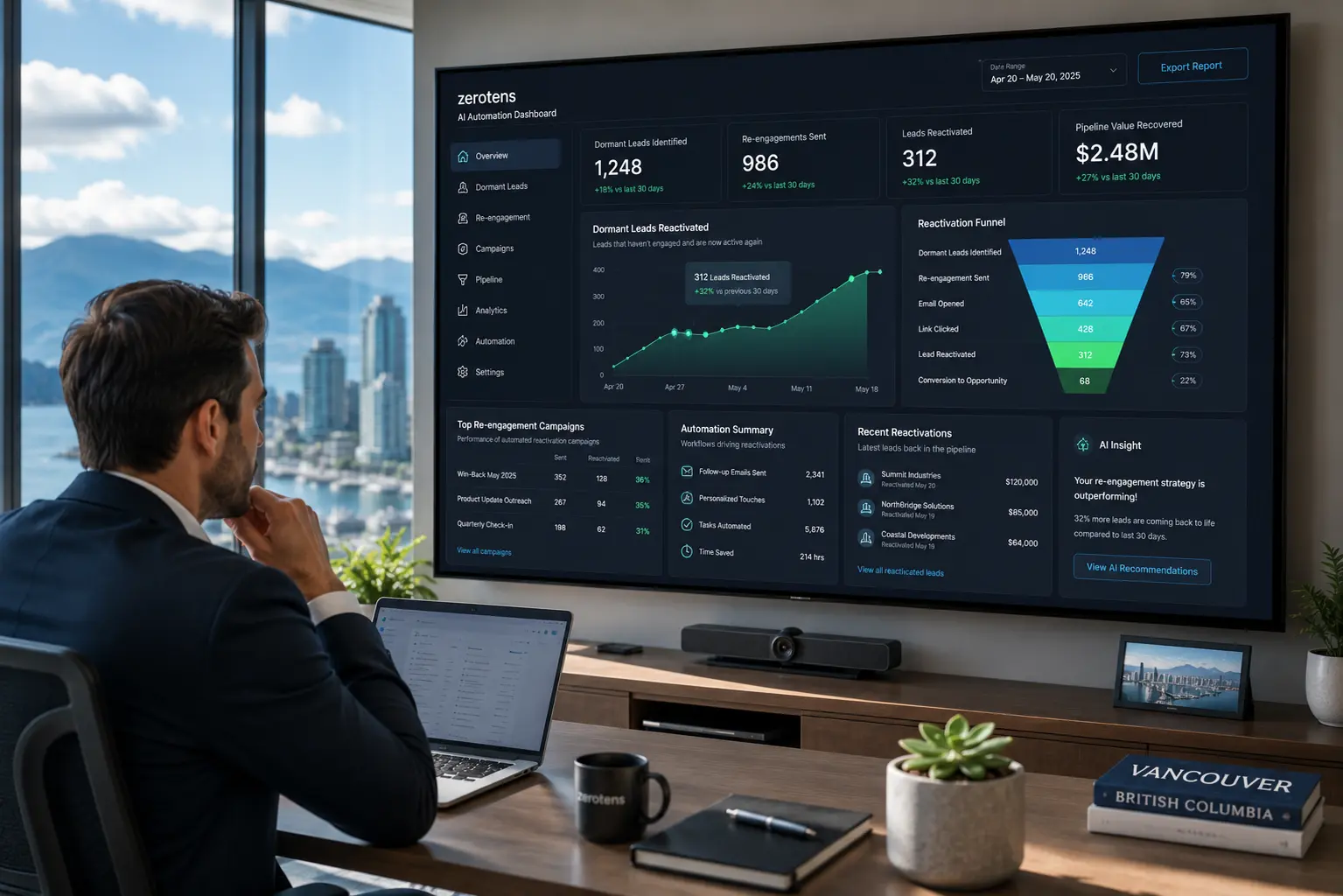
Zerotens has implemented AI sales automation systems for Vancouver-based B2B clients that recovered between 15% and 25% of leads previously classified as lost or dormant through systematic automated re-engagement sequences triggered by specific time and behavioural signals. These recovered leads represent pure revenue contribution — they came from an existing lead pool that the sales team had deprioritized, required no additional marketing investment to generate, and converted through automated sequences rather than representative time.
Sales Pipeline Automation and Forecast Accuracy
Sales pipeline automation delivers a revenue contribution that is less immediately visible than lead conversion improvement but equally significant over time: substantially improved sales forecast accuracy. When pipeline data is maintained automatically — deal stages updated based on actual prospect behaviour rather than representative self-reporting, engagement scores calculated from real interaction data, and deal velocity tracked continuously — sales leaders can make resource allocation, hiring, and investment decisions based on reliable data rather than optimistically reported pipeline assessments that rarely materialize as expected.
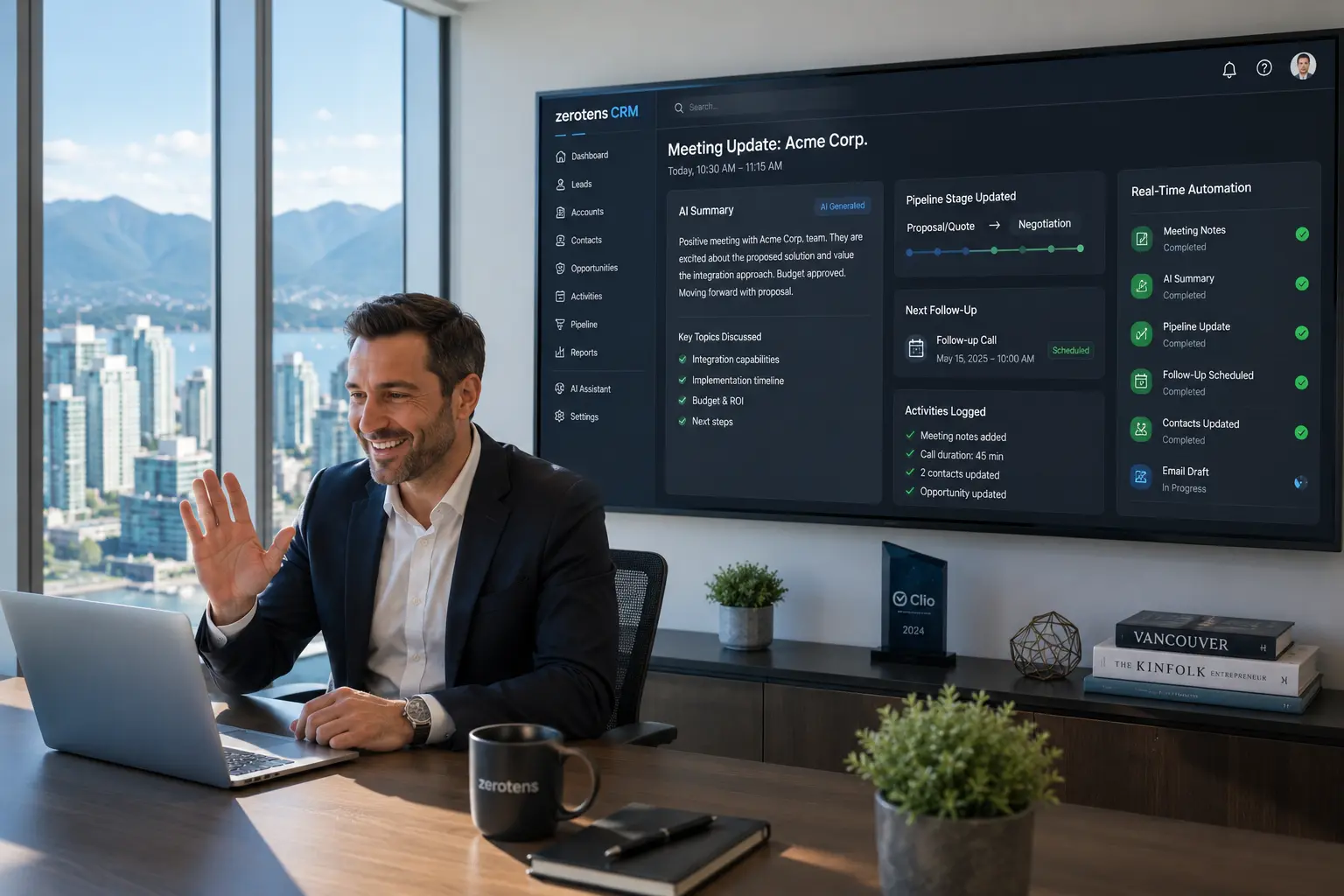
CRM automation that keeps deal records current without depending on sales representative data entry discipline produces pipeline visibility that manually maintained CRM systems cannot match — enabling AI sales automation platforms to generate predictive insights about which deals are most likely to close, which are at risk of competitive loss, and where sales management attention should be focused across the current pipeline to maximize conversion probability.
AI Sales Automation Best Practices
The difference between AI sales automation implementations that deliver strong, measurable revenue outcomes and those that generate buyer friction or adoption resistance comes down to the discipline applied during implementation planning rather than the sophistication of the technology deployed. The best AI sales tools are only as effective as the workflows, qualification criteria, messaging frameworks, and integration architecture within which they operate — and these elements require careful design that reflects how the specific sales process and buyer journey of the specific Canadian business actually work.
Lead Qualification
Effective lead qualification within an AI sales automation system begins with precise definition of what a qualified lead looks like for the specific business and sales context — the combination of firmographic characteristics, behavioural signals, and explicit interest indicators that have historically predicted conversion in the business’s specific sales environment. Without this precise definition, automated qualification systems either pass too many unqualified leads to sales representatives — generating friction and reducing trust in the automation — or filter too aggressively and exclude genuinely qualified prospects whose profiles deviate from the expected pattern.
Zerotens designs lead qualification frameworks for every AI sales automation engagement through a discovery process that examines historical conversion data, interviews experienced sales representatives about the signals they rely on to identify genuine buyer intent, and maps the specific behavioural journey that high-converting leads in the business’s pipeline have historically followed. This data-grounded approach to qualification definition produces automation systems that reflect the actual intelligence of the sales team rather than generic qualification templates that were designed for a different business’s buyer profile.
Automated Follow-Up
Automated follow-up is the highest-ROI application of AI sales automation for most Canadian B2B businesses — delivering consistent prospect engagement across the full evaluation period without consuming sales representative time on the routine check-ins, resource sends, and meeting confirmations that maintain buyer momentum between active sales conversations. Effective automated follow-up sequences are calibrated to the specific duration and decision patterns of the business’s typical sales cycle — delivering value-adding content and contextually relevant messages at intervals that reflect the buyer’s information consumption pace rather than arbitrary cadence schedules.
The most effective automated follow-up sequences deployed by Zerotens for Vancouver and Canadian clients combine time-based triggers with behavioural triggers — responding to specific prospect actions such as content downloads, pricing page visits, or email engagement with contextually relevant messages within minutes, rather than waiting for the next scheduled cadence step. This behaviour-triggered approach produces significantly higher response rates than time-based cadence alone because messages arrive when buyers are actively engaged with the vendor’s content and most receptive to continued conversation.
CRM Integration and Data Integrity
CRM automation is the technical foundation that makes every other AI sales automation capability function reliably — because the intelligence of qualification algorithms, follow-up triggers, and pipeline analytics all depend on the quality and completeness of the CRM data they operate on. Zerotens designs CRM integration architecture for every sales automation implementation to ensure that every meaningful prospect interaction — email opens, content downloads, meeting attendance, website visits, and response signals — is captured automatically in the CRM without requiring manual data entry from sales representatives whose attention is better directed toward the buyers they are actively engaging.
The data integrity that automatic CRM capture produces compounds in value over time as the accumulated interaction data becomes the training foundation for increasingly accurate qualification scoring, increasingly precise follow-up timing, and increasingly reliable pipeline forecasting. An AI sales automation system operating on 18 months of clean, automatically captured CRM data is substantially more capable than the same system operating on 18 months of manually entered data with the inconsistencies and gaps that manual entry inevitably introduces.
How Zerotens Builds AI Sales Automation Systems
Zerotens approaches AI sales automation system design for Canadian clients through a sales process mapping phase that documents every step of the current sales workflow before any technology selection or development work begins. This mapping phase identifies which steps are genuinely automation candidates — high-volume, rules-based, low-judgment execution tasks — and which steps require the relationship intelligence that human sales professionals provide. The design ensures automation is applied precisely where it improves performance rather than uniformly across the sales process, where indiscriminate automation frequently damages the buyer experience that drives conversion.
Every AI sales automation system Zerotens builds is developed technology-agnostically — selecting the specific combination of sales automation software, AI sales tools, and integration architecture that best serves the client’s specific CRM environment, sales team structure, and buyer journey characteristics. The Canadian B2B sales landscape spans a wide range of CRM platforms, sales methodologies, and pipeline structures that require different automation architectures — and no single platform is the right choice for every context. Zerotens recommends based on fit, not familiarity.
Integration With Existing Sales Infrastructure
The most commercially significant technical challenge in building AI sales automation systems for Canadian businesses with established sales infrastructure is integration — ensuring that automation platforms connect cleanly with existing CRM systems, communication tools, marketing automation platforms, and calendar and scheduling infrastructure without requiring wholesale replacement of technology investments that are functioning effectively. Zerotens maps the integration architecture required before development begins, identifying every system the automation must connect with and designing the data flow between them to eliminate the manual handoffs that currently interrupt workflow continuity.
For Vancouver businesses already operating Salesforce, HubSpot, Microsoft Dynamics, or other established CRM platforms, Zerotens identifies and activates the native AI sales automation capabilities embedded within existing licenses before recommending additional platform purchases — frequently enabling meaningful automation capability from tools the business is already paying for but underutilizing. This approach reduces implementation cost and timeline while delivering automation value within the familiar interface environments that sales teams are already comfortable navigating.
Measurement and Continuous Optimization
Zerotens builds measurement infrastructure into every AI sales automation system from the outset — defining specific commercial success metrics before deployment and establishing the baseline data that allows automation ROI to be attributed accurately after launch. According to Deloitte’s research on AI adoption in enterprise organizations, organizations with formal measurement frameworks for AI investments consistently report stronger returns than those evaluating AI performance through general impressions rather than defined metrics — reinforcing why Zerotens treats measurement infrastructure as a non-negotiable component of every AI sales automation engagement rather than an optional reporting layer added after deployment.
Post-deployment optimization — the systematic review and refinement of qualification criteria, follow-up sequences, and integration performance based on accumulated operational data — is where AI sales automation systems deliver their compounding returns. An implementation that achieves a 65% automated resolution rate at launch can reach 80% or more through 6 months of rigorous optimization, as the system’s pattern recognition improves and its workflows are refined against real performance data. Zerotens includes structured optimization cycles in every engagement, ensuring implementations improve continuously rather than plateauing at their initial performance baseline.
Future Trends in AI Sales Automation
The trajectory of AI sales automation points toward increasingly autonomous, increasingly personalized, and increasingly integrated capability — driven by advances in large language models, multimodal AI, and the expanding data infrastructure that enterprise sales organizations are building as they mature their AI adoption. The most significant near-term developments affecting Canadian B2B sales teams include AI sales assistants capable of genuine multi-turn negotiation conversations, predictive deal intelligence that identifies at-risk opportunities before signals are visible to human reviewers, and revenue intelligence platforms that synthesize conversation, email, and CRM data into actionable coaching recommendations for individual sales representatives.
For Vancouver businesses making AI sales automation investment decisions now, these near-term trends carry important architectural implications. The data infrastructure, CRM integration quality, and organizational automation maturity built through current implementations are the same foundations that next-generation intelligent sales capability will require. Businesses that invest in building clean data infrastructure and automation discipline today will have a substantially easier and less costly transition to more advanced AI sales capability as it becomes commercially accessible across North American B2B markets.
Agentic AI in B2B Sales
The most transformative near-term development in AI sales automation is the emergence of agentic AI systems capable of managing complete, multi-step sales sub-processes autonomously — handling the full sequence from inbound lead response through qualification conversation, meeting scheduling, pre-meeting research preparation, and follow-up documentation without human involvement at any intermediate step. These agentic systems go substantially beyond current automation platforms, combining the workflow automation capabilities of existing AI sales tools with the contextual reasoning of large language models to manage genuine multi-turn sales interactions.
Revenue Intelligence and Coaching
Revenue intelligence platforms — AI systems that analyze conversation recordings, email threads, and CRM activity to identify winning sales patterns and coaching opportunities — are emerging as a complementary capability to process automation, extending AI sales automation from workflow execution into sales performance improvement. Canadian businesses that combine process automation with revenue intelligence will progressively develop sales teams whose execution quality improves continuously based on AI-identified patterns from their own best performers, rather than relying solely on manager observation and periodic training cycles that cannot monitor or respond to the full volume of sales activity at scale.
LET’S CONNECT
Ready to Start a Project?
Tell us what you’re building,
and the ZEROTENS team will help
you shape the next step.
FAQ — AI Sales Automation
What is AI sales automation?
AI sales automation uses artificial intelligence to handle repetitive sales tasks — including lead qualification, follow-up sequencing, CRM updates, and meeting scheduling — without manual execution at each step, freeing sales professionals for the relationship and closing work that drives revenue.
How does AI sales automation improve sales performance?
AI sales automation improves performance by responding to leads faster, maintaining consistent follow-up without gaps, keeping CRM data accurate automatically, and delivering qualified prospects to sales representatives instead of unfiltered inquiries — producing higher conversion rates and shorter sales cycles across the pipeline.
What tasks can AI sales automation handle?
These systems handle lead routing and qualification, multi-step follow-up sequences, meeting scheduling, CRM data capture, pipeline reporting, content delivery based on buyer behaviour, and re-engagement of dormant leads — all tasks that consume significant sales representative time without requiring the judgment that experienced salespeople provide.
Can AI sales automation integrate with CRM systems?
Yes — AI sales automation platforms integrate with all major CRM systems including Salesforce, HubSpot, and Microsoft Dynamics. Zerotens maps integration architecture before development begins, ensuring automation connects cleanly with existing infrastructure and captures every meaningful prospect interaction automatically.
How does Zerotens implement AI sales automation?
Zerotens begins with sales process mapping to identify the highest-value automation opportunities, selects platforms technology-agnostically based on client CRM and workflow requirements, builds measurement infrastructure before deployment, and delivers structured post-deployment optimization cycles that improve performance continuously after launch.
Ready to help your sales team spend less time on administration and more time closing deals? Connect with Zerotens to build an AI sales automation system that qualifies leads, automates follow-ups, integrates with your CRM, and creates a faster, more predictable revenue pipeline.
Conclusion
Zerotens builds AI sales automation systems for Canadian businesses through a structured, commercially focused methodology — beginning with honest sales process mapping, maintaining technology-agnostic platform recommendations, building integration architecture that works within existing CRM and sales infrastructure, and delivering continuous post-deployment optimization that ensures the system compounds in performance and commercial value with every month of operational data it accumulates. If your sales team is ready to redirect its capacity from administrative execution toward the relationship work that wins customers, AI sales automation through Zerotens is exactly where that transformation begins.