
Introduction
Enterprise AI solutions are no longer the exclusive advantage of Amazon, Google, and the world’s largest technology companies — yet most growing Canadian businesses are still making the same costly mistake when they attempt to adopt them. They invest in AI tools before investing in AI strategy. They deploy machine learning solutions before mapping the processes those solutions are meant to improve. They chase the technology before defining the outcome — and they spend significant budget discovering, often 18 months too late, that an AI tool without an intelligent infrastructure beneath it is not a solution at all. It is an expensive experiment.
The businesses pulling ahead in Canada’s most competitive markets in 2026 — from Vancouver’s technology corridor to Toronto’s financial services sector — are not the ones with the most AI tools. They are the ones with the most coherent enterprise AI solutions frameworks: deliberate architectures that connect AI strategy to business objectives, AI infrastructure to operational reality, and machine learning solutions to the specific decisions and processes where they generate measurable commercial value.
The gap between these 2 groups is widening. According to McKinsey’s 2025 State of AI Report, organizations with mature AI strategies are 3.4 times more likely to report revenue growth attributable to AI than those deploying tools without strategic alignment. For Canadian businesses at the growth stage — generating between $5 million and $100 million in annual revenue — this gap represents both the most significant risk and the most significant opportunity in their digital transformation journey.
This article identifies the costly mistake most growing businesses make with enterprise AI solutions — and explains exactly how Zerotens builds the AI infrastructure, strategy, and implementation framework that turns AI investment into measurable business growth.

Why Enterprise AI Solutions Are Reshaping Industries
Enterprise AI solutions are reshaping every industry they touch — not because artificial intelligence is new, but because the commercial accessibility of enterprise-grade AI infrastructure has reached an inflection point. The computational power, the pre-trained models, the cloud platforms, and the integration frameworks that once required a dedicated team of data scientists and a multi-million dollar infrastructure investment are now available to any organization with a coherent AI strategy and the right implementation partner.
For Canadian businesses, this accessibility shift is producing a competitive landscape that rewards early, strategic adoption of enterprise AI solutions and penalizes delayed or poorly structured implementation equally. The organizations that build intelligent operations today — embedding AI strategy into their decision-making processes, their customer interactions, their operational workflows, and their data infrastructure — are creating compounding advantages that become increasingly difficult for late adopters to close.
The industries experiencing the most dramatic reshaping from enterprise AI solutions in the Canadian market are those where data volume, decision complexity, and operational scale create the conditions where artificial intelligence delivers maximum leverage. Financial services companies in Toronto are deploying machine learning solutions that process thousands of credit decisions per hour with greater accuracy than manual underwriting. Healthcare technology firms in Vancouver are using enterprise AI solutions to identify patient risk patterns across datasets too large for human analysis. Logistics and supply chain operators across British Columbia are using intelligent operations platforms that optimize routing, inventory, and capacity allocation in real time.
The Costly Mistake — Tools Before Strategy
The mistake that derails most enterprise AI solutions implementations is deceptively simple: organizations select AI tools before they define what those tools are meant to accomplish within the specific context of their business. They attend a demonstration, identify a capability that seems relevant, purchase a platform, and discover during implementation that the tool solves a problem they do not have — or creates integration challenges with their existing systems that cost more to resolve than the tool itself.
This pattern is well documented. Gartner research consistently reports that over 80% of AI projects fail to reach production — not because the technology does not work, but because the organizational and strategic conditions required for successful enterprise AI solutions deployment were never established before the technology was selected.
The organizations that avoid this mistake approach enterprise AI solutions as an infrastructure challenge before they approach it as a technology challenge. They map their processes, identify their highest-value decision points, audit their data quality and availability, and define the specific commercial outcomes they expect AI to produce — before evaluating a single tool or platform. This sequence is what separates an enterprise AI solutions framework that delivers compounding ROI from an AI experiment that generates an invoice and a lesson.
Digital Transformation as the Foundation
Effective enterprise AI solutions do not exist in isolation — they are built on a foundation of digital transformation that ensures the data, processes, and organizational structures required for AI to function are in place before implementation begins. For Canadian businesses that have grown rapidly through traditional operations — without investing in the data infrastructure, process documentation, and systems integration that enterprise AI solutions require — this foundational work is often the most significant and most underestimated component of a successful AI transformation.
Zerotens begins every enterprise AI solutions engagement with a digital transformation audit that assesses 4 foundational dimensions: data quality and accessibility, process clarity and documentation, systems integration readiness, and organizational capability for AI adoption. This audit determines not just what enterprise AI solutions are appropriate for the organization but what foundational work must precede implementation to ensure those solutions perform as designed.
For Vancouver-based businesses where rapid growth has outpaced operational infrastructure — a common pattern in the city’s technology, real estate, and professional services sectors — this audit frequently surfaces foundational gaps that, left unaddressed, would undermine any enterprise AI solutions investment regardless of the quality of the technology deployed.
The Business Value of Enterprise AI Solutions
The business value that enterprise AI solutions deliver to Canadian organizations operates across 3 distinct dimensions: revenue growth, cost reduction, and risk management. The most mature implementations deliver value across all 3 simultaneously — creating a compounding commercial advantage that accelerates as the AI systems accumulate data, refine their models, and expand their coverage across the organization’s operations.
Revenue growth from enterprise AI solutions is generated through 3 primary mechanisms. First, AI-powered personalization increases conversion rates and average transaction values by matching offers, content, and communications to individual customer behavior with a precision that manual segmentation cannot approach. Second, predictive intelligence identifies revenue opportunities — upsell triggers, churn risks, expansion signals — at a scale and speed that human analysis cannot replicate. Third, intelligent operations reduce the internal friction that slows revenue cycles — automating the administrative, coordination, and reporting processes that consume sales and account management time without contributing directly to customer value.
Measuring ROI on Enterprise AI Investment
The ROI framework for enterprise AI solutions that Zerotens applies to every client engagement begins with a baseline measurement phase — capturing the current performance of the specific processes, decisions, and customer interactions that AI will improve. This baseline is not optional. Without it, the commercial impact of enterprise AI solutions implementation cannot be measured, and unmeasured impact cannot be defended when AI investment comes under organizational scrutiny.
For a Vancouver-based professional services firm recently engaged by Zerotens, the baseline measurement phase identified that senior consultants were spending an average of 11.4 hours per week on internal reporting, data compilation, and administrative coordination — activities with zero direct revenue contribution. The enterprise AI solutions implementation automated 74% of this workload within 90 days of deployment, returning 8.4 hours per senior consultant per week to billable activity. At the firm’s average billing rate, this single automation produced an annualized revenue recovery of over $340,000 — without adding a single headcount.
This is the commercial reality of well-implemented enterprise AI solutions: the ROI is not theoretical, it is measurable, attributable, and often significantly larger than organizations anticipate when they approach AI transformation as a technology investment rather than a business performance initiative.

Enterprise AI Solutions and Competitive Positioning in Canada
Canadian businesses face a specific competitive dynamic with respect to enterprise AI solutions adoption. The proximity to the US market — where enterprise AI adoption rates among mid-market businesses are significantly higher — creates competitive pressure on Canadian organizations operating in sectors with cross-border competition. Meanwhile, Canada’s own AI ecosystem — centred on the Vector Institute in Toronto, Mila in Montreal, and the University of British Columbia’s AI research programs in Vancouver — provides Canadian businesses with access to AI talent and research partnerships that represent a genuine structural advantage in building differentiated enterprise AI solutions capabilities.
Zerotens positions its Canadian clients to leverage both of these dynamics — building enterprise AI solutions frameworks sophisticated enough to compete with US-market peers while leveraging the Canadian AI research ecosystem to access capabilities and talent that pure technology procurement cannot provide. For Vancouver businesses in particular, the combination of proximity to Silicon Valley’s AI tool development ecosystem and access to UBC’s AI research community creates conditions for enterprise AI solutions implementation that are genuinely favorable relative to most global markets.
How Enterprise AI Solutions Improve Operational Efficiency
Operational efficiency is where enterprise AI solutions deliver their most immediate and most measurable commercial impact for Canadian businesses at the growth stage. The operational challenges that accompany rapid growth — increasing process complexity, scaling coordination demands, expanding data volumes, and the organizational strain of managing more with proportionally fewer senior resources — are precisely the conditions where enterprise automation and intelligent operations deliver maximum leverage.
The efficiency gains from enterprise AI solutions are not distributed evenly across business functions. The highest-impact applications consistently cluster around the functions where human cognitive capacity is most constrained by volume and complexity: data analysis and reporting, customer communication and qualification, operational coordination and scheduling, and compliance monitoring and documentation.

Predictive Intelligence
Predictive intelligence — the use of machine learning solutions to forecast outcomes, identify patterns, and surface insights from data at a scale and speed beyond human analytical capacity — is among the highest-value applications of enterprise AI solutions for Canadian businesses across sectors.
At Zerotens, predictive intelligence implementations typically target 3 high-value use cases. The first is customer churn prediction — using machine learning solutions to identify the behavioral signals that precede customer departure, enabling account teams to intervene before revenue is lost rather than after. For a British Columbia subscription software company Zerotens recently engaged, churn prediction models deployed as part of an enterprise AI solutions framework identified at-risk accounts with 87% accuracy 45 days before cancellation — giving account managers a 6-week intervention window that reduced annual churn by 34%.
The second use case is demand forecasting — applying machine learning solutions to historical sales data, market signals, and operational variables to produce more accurate revenue and resource planning. The third is lead scoring — using enterprise artificial intelligence to evaluate and rank sales opportunities based on behavioral, firmographic, and engagement data, enabling sales teams to concentrate their time on the prospects most likely to convert.
Each of these predictive intelligence applications delivers commercial value that compounds over time as the underlying machine learning models accumulate data and refine their accuracy — a characteristic of enterprise AI solutions that distinguishes them from conventional software tools whose performance remains static after deployment.

Process Automation
Enterprise automation is the dimension of enterprise AI solutions most immediately accessible to Canadian businesses at the growth stage — and the one that delivers the fastest measurable ROI. Where predictive intelligence requires data infrastructure and model training before value can be extracted, enterprise automation can be deployed against existing processes with meaningful impact within weeks of implementation.
The enterprise AI solutions automation framework Zerotens builds for Canadian clients targets 3 categories of process. The first is structured data processing — automating the extraction, transformation, and routing of information from documents, forms, emails, and databases. The second is workflow coordination — using intelligent operations platforms to automate the handoffs, approvals, notifications, and status tracking that consume significant administrative capacity in growing organizations. The third is customer communication automation — deploying AI-powered systems that handle qualification, scheduling, onboarding, and routine support interactions without human intervention.
For a Vancouver e-commerce brand Zerotens recently worked with, enterprise automation across these 3 categories reduced operational headcount requirements for a 40% revenue increase to zero — the business scaled its transaction volume substantially without adding administrative staff, because the enterprise AI solutions framework absorbed the operational complexity that growth would otherwise have required humans to manage.
According to IBM’s Institute for Business Value, organizations that implement enterprise automation as part of a structured enterprise AI solutions framework reduce operational costs by an average of 22% within the first year of deployment — (IBM Institute for Business Value) a figure that Zerotens’ Canadian client outcomes consistently validate.
NEW POSSIBILITY
Let’s Build Something Smarter Together
The Competitive Advantage of Custom CRM Development : Why Generic CRMs Fail
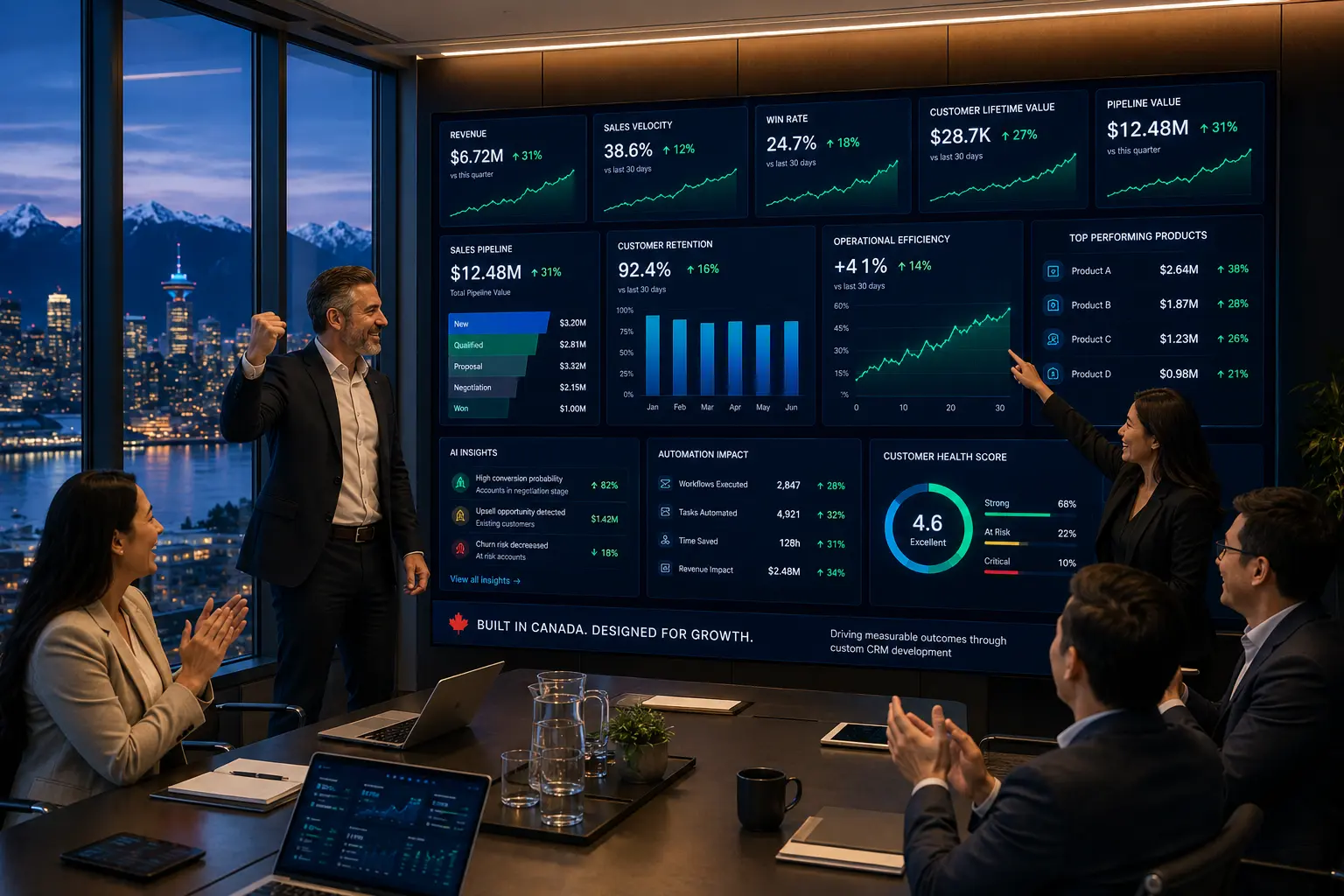
How Zerotens Builds Enterprise AI Solutions
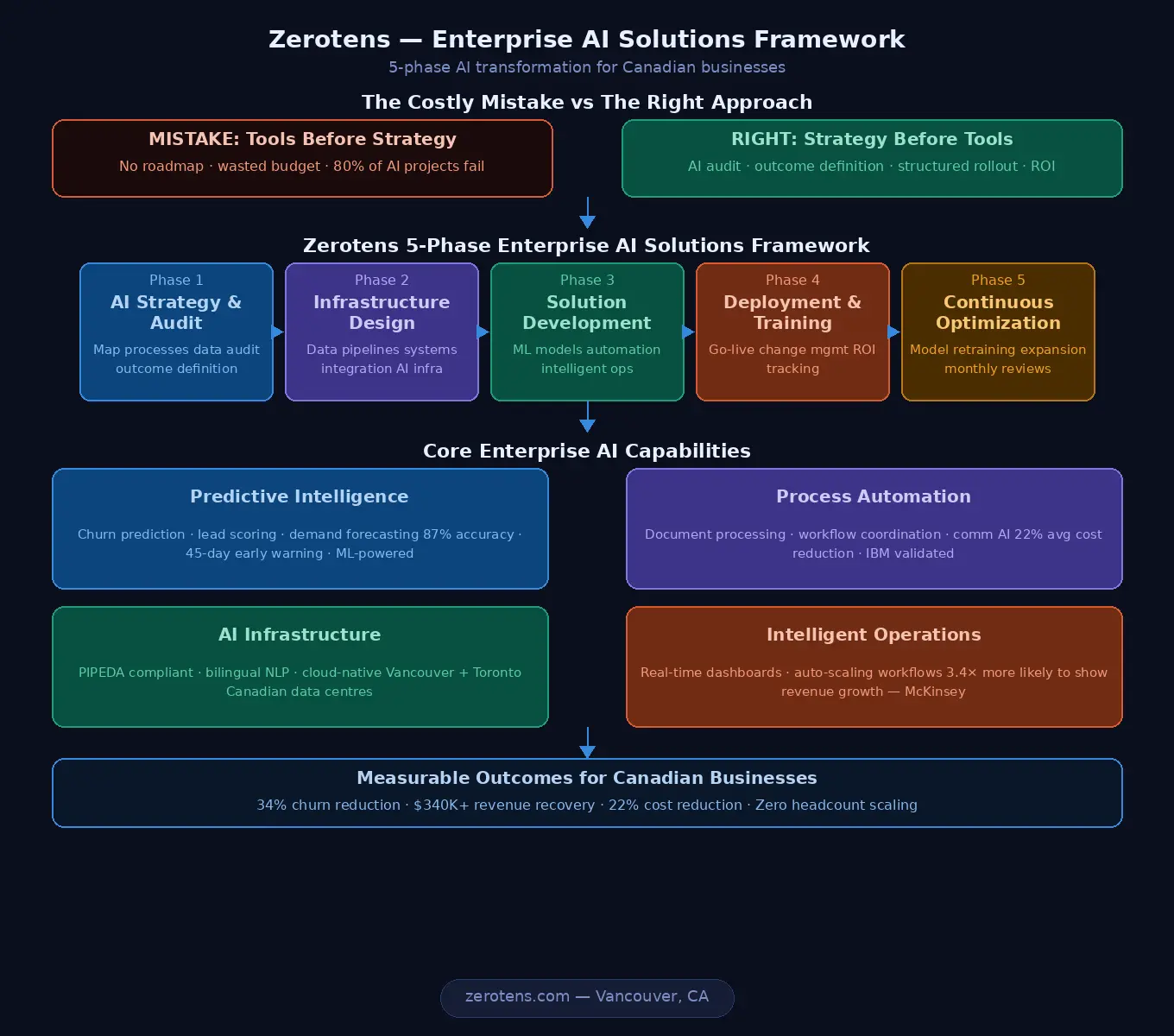
Zerotens’ approach to enterprise AI solutions is built on a 5-phase framework that takes Canadian organizations from strategic assessment through to fully deployed, continuously optimizing AI systems — without the tool-before-strategy mistake that derails most implementations.
Phase 1 is the AI strategy and audit phase. Zerotens maps the organization’s processes, data infrastructure, commercial objectives, and operational pain points — producing a prioritized enterprise AI solutions roadmap that sequences implementations by commercial impact and organizational readiness. Phase 2 is infrastructure design — building or optimizing the data infrastructure, systems integrations, and AI infrastructure that enterprise AI solutions require to perform reliably at scale.
Phase 3 is solution development — building or configuring the specific machine learning solutions, enterprise automation workflows, and intelligent operations platforms identified in the strategy phase. Phase 4 is deployment and change management — implementing enterprise AI solutions within the organization’s operational environment, training the teams who will use and manage them, and establishing the measurement frameworks that track commercial impact. Phase 5 is continuous optimization — monthly performance reviews, model retraining, and capability expansion that ensure the enterprise AI solutions framework continues to deliver improving results as the organization grows and its data accumulates.
AI Transformation Built for the Canadian Market
Canadian organizations face specific AI transformation requirements that generic enterprise AI solutions frameworks frequently overlook. PIPEDA compliance governs how customer data can be collected, stored, and processed by AI systems — a regulatory dimension that must be designed into the AI infrastructure from the beginning, not retrofitted after deployment. Canada’s bilingual market requirements affect natural language processing implementations, requiring AI systems trained on both English and French datasets to serve the full national market effectively.
Zerotens designs enterprise AI solutions that are Canadian-market-ready from the first line of code — PIPEDA-compliant by architecture, bilingual where required by application, and calibrated to the specific competitive and regulatory environment of the Canadian industries they serve. For Vancouver businesses serving both Canadian and US markets, Zerotens builds enterprise AI solutions that navigate cross-border data governance requirements without compromising the performance or accessibility of the AI systems that deliver commercial value.
The organizations that partner with Zerotens for enterprise AI solutions are not purchasing a technology stack. They are building a strategic capability — one that delivers compounding commercial returns, creates genuine competitive differentiation, and positions the business to capture the AI-driven growth opportunities that its market will increasingly reward.
FAQ — Enterprise AI Solutions Explained
1. What are enterprise AI solutions? Enterprise AI solutions are integrated systems combining artificial intelligence, machine learning, and enterprise automation to improve business performance at scale. Unlike standalone AI tools, enterprise AI solutions connect strategy, infrastructure, and implementation into a unified framework — delivering measurable commercial outcomes across revenue growth, operational efficiency, and risk management.
2. Which companies need enterprise AI solutions? Any Canadian organization generating over $5 million in annual revenue with complex operations, significant data volumes, or competitive pressure from AI-enabled rivals benefits from enterprise AI solutions. Industries including professional services, financial services, e-commerce, SaaS, and healthcare technology in Vancouver and across Canada are among the highest-impact sectors.
3. How much do enterprise AI solutions cost? Enterprise AI solutions investments vary significantly based on scope, complexity, and existing infrastructure. Zerotens structures implementations to deliver positive ROI within the first 12 months — beginning with the highest-impact, lowest-complexity applications and expanding the AI infrastructure as commercial returns fund further development. Contact Zerotens for a scoped assessment.
4. What are the benefits of enterprise AI solutions? The primary benefits of enterprise AI solutions include reduced operational costs, faster decision-making, improved customer experience, predictive business intelligence, and scalable automation of high-volume processes. Canadian organizations that implement structured enterprise AI solutions frameworks consistently report revenue growth, cost reduction, and competitive differentiation within the first year.
5. How does Zerotens implement enterprise AI solutions? Zerotens implements enterprise AI solutions through a 5-phase framework: AI strategy and audit, infrastructure design, solution development, deployment and change management, and continuous optimization. Every implementation begins with a commercial outcome definition — ensuring the AI strategy delivers measurable business value rather than technology for its own sake.
Conclusion
Enterprise AI solutions are the defining competitive investment for Canadian businesses in 2026 — and the costly mistake most growing organizations make is not failing to invest in AI, but failing to invest in the strategy, infrastructure, and implementation discipline that transforms AI tools into business performance engines. The gap between organizations with coherent enterprise AI solutions frameworks and those deploying tools without strategic alignment is measurable, growing, and increasingly difficult to close the longer the decision to act is deferred.
Zerotens builds enterprise AI solutions that start with commercial outcomes and work backward to technology — connecting AI strategy, machine learning solutions, enterprise automation, and intelligent operations into a unified framework calibrated to the specific requirements of Canadian businesses and the markets they serve. From Vancouver startups scaling their first AI infrastructure to established Canadian enterprises undertaking full AI transformation, the Zerotens approach to enterprise AI solutions delivers the measurable, compounding business value that AI investment promises and too rarely delivers without the right partner.
The costly mistake is avoidable. And enterprise AI solutions built on strategy rather than tools are exactly what Zerotens provides.