
Introduction
Custom CRM development is the strategic decision that separates growing Canadian businesses from those permanently constrained by software built for someone else’s workflows, team structures, and commercial priorities. Generic CRM platforms — Salesforce, HubSpot, Zoho, and their equivalents — are engineered for the broadest possible market. They are designed to be adequate for everyone and excellent for no one. And for businesses whose competitive advantage depends on the precision of their client relationships, the efficiency of their sales processes, and the intelligence of their operational data, adequate is not a sustainable position.
The failure pattern of generic CRM adoption is consistent and well documented. A business purchases a platform, invests in setup and training, discovers that critical workflows require workarounds, accumulates integrations that introduce data inconsistencies, and ultimately operates a system that the team has learned to work around rather than within. The CRM becomes a data entry obligation rather than a growth asset — and the business intelligence that a properly designed custom CRM development project would deliver remains inaccessible within a platform that was never built to understand the specific way this business operates.
“Custom CRM development involves building a tailored customer relationship management system designed specifically for your unique sales processes, workflows, and integrations. Unlike rigid off-the-shelf platforms, a custom build carries only the features you need, scaling with your organization while eliminating recurring per-seat licensing fees. [lightspeedweb, IOA, salesforce]
For Canadian businesses in Vancouver’s competitive technology sector, Toronto’s financial services market, and across the national B2B landscape, the cost of this misalignment is measurable — in sales opportunities lost to poor pipeline visibility, in customer relationships damaged by inadequate follow-up systems, and in operational inefficiencies that compound daily across every team that depends on the CRM to do its job. The solution is not a better generic platform. The solution is custom CRM development — a system built around the specific logic, workflows, and intelligence requirements of the business it serves.
This article examines why custom CRM development consistently outperforms generic alternatives for growing businesses and how Zerotens delivers tailored customer relationship management systems that become genuine competitive advantages.

Why Custom CRM Development Outperforms Generic CRM Platforms
Custom CRM development begins with a fundamental advantage that no generic platform can replicate: it is built around the actual way a business operates rather than the way a software vendor assumes businesses generally operate. This distinction produces cascading benefits across every dimension of CRM performance — from the quality of data capture to the accuracy of sales forecasting to the usability of the interface that determines whether the sales team actually uses the system or treats it as a compliance exercise.
Generic CRM platforms are built on assumptions. They assume a standard sales pipeline structure, a conventional lead qualification process, a typical customer lifecycle, and a predictable set of integration requirements. For businesses whose commercial reality matches these assumptions closely enough, generic platforms deliver acceptable value. For businesses — and most growing Canadian companies fall into this category — whose competitive differentiation depends on how specifically they do things rather than how generally, generic assumptions introduce friction at every point where the platform’s logic conflicts with the business’s actual process.
Custom CRM development eliminates assumption-driven friction by replacing it with purpose-built precision. Every data field captures information the business actually needs. Every workflow reflects the process the team actually follows. Every report surfaces the intelligence the leadership team actually uses to make decisions. The result is a customer relationship management system that amplifies how the business works rather than requiring the business to adapt to how the software works.
The Hidden Cost of Generic CRM Platforms
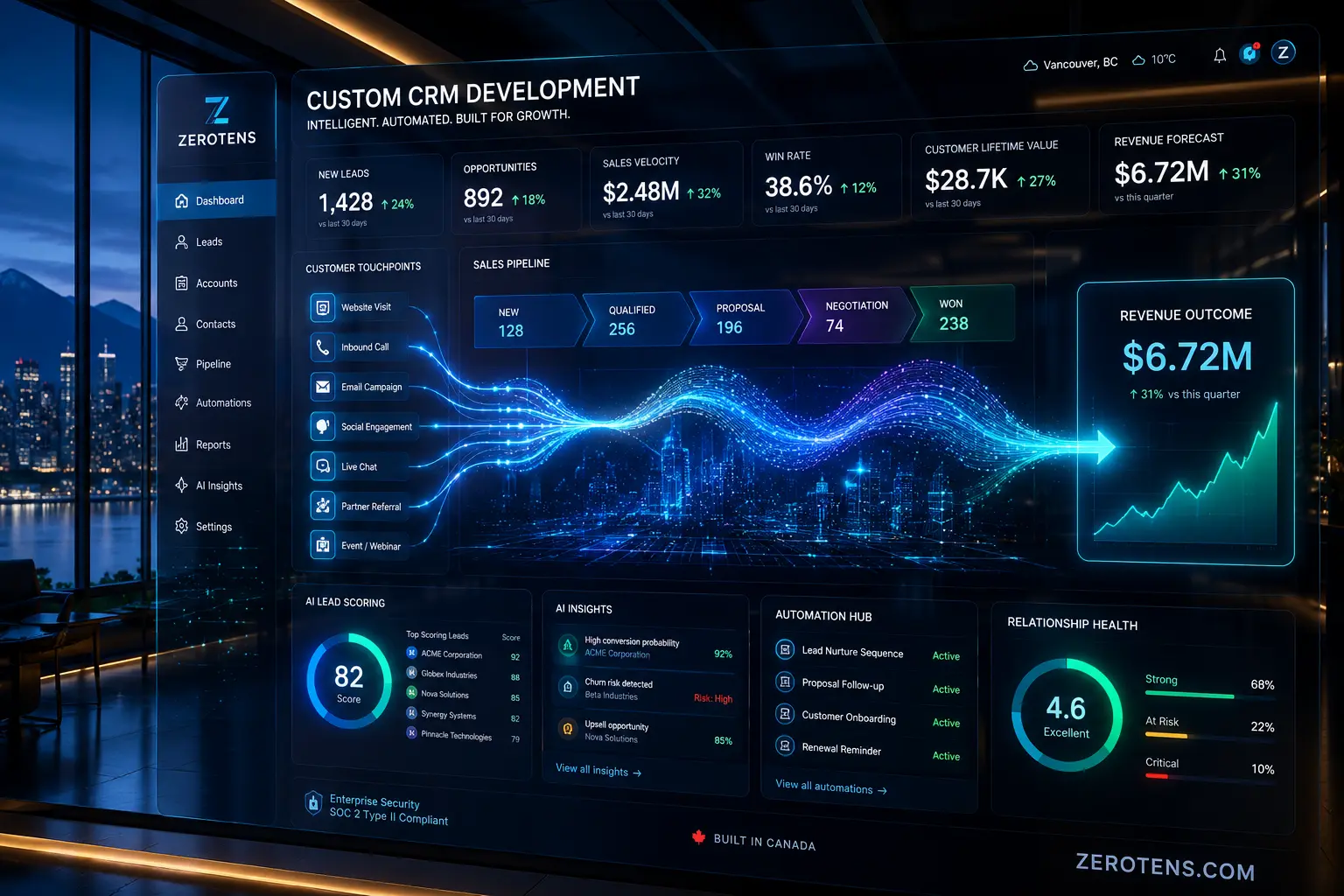
The financial case for custom CRM development over generic platforms is most compelling when the full cost of generic CRM ownership is accurately calculated — including the costs that never appear on a subscription invoice. Research from Gartner confirms that 70% of CRM implementations fail to deliver expected ROI — a failure rate driven not by poor adoption effort but by fundamental misalignment between platform capabilities and business requirements.
The hidden costs of this misalignment accumulate across 4 dimensions. First, integration costs — the development investment required to connect a generic CRM software development platform to the other systems the business operates. Second, customization costs — the ongoing development spend required to extend platform functionality toward the business’s specific requirements. Third, workaround costs — the productivity loss incurred when teams develop manual processes to compensate for platform limitations. Fourth, data quality costs — the operational impact of inconsistent, duplicated, or inaccessible data that accumulates when a customer relationship management system was not designed for the specific data architecture the business requires.
For Canadian businesses that have spent 18 to 36 months accumulating these costs within a generic platform, a Zerotens custom CRM development engagement frequently delivers positive ROI within 12 months — because the system it builds eliminates the hidden costs that the generic platform was generating continuously.
Custom Business Software as a Competitive Differentiator
Custom business software — and custom CRM development specifically — creates competitive differentiation through a mechanism that generic platforms structurally cannot replicate: it encodes the business’s specific commercial intelligence into its operational infrastructure. A custom CRM built by Zerotens does not just manage customer relationships — it operationalizes the specific approach to customer relationship management that defines the business’s competitive advantage.
For a Vancouver-based professional services firm, this might mean a custom CRM development project that encodes the firm’s specific client qualification methodology — automatically scoring and routing prospects based on the precise criteria that the firm’s most successful partners apply in their own assessment process. For a Canadian B2B technology company, it might mean a custom CRM development system that maps the multi-stakeholder buying journeys specific to enterprise technology procurement — tracking influence, decision authority, and relationship health across all stakeholders within each target account simultaneously.
These capabilities are not available in generic platforms — because generic platforms were not built with knowledge of this specific business’s competitive approach. Custom CRM development is the mechanism by which that approach becomes systematic, scalable, and protected from the knowledge loss that occurs when key personnel change.

How Custom CRM Development Improves Sales, Operations, and Customer Retention
The commercial impact of custom CRM development operates simultaneously across 3 business dimensions — sales performance, operational efficiency, and customer retention — and it is the compounding effect across all 3 that produces the ROI that makes custom CRM development investment straightforwardly justifiable for growing Canadian businesses.
Sales pipeline management is where custom CRM development delivers its most immediately visible impact. A custom sales pipeline built by Zerotens reflects the actual stages, conversion criteria, and decision signals of the client’s specific sales process — rather than the generic 5-stage pipeline that most generic CRMs impose as a default. This precision produces sales forecasting accuracy that generic pipeline models cannot approach — because the pipeline stages reflect real commercial milestones rather than approximate approximations of them.
CRM Automation and Sales Velocity
CRM automation — the systematic elimination of manual process steps through intelligent automation built into the CRM architecture — is one of the highest-value outcomes of custom CRM development for Canadian sales organizations. The average B2B sales representative spends 65% of their working time on non-selling activities — data entry, follow-up scheduling, reporting, and administrative coordination — according to research from Salesforce. CRM automation through a purpose-built system reclaims a significant portion of this time and redirects it toward revenue-generating activity.
Zerotens builds CRM automation into every custom CRM development project — automating the specific repetitive processes that the client’s team actually performs rather than the generic automation templates that generic platforms offer. For a Vancouver-based financial services firm Zerotens recently engaged, custom CRM automation eliminated 14 hours per week of manual data entry across the sales team — immediately recovering productivity equivalent to 0.4 full-time sales positions without any additional headcount investment.
Sales pipeline management precision also accelerates sales velocity — the speed at which opportunities progress from initial contact to closed revenue. A custom CRM development system that accurately reflects the client’s sales process identifies pipeline stagnation in real time, triggers automated follow-up sequences at the precise moments that data identifies as highest-impact, and surfaces the intelligence that enables sales managers to coach their teams with specific, data-grounded precision rather than general guidance.
Business Process Optimization Through CRM Integration
Business process optimization through CRM integration — connecting the CRM to the full ecosystem of business systems the company operates — is where custom CRM development delivers operational impact that extends beyond the sales team to every function that touches customer relationships.
A custom CRM development project that integrates the CRM with the company’s ERP, marketing automation, customer support, billing, and project management systems creates a unified operational intelligence layer — a single source of truth for every customer interaction, transaction, and relationship signal across the entire business. This integration eliminates the data silos that produce the inconsistent customer experiences and missed commercial opportunities that generic CRM deployments, with their limited and expensive integration capabilities, routinely generate.
For Canadian businesses operating across multiple functional teams — sales, marketing, customer success, professional services, and finance — this CRM integration architecture transforms cross-functional coordination from an ongoing friction source into a seamless operational flow. Every team member who touches a customer relationship has access to complete, current, and contextually relevant information about that relationship — because the custom CRM development architecture was designed to make that information available at every operational touchpoint.
Essential Features Every Custom CRM Development Project Should Include
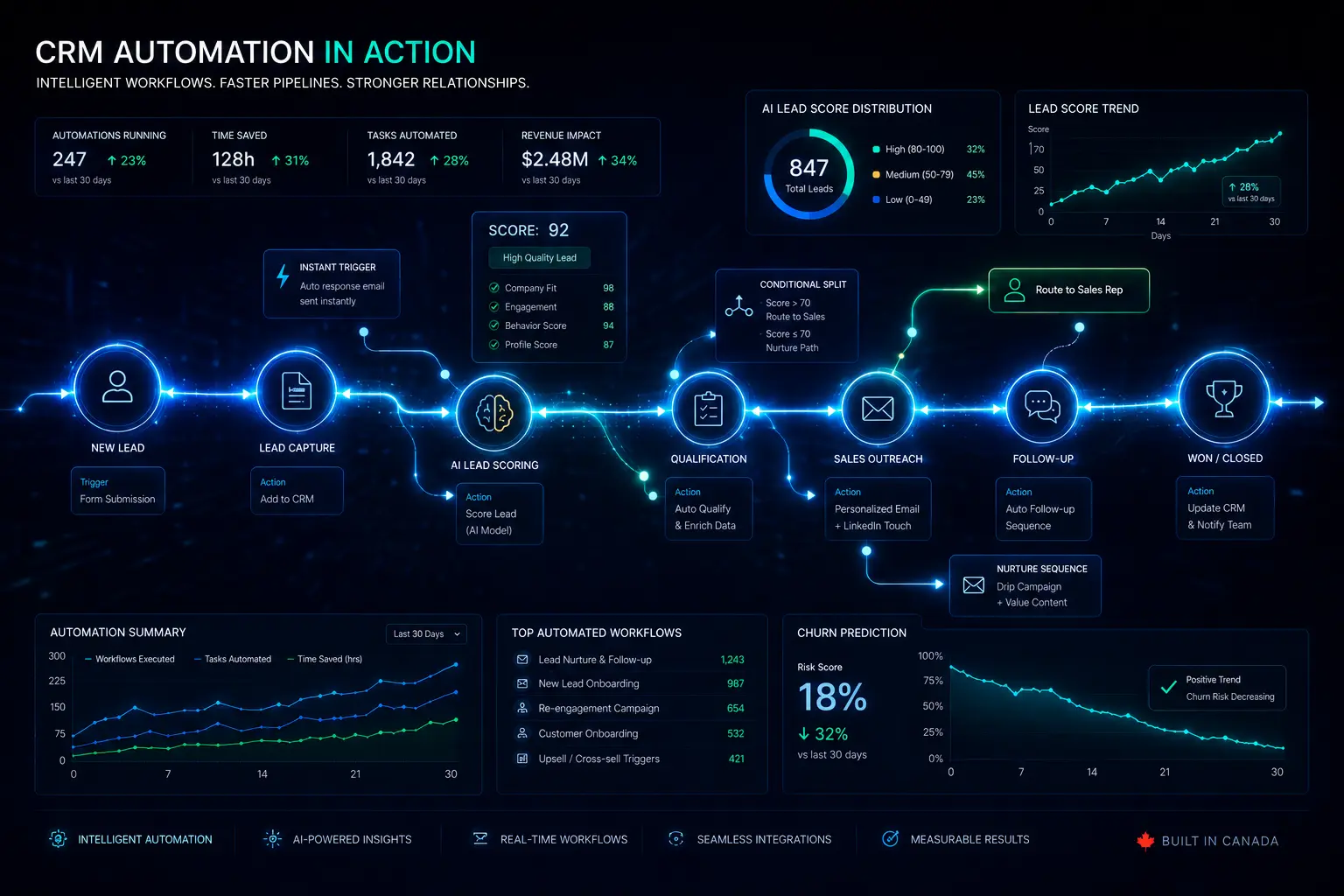
A custom CRM development project that delivers genuine competitive advantage requires a specific set of core features — each one addressing a dimension of customer relationship management that generic platforms handle inadequately and purpose-built systems can optimize completely. Zerotens builds these features into every custom CRM development engagement as standard components — because their absence limits the commercial impact of even the most sophisticated custom architecture.
AI Integration in Custom CRM Development
AI integration is the feature that most significantly differentiates a custom CRM development project from a sophisticated manual database. Artificial intelligence applied to CRM data surfaces patterns, predictions, and recommendations that human analysis of the same data would identify too slowly to act on competitively — transforming the customer relationship management system from a record of what has happened into a guide for what to do next.
Zerotens integrates AI capabilities into custom CRM development projects across 4 dimensions. Predictive lead scoring — AI models trained on the client’s own conversion data that score incoming leads based on the characteristics most predictive of conversion in this specific business context. Churn prediction — models that identify early warning signals of customer disengagement before they manifest as cancellations or lost renewals. Next best action recommendations — AI guidance that identifies the optimal next touchpoint for each customer relationship based on behavioral signals and historical response patterns. And natural language processing for communication analysis — models that assess the sentiment and engagement signals in customer communication to identify relationship health changes that manual review would miss.
For Canadian B2B companies managing large customer portfolios where relationship health monitoring at scale is operationally impossible without AI assistance, this custom CRM development AI integration capability is not a feature enhancement — it is a fundamental business intelligence requirement.
NEW POSSIBILITY
Let’s Build Something Smarter Together
Web Usability That Never Stops Selling: A UX UI Design Agency in Vancouver Perspective

Workflow Automation Through Custom CRM Development
Workflow automation built into custom CRM development projects systematizes the specific business processes that determine customer experience quality and operational efficiency — replacing inconsistent manual execution with reliable, intelligent automation that performs correctly every time, at any scale.
Zerotens designs workflow automation in every custom CRM development project by mapping the client’s actual operational processes — identifying every step that is currently performed manually, assessing which steps are rule-based enough to automate reliably, and building automation logic that executes those steps with the precision and consistency that manual execution cannot maintain at scale.
For Vancouver-based professional services firms, workflow automation through custom CRM development typically addresses client onboarding sequences, contract renewal workflows, project status communication triggers, and satisfaction survey deployment — processes that are critical to client retention but too complex and context-dependent to automate reliably within generic CRM platforms. A custom CRM development system designed around the firm’s specific onboarding methodology and client communication standards delivers these processes consistently across every client engagement — protecting the service quality that the firm’s reputation depends on.
How Zerotens Approaches Custom CRM Development Projects
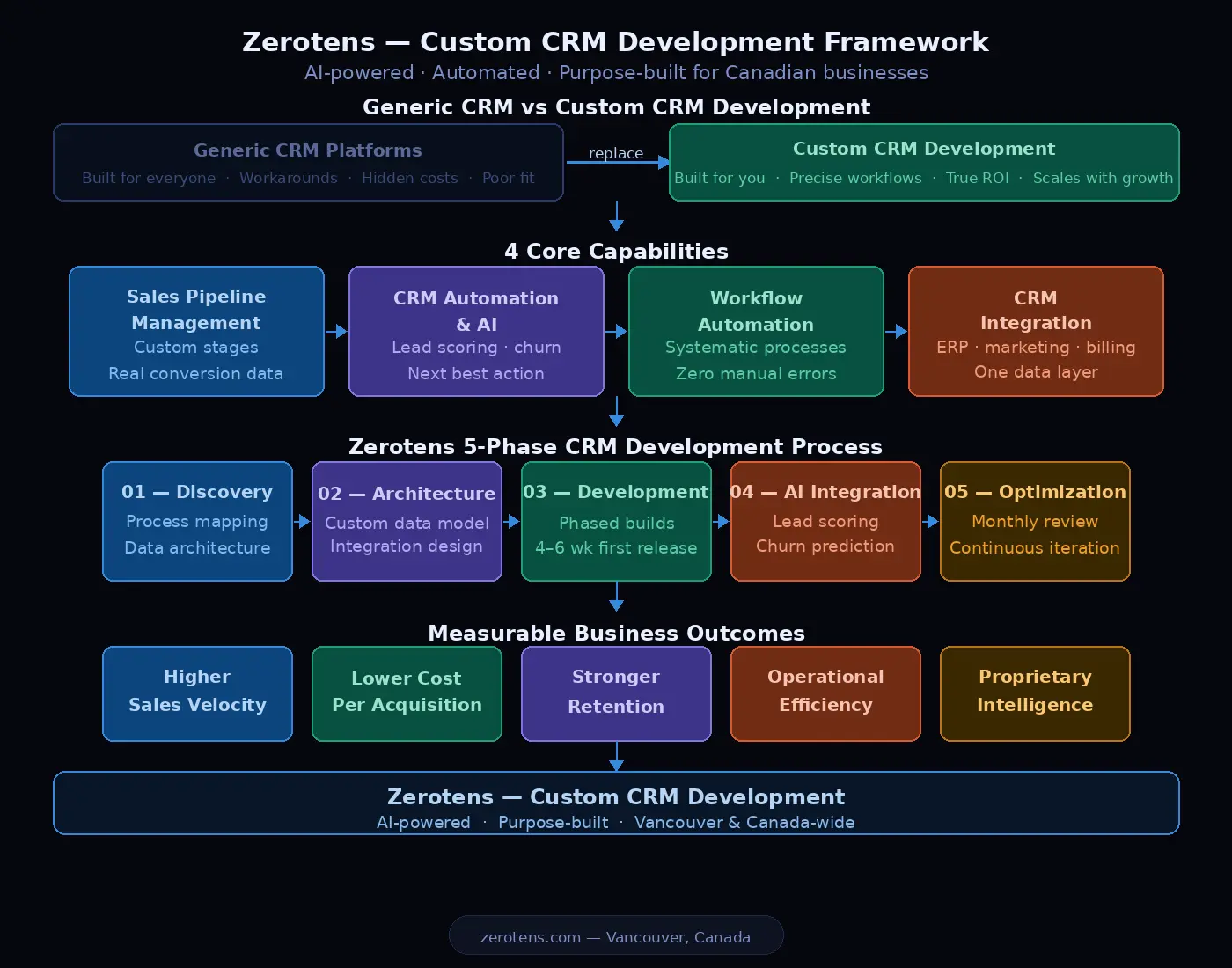
Zerotens’ custom CRM development methodology is built on a discovery-first principle — the conviction that a CRM can only be built correctly when the business it serves is understood completely. Every custom CRM development engagement begins with a structured discovery process that maps the client’s commercial processes, data architecture requirements, integration ecosystem, team workflows, and strategic growth objectives before a single line of code is written.
This discovery investment pays dividends throughout the project lifecycle — because it ensures that the custom CRM development architecture reflects the business’s actual requirements rather than the consultant’s assumptions about them. The most common failure in custom CRM development projects is building the wrong system correctly — producing technically excellent software that solves problems the business does not actually have while missing the ones it does. Zerotens’ discovery methodology eliminates this risk by replacing assumption with documented, validated understanding.
The development process follows a phased delivery model — delivering functional custom CRM development capabilities in iterative releases that allow the client’s team to begin using and validating the system before it is fully complete. This approach produces faster time-to-value, higher adoption rates, and a final system that reflects real operational experience rather than pre-launch speculation. For Canadian businesses that cannot afford the operational disruption of a big-bang CRM deployment, Zerotens’ phased custom CRM development delivery model provides the risk management and progressive value realization that complex system implementations require.
Post-launch, Zerotens provides ongoing custom CRM development optimization — monthly performance reviews, adoption analysis, and iterative feature development that ensures the CRM evolves alongside the business it serves. A custom CRM development system that is optimized continuously delivers compounding value — because every improvement compounds the efficiency and intelligence of every subsequent customer interaction the system supports.
The Future of Custom CRM Development and Business Intelligence
Custom CRM development in 2026 is evolving toward a model of unified business intelligence — where the CRM is not just a customer relationship tool but the central operational nervous system of the business, integrating every data source, automating every repeatable process, and surfacing AI-generated intelligence that guides every significant commercial decision.
The Canadian businesses that will lead their markets in 2030 are building this capability now — investing in custom CRM development projects that create proprietary data advantages, operational intelligence moats, and customer relationship capabilities that generic platforms will never offer. Zerotens is building these systems today for Canadian businesses across Vancouver, Toronto, Calgary, and nationally — delivering custom CRM development projects that position clients for a business intelligence landscape where the quality of a company’s customer data infrastructure is as strategically significant as the quality of its product or service.
CRM software development is moving toward predictive business management — systems that not only record what has happened but anticipate what will happen, recommend what should be done, and automate the execution of the actions that data identifies as highest-value. Every custom CRM development project Zerotens delivers today is built with this trajectory in mind — ensuring that the architecture it creates is extensible, data-rich, and AI-ready for the business intelligence capabilities that are already emerging and will define competitive advantage in every Canadian market Zerotens serves.
FAQ — Custom CRM Development Explained
1. What is custom CRM development? Custom CRM development is the process of building a bespoke customer relationship management system designed around a specific business’s workflows, data requirements, and commercial processes — rather than adapting a generic platform to approximate those requirements. A custom CRM integrates precisely with existing systems, automates specific business processes, and delivers intelligence tailored to the business’s unique growth objectives.
2. Why choose custom CRM development over ready-made CRM software? Generic CRM platforms are built for average requirements — they deliver adequate performance across a broad market but rarely excel for any specific business. Custom CRM development eliminates the workarounds, integration costs, and capability gaps that generic platforms generate — producing a system that amplifies the specific way a business operates rather than requiring it to adapt to generic software logic.
3. How long does a custom CRM development project take? A typical custom CRM development project with Zerotens takes 8 to 16 weeks from discovery to initial deployment — depending on complexity, integration requirements, and automation scope. Zerotens’ phased delivery model ensures that core functionality is operational within the first 4 to 6 weeks, with advanced features and AI integration delivered in subsequent releases.
4. Can custom CRM development include AI automation? Yes — AI integration is a standard component of Zerotens’ custom CRM development projects. This includes predictive lead scoring, churn prediction, next best action recommendations, and natural language processing for communication analysis — all trained on the client’s own data to deliver intelligence that is specific to their business context rather than generic industry benchmarks.
5. How does custom CRM development improve customer retention? Custom CRM development improves customer retention by making relationship health monitoring systematic and proactive. AI-powered churn prediction identifies at-risk customers before disengagement becomes visible. Automated renewal and follow-up workflows ensure no relationship falls through the cracks. And integrated customer data gives every team member complete relationship context — enabling the personalized, responsive service that retains clients in competitive Canadian markets.
Conclusion
Custom CRM development is not a premium option for large enterprises — it is the logical choice for any Canadian business whose commercial performance depends on the quality of its customer relationships and the efficiency of its sales and operational processes. Generic CRM platforms deliver generic results. Custom CRM development delivers a system built around the specific logic, intelligence requirements, and competitive approach of the business it serves — and that specificity is the foundation of the measurable performance advantages that Zerotens’ Canadian clients report consistently.
Zerotens builds custom CRM development solutions that combine purpose-built architecture, AI integration, CRM automation, workflow optimization, and seamless CRM integration — delivering customer relationship management systems that grow more intelligent and more valuable with every customer interaction they process. From Vancouver’s competitive professional services sector to Canada’s national B2B technology market, every Zerotens custom CRM development project is built on one conviction: that the businesses which win the decade ahead are those that invest in proprietary operational intelligence rather than renting generic software that their competitors use equally.
If your business has outgrown its generic CRM — or has never found one that truly fits — custom CRM development is what replaces limitation with competitive advantage.