
Introduction
An AI readiness assessment is the single most overlooked step in Canadian businesses’ AI journeys — and skipping it is the reason most AI initiatives fail before they ever reach production. Every week, growing organizations across Vancouver, Toronto, and Calgary purchase AI tools, hire AI consultants, or launch internal AI projects without first understanding whether their data, processes, and people are actually prepared to support what they are about to build. The result is predictable: stalled pilots, abandoned platforms, and AI budgets that produced a lesson rather than a return.
The pattern repeats with remarkable consistency. A leadership team sees a competitor’s AI success story, feels the pressure to act, and moves directly to tool selection — skipping the foundational question that determines whether any AI investment will succeed: is this organization actually ready? An AI readiness assessment answers that question before a single dollar is committed to implementation, evaluating data quality, process maturity, organizational capability, and strategic alignment against the specific AI opportunities the business is considering.
For Canadian businesses, the cost of skipping this step is measurable. Gartner research confirms that over 80% of AI projects never reach production — and the organizations behind those failed projects consistently share one trait: they evaluated AI tools before they evaluated their own readiness to adopt them. An AI readiness assessment is how Zerotens ensures every Canadian client avoids becoming part of that statistic — building AI adoption strategy on a foundation of organizational reality rather than technology enthusiasm.
Why Most Businesses Fail Their First AI Initiative
The failure pattern behind most unsuccessful AI initiatives is strikingly consistent across industries, company sizes, and geographies — and an AI readiness assessment exists specifically to interrupt this pattern before it consumes budget and credibility. Organizations fail their first AI initiative not because the technology does not work, but because the technology was deployed onto a foundation that could not support it.
3 failure modes account for the overwhelming majority of stalled AI projects. The first is data unreadiness — organizations whose data is fragmented across disconnected systems, inconsistently formatted, or simply not collected at the volume and quality AI models require to perform reliably. The second is process unreadiness — organizations whose business processes are undocumented or inconsistent, meaning there is no stable workflow for AI to integrate into or improve. The third is organizational unreadiness — teams who have not been prepared, trained, or aligned around how AI will change their daily work, producing resistance and underutilization even when the technology itself performs correctly.
An AI readiness assessment identifies which of these failure modes — often more than one simultaneously — an organization faces before implementation begins, allowing the foundational gaps to be addressed proactively rather than discovered expensively mid-project.

The True Cost of Skipping AI Readiness Assessment
The financial cost of bypassing an AI readiness assessment extends well beyond the wasted technology spend. McKinsey’s research on AI implementation found that organizations that skip structured readiness evaluation spend an average of 2.3 times more on AI implementation than organizations that conduct proper assessment first — because foundational gaps discovered during implementation require expensive remediation under time pressure, rather than planned investment before the project begins.
For a Vancouver-based logistics company that approached Zerotens after a failed AI initiative, the post-mortem revealed that the original implementation had proceeded without any AI readiness assessment — and the AI platform had been integrated against data with a 23% error rate, producing predictions that operations staff quickly learned to ignore. The remediation cost, including data cleansing, process redocumentation, and platform reconfiguration, exceeded the original implementation budget by 180% before the system delivered any reliable value.
This pattern repeats across the Canadian market with sufficient frequency that AI readiness assessment has shifted, in Zerotens’ client conversations, from an optional best practice to a non-negotiable first step in any serious AI adoption strategy.

Organizational Readiness as the Hidden Variable
Organizational readiness is the dimension of AI readiness assessment that technology vendors consistently underweight — because it cannot be solved by purchasing a better platform. An AI system that performs flawlessly in a technical sense delivers zero business value if the people who are supposed to use its outputs do not trust it, understand it, or have the workflow capacity to act on what it produces.
Zerotens evaluates organizational readiness across 4 dimensions during every AI readiness assessment: leadership alignment on AI strategy and investment, team capability and training requirements, change management capacity for the workflow disruptions AI introduces, and cultural openness to AI-augmented decision-making versus pure human judgment. For Canadian businesses where workforce composition spans multiple generations and varying technology comfort levels, this organizational readiness dimension frequently surfaces adoption barriers that purely technical assessments miss entirely.
What an AI Readiness Assessment Actually Measures
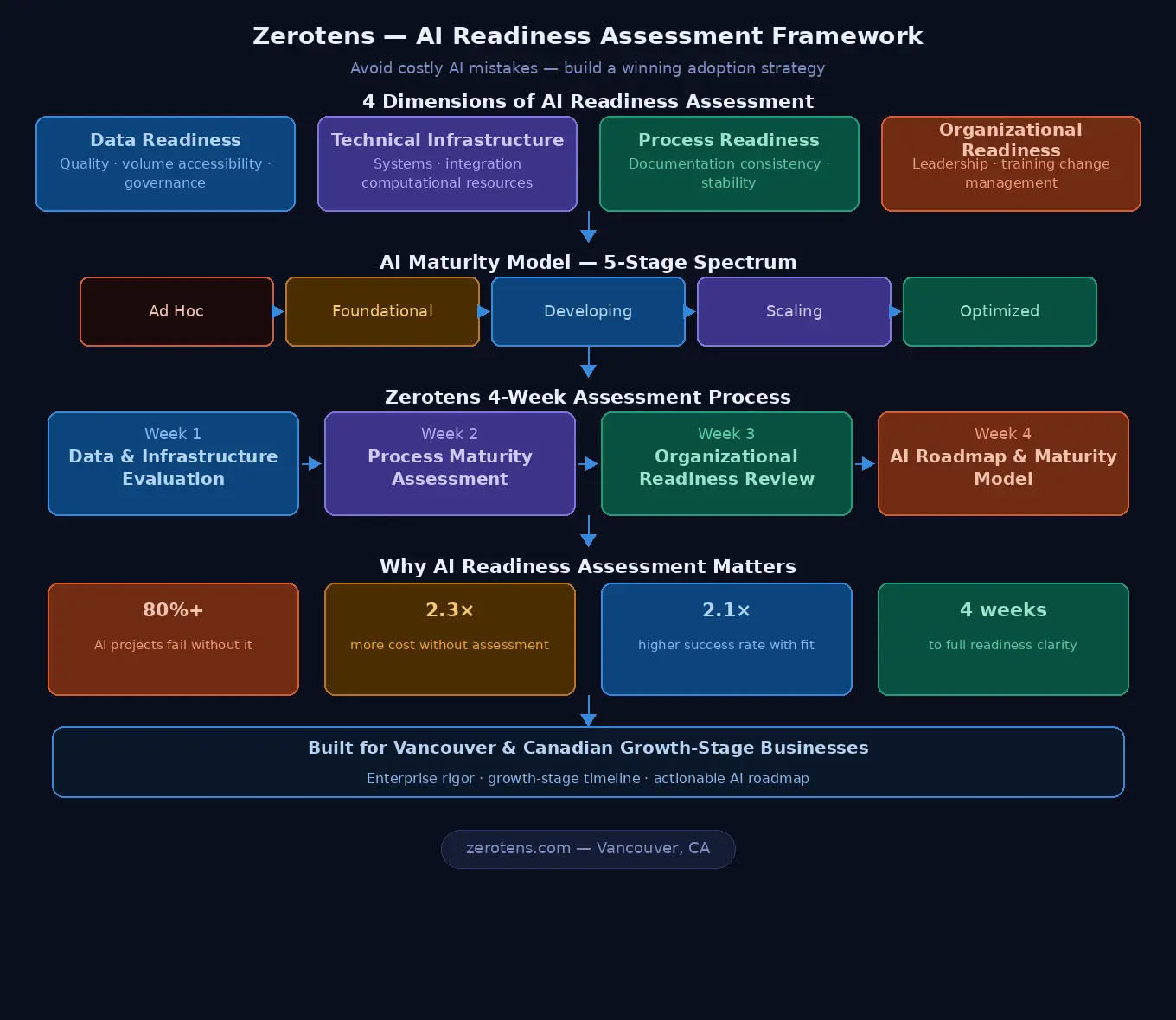
A professional AI readiness assessment evaluates an organization across 4 structured dimensions — each contributing to an overall AI maturity model score that determines not whether the organization should pursue AI adoption, but which AI opportunities are achievable now and which require foundational investment first.
The first dimension is data readiness — assessing data volume, quality, accessibility, and governance against the specific requirements of the AI applications under consideration. The second is technical infrastructure readiness — evaluating existing systems, integration capability, and computational resources against what the proposed AI solutions require. The third is process readiness — examining whether the business processes targeted for AI enhancement are documented, consistent, and stable enough to support automation or augmentation. The fourth is organizational readiness — the leadership alignment, team capability, and change management capacity described above.
Building an AI Maturity Model for Your Organization
An AI maturity model translates the findings of an AI readiness assessment into a structured framework that positions the organization along a defined readiness spectrum — typically ranging from foundational, where basic data and process infrastructure must be established before meaningful AI adoption is possible, through to optimized, where AI is deeply integrated into decision-making and continuously refined based on performance feedback.
Zerotens builds custom AI maturity models for every Canadian client based on industry-specific benchmarks and the organization’s own strategic objectives — recognizing that a Vancouver SaaS company and a British Columbia manufacturing business face fundamentally different AI maturity considerations despite both potentially scoring similarly on a generic readiness scale. The maturity model produced through an AI readiness assessment becomes the strategic reference point against which all subsequent AI investment decisions are evaluated — ensuring that each new AI initiative builds on demonstrated organizational capability rather than outpacing it.
Identifying AI Opportunities That Match Organizational Capacity
The most valuable output of a well-executed AI readiness assessment is not a readiness score — it is a prioritized map of AI opportunities matched precisely to what the organization can realistically execute given its current data, process, and organizational maturity. This matching exercise prevents the common mistake of pursuing ambitious AI applications that exceed organizational capacity while overlooking simpler, high-value opportunities that the organization is fully equipped to capture immediately.
For a Toronto-based professional services firm Zerotens assessed, the AI readiness assessment revealed that the organization’s leadership had been focused on an ambitious predictive analytics initiative requiring data infrastructure the firm did not yet have — while overlooking a straightforward document processing automation opportunity that matched their existing systems perfectly and could be implemented within 6 weeks. Sequencing AI opportunities correctly, based on actual organizational readiness rather than aspirational technology goals, transformed the firm’s AI adoption strategy from a single high-risk bet into a structured sequence of compounding wins.

Building an AI Maturity Model for Your Organization
Every AI readiness assessment Zerotens conducts produces an AI maturity model calibrated to the client’s specific industry, scale, and strategic context — because generic maturity frameworks consistently misjudge the readiness of Canadian mid-market businesses whose data infrastructure and process maturity vary significantly from the enterprise benchmarks most AI maturity models are built around.
The AI maturity model framework Zerotens applies evaluates organizations across 5 progressive stages: ad hoc, where data and process infrastructure are inconsistent and AI adoption would be premature; foundational, where basic data governance and process documentation exist but require strengthening; developing, where the organization has successfully piloted limited AI applications and is building internal capability; scaling, where AI is integrated across multiple functions with established governance and measurement frameworks; and optimized, where AI-augmented decision-making is embedded organization-wide and continuously refined through performance feedback loops.
Digital Transformation Readiness as a Prerequisite
Digital transformation readiness underlies every dimension of a credible AI readiness assessment — because AI adoption is fundamentally constrained by the digital infrastructure an organization has already built. A business still operating significant portions of its operations through paper processes, disconnected spreadsheets, or legacy systems without API access faces digital transformation readiness gaps that must be addressed before AI adoption strategy can proceed meaningfully.
Zerotens incorporates digital transformation readiness evaluation directly into every AI readiness assessment — distinguishing between organizations that need foundational digital infrastructure investment before AI adoption is viable and organizations whose digital foundation is sufficiently mature to support AI implementation immediately. This distinction prevents Canadian clients from investing in AI capabilities that their underlying digital infrastructure cannot actually support or sustain.
From Assessment to Action — The AI Roadmap
The AI readiness assessment is only valuable when it converts into an actionable AI roadmap — a sequenced implementation plan that translates readiness findings and maturity model positioning into specific, prioritized AI initiatives with defined timelines, resource requirements, and expected business outcomes.
Zerotens builds AI roadmaps that sequence implementation according to 3 prioritization criteria identified during the AI readiness assessment: commercial impact potential, implementation complexity relative to current organizational readiness, and foundational dependency — ensuring that initiatives requiring infrastructure or capability not yet in place are sequenced after the foundational work required to support them. This sequencing prevents the common mistake of attempting advanced AI applications before the organizational groundwork that supports them has been established.
NEW POSSIBILITY
Let’s Build Something Smarter Together
Enterprise AI Solutions: The Costly Mistake Most Growing Businesses Still Make

AI Implementation Planning That Reflects Real Constraints
AI implementation planning that emerges from a genuine AI readiness assessment differs fundamentally from generic AI strategy templates because it reflects the organization’s actual constraints — its real data quality, its real process maturity, its real team capacity — rather than an idealized version of organizational capability that technology vendors often assume.
For Vancouver businesses operating with limited internal data science capacity — a common constraint among Canadian mid-market organizations — Zerotens’ AI implementation planning explicitly accounts for resourcing reality, sequencing initiatives that the organization’s existing team can execute and support before introducing AI applications that would require capability the organization does not yet possess and has not budgeted to acquire. According to Deloitte’s 2025 State of AI survey, organizations that align AI implementation planning with actual organizational capacity report 2.1 times higher project success rates than those pursuing capability-mismatched AI roadmaps. (Deloitte State of AI Survey)
How Zerotens Conducts AI Readiness Assessments
Zerotens’ AI readiness assessment methodology follows a structured 4-week process designed to deliver a comprehensive readiness evaluation without the months-long engagement that larger consulting frameworks typically require — recognizing that Canadian mid-market businesses need actionable findings on a timeline that matches their decision-making pace.
Week 1 focuses on data and infrastructure evaluation — auditing data sources, quality, governance, and existing technical systems against the AI opportunities under consideration. Week 2 examines process maturity — documenting and assessing the specific business processes targeted for AI enhancement. Week 3 evaluates organizational readiness — conducting leadership interviews, team capability assessments, and change readiness evaluation. Week 4 synthesizes findings into the AI maturity model, prioritized AI opportunity map, and actionable AI roadmap that the client team uses to guide implementation decisions.
Why Vancouver Businesses Choose Zerotens for AI Readiness Assessment
Vancouver’s competitive technology and professional services landscape has created a specific demand for AI readiness assessment services calibrated to the city’s unique combination of ambitious growth-stage companies and resource-constrained mid-market organizations. Zerotens has positioned its AI readiness assessment methodology specifically to serve this Vancouver market reality — delivering enterprise-grade readiness evaluation rigor at a timeline and investment level appropriate to growth-stage Canadian businesses rather than the multi-month, six-figure engagements that global consulting firms typically require.
For British Columbia businesses across technology, professional services, retail, and logistics sectors, Zerotens’ AI readiness assessment has become the standard first step before any AI adoption strategy investment — ensuring that Canadian businesses build their AI capability on demonstrated readiness rather than aspirational technology goals that exceed what their organization is currently equipped to support.

FAQ — AI Readiness Assessment Explained
1. What is an AI readiness assessment? An AI readiness assessment is a structured evaluation of an organization’s data quality, technical infrastructure, process maturity, and organizational capability to determine which AI initiatives are achievable now and which require foundational investment first. It prevents costly AI failures by identifying readiness gaps before implementation begins.
2. Why do most AI projects fail without an AI readiness assessment? Most AI projects fail because organizations evaluate AI tools before evaluating their own readiness. An AI readiness assessment identifies data, process, and organizational gaps in advance — preventing the 80%+ AI project failure rate that Gartner attributes to foundational unreadiness rather than technology shortcomings.
3. How long does an AI readiness assessment take? Zerotens conducts a complete AI readiness assessment in 4 weeks — evaluating data infrastructure, process maturity, and organizational readiness before delivering an AI maturity model, opportunity map, and actionable AI roadmap calibrated to the client’s specific business context and resources.
4. What is an AI maturity model? An AI maturity model positions an organization along a readiness spectrum — from ad hoc to fully optimized — based on AI readiness assessment findings. It guides which AI opportunities are appropriate now and which require foundational data, process, or organizational investment before pursuing them successfully.
5. How does Zerotens help with AI adoption strategy? Zerotens builds AI adoption strategy directly from AI readiness assessment findings — sequencing AI roadmap initiatives according to commercial impact, implementation complexity, and organizational readiness, ensuring Canadian businesses pursue AI opportunities that match their actual capacity rather than aspirational technology goals.
Conclusion
An AI readiness assessment is the foundation that determines whether AI investment becomes a competitive advantage or an expensive lesson — and for Canadian businesses navigating the pressure to adopt AI quickly, this foundational step is the difference between organizations building compounding AI capability and organizations repeating the 80% failure pattern that defines unstructured AI adoption.
Zerotens conducts AI readiness assessment engagements that evaluate data, infrastructure, process, and organizational readiness with the rigor of enterprise consulting at a timeline and investment level built for Canadian growth-stage businesses — translating findings into AI maturity models, prioritized AI opportunities, and actionable roadmaps that guide confident, successful AI adoption strategy. From Vancouver’s technology sector to British Columbia’s broader business community, Zerotens ensures that every AI investment is built on demonstrated organizational readiness rather than technology enthusiasm alone.
If your organization is considering AI adoption, the first step is not selecting a platform. It is an AI readiness assessment — and that is exactly what Zerotens delivers.