
Introduction
Business process automation has moved from a competitive advantage reserved for the largest enterprises to an operational necessity accessible to Canadian businesses of nearly every size, fundamentally changing how growing organizations allocate their most valuable resource — skilled employee time. Every business accumulates repetitive, rules-based processes as it grows: invoice processing, data entry, appointment scheduling, status reporting, and dozens of similar tasks that consume significant hours without requiring genuine human judgment.
The commercial case for addressing these processes through automation rather than additional headcount has become increasingly compelling as the underlying technology has matured and become more accessible. Business process automation powered by modern workflow tools and increasingly by AI capability can now handle process categories that, just a few years ago, genuinely required human attention — freeing that human capacity for the strategic, creative, and relationship-driven work that actually drives business growth.
For Vancouver businesses navigating growth without proportionally expanding administrative headcount, business process automation represents one of the highest-leverage operational investments available. This article examines why automation has become essential, which processes deliver the fastest measurable ROI, and how Zerotens implements automation strategies that deliver genuine operational excellence for Canadian organizations.

Why Business Process Automation Is Becoming Essential
“Business process automation (BPA) is the use of technology to execute recurring, multi-step tasks without human intervention. Its primary goal is to reduce manual busywork, streamline workflows, minimize human error, and free up employee time for higher-level, strategic work.(ibm)
The shift toward business process automation as a baseline operational expectation, rather than a premium differentiator, reflects both rising cost pressures and improving technology accessibility across Canadian markets. Labor costs continue rising across most skilled positions, while the technology required to automate routine, rules-based processes has become significantly more affordable and easier to implement than it was even three years ago.
This combination creates a clear economic logic: processes that can be reliably automated should be automated, freeing the skilled employees who previously performed them for work that genuinely requires human judgment, creativity, or relationship management. Businesses that delay this transition are not simply maintaining the status quo — they are accepting a growing cost disadvantage relative to competitors who have already redirected their administrative spending toward automation infrastructure that scales without proportional cost increases.
The Compounding Cost of Unautomated Processes
The cost of maintaining unautomated processes is rarely visible in a single line item but accumulates across payroll, error correction, and the opportunity cost of skilled staff time spent on low-value administrative tasks. A senior account manager who spends 8 hours per week on data entry, status updates, and administrative coordination is delivering approximately 20% of their potential value to the business — the other 80% of their salary is purchasing administrative output that business process automation could handle at a fraction of the cost.
This opportunity cost calculation multiplies across an organization as headcount grows. A business with 50 professional staff members each spending 20% of their time on automatable administrative tasks is effectively maintaining the equivalent of 10 full-time administrative positions embedded within its professional staff — positions whose output could be captured through business process automation at a cost far below the fully loaded salary and benefits burden they currently represent.

Business Process Automation Examples That Deliver Immediate ROI
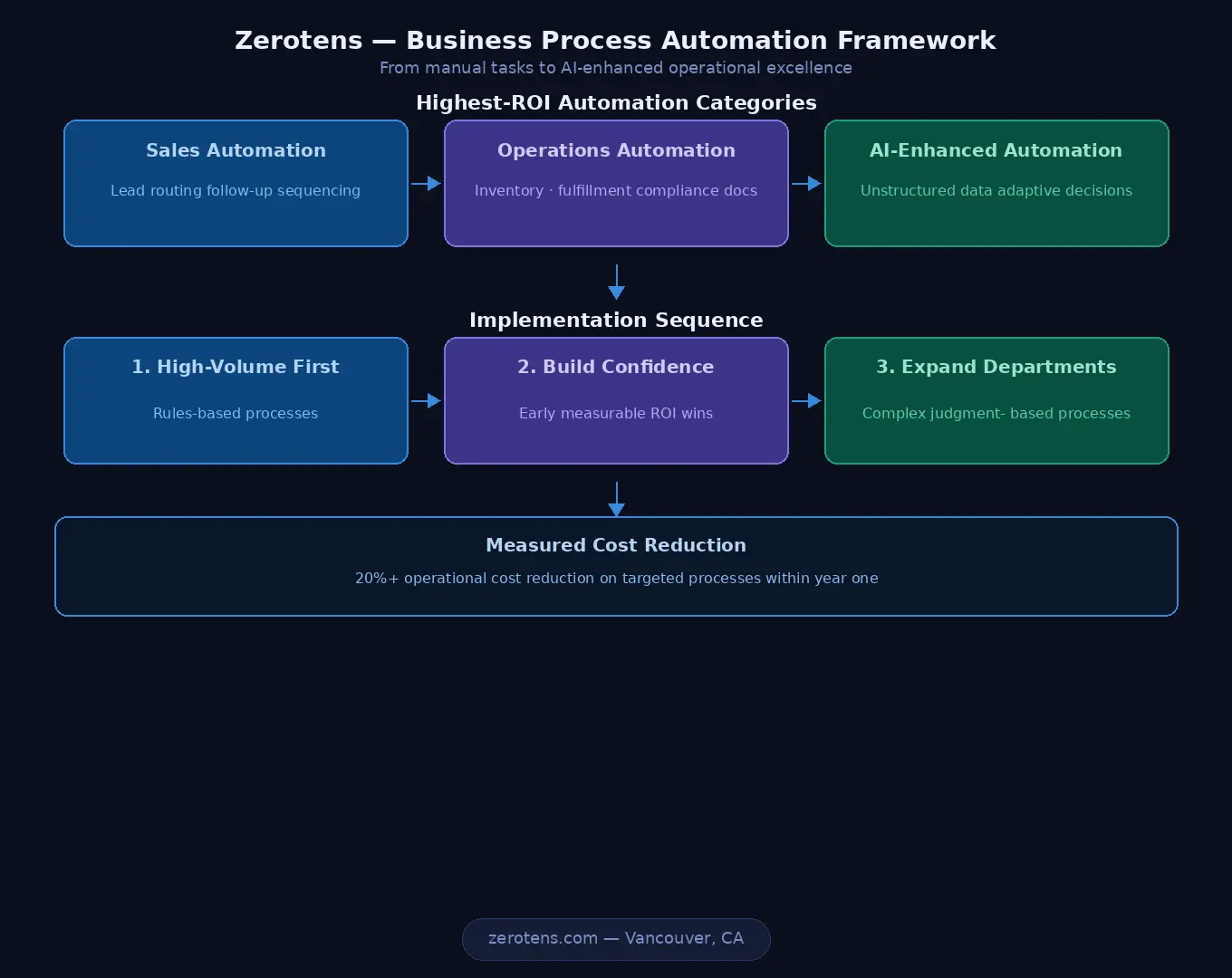
The fastest-ROI applications of business process automation consistently cluster around high-volume, rules-based processes where the decision logic is clear and repeatable. Invoice processing and approval routing, appointment scheduling and confirmation, customer onboarding documentation, and routine status reporting are among the process categories that Zerotens consistently finds deliver measurable time and cost savings within the first 90 days of implementation.
These quick-win automation targets share several characteristics: they involve high transaction volumes that justify the setup investment, they follow predictable decision logic that rules-based systems can reliably replicate, they do not require the contextual judgment or relationship sensitivity that makes automation inappropriate for certain customer-facing interactions, and they consume skilled staff time that could be more valuably redirected elsewhere in the organization.
Sales Automation
Sales automation addresses the administrative burden that consumes significant sales team capacity without directly contributing to revenue generation — lead routing, follow-up sequencing, proposal generation, and CRM data entry. For Vancouver businesses with growing sales teams, automating these processes typically returns 5 to 8 hours per week per sales representative to actual selling activity, a direct and easily measured productivity gain.
The commercial impact of this time recovery extends beyond the immediate productivity gain. Sales representatives who spend more time in genuine customer conversations typically develop stronger customer relationships, identify additional needs more consistently, and close at higher rates than those whose selling time is continuously interrupted by administrative tasks. Business process automation in the sales context is therefore both a cost efficiency measure and a revenue performance improvement — making it among the most compelling automation investment categories for Canadian B2B businesses.

Operations Automation
Operations automation targets the coordination and documentation processes that consume administrative and operational staff capacity — inventory reconciliation, shipping and fulfillment status updates, compliance documentation, and internal reporting. For Canadian businesses managing complex operational workflows, operations automation reduces both the time burden and the error rate associated with manual data handling across these high-volume coordination tasks.
Error reduction is frequently the most financially significant benefit of operations automation in manufacturing and distribution environments, where manual data entry errors cascade into inventory discrepancies, fulfillment mistakes, and customer service issues whose total cost can significantly exceed the direct administrative cost of the processes they corrupt. Zerotens has documented error rate reductions of 70% or more in inventory reconciliation and order processing processes following business process automation implementation, producing downstream cost savings that dwarf the direct time savings.
How Business Process Automation Reduces Operational Costs
Business process automation reduces operational costs through two primary mechanisms: direct labor cost avoidance on tasks that no longer require manual handling, and error reduction that prevents the downstream costs associated with mistakes in manual data entry and process execution. Both mechanisms compound as transaction volume grows, since automated processes handle increased volume without the proportional cost increase that scaling a manual process requires.
Zerotens has observed across its Vancouver client base that well-implemented business process automation typically delivers cost reductions of 20% or more on targeted processes within the first year, driven by a combination of reduced labor hours and meaningfully lower error-related rework costs that manual processes inevitably accumulate at scale. This 20% figure represents an average across diverse process categories — individual high-value automation targets frequently deliver substantially stronger returns.
Scaling Without Proportional Headcount Growth
The most strategically significant cost reduction delivered by business process automation is not the savings on existing processes but the elimination of the headcount growth that would otherwise be required to maintain operational capacity as the business scales. For a Vancouver business growing 30% annually without automation, operational headcount typically needs to grow at a similar rate to maintain service levels — consuming the majority of the revenue growth the business is achieving in additional salary and benefits expense.
Business process automation breaks this coupling between revenue growth and administrative headcount growth, allowing the operational capacity of the business to scale significantly beyond its current level without proportional staff additions. A business that automates its core operational processes effectively can often grow 2 to 3 times its current size before needing to add significant administrative headcount — a compounding efficiency advantage that becomes one of the most powerful levers of profitability improvement available to growing Canadian businesses.
How AI Enhances Business Process Automation
AI capability has meaningfully expanded what business process automation can accomplish, moving beyond simple rules-based automation into processes requiring judgment, pattern recognition, and adaptive decision-making that traditional automation tools could not handle. AI-enhanced automation can now process unstructured data — emails, documents, customer inquiries — extracting relevant information and routing it appropriately without requiring the rigid, predetermined rules that earlier automation technology demanded.
This AI enhancement extends business process automation into genuinely new territory for Canadian businesses — customer service automation that handles nuanced inquiries rather than only scripted responses, document processing that adapts to varied formats rather than requiring standardized inputs, and predictive automation that anticipates process needs based on historical patterns rather than only responding to explicit triggers.
Intelligent Document Processing
ZEROTENS INSIGHT
Let’s Build Something Smarter Together
AI Implementation Strategy: The Proven Secret to Faster, Smarter Business Transformation
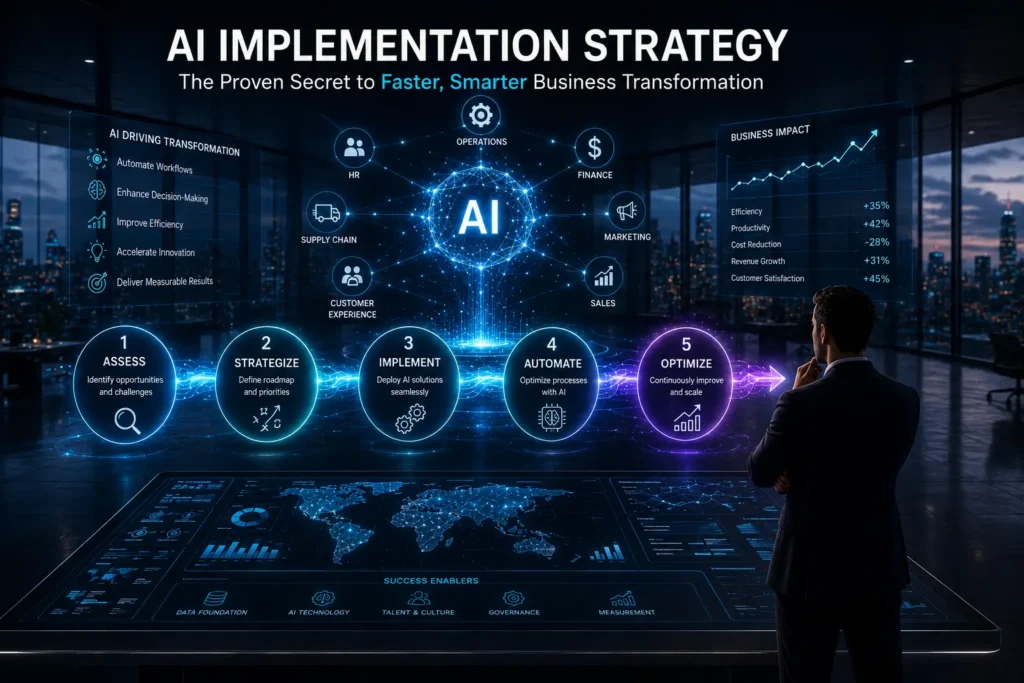
Intelligent document processing represents one of the most commercially significant AI automation applications for Canadian businesses — using machine learning models to extract structured data from unstructured documents like invoices, contracts, purchase orders, and regulatory submissions, regardless of format variations between different suppliers, clients, or issuing authorities.
For Vancouver businesses managing high volumes of incoming documents across diverse formats, intelligent document processing eliminates the manual data entry burden that standard document handling requires, replacing hours of human effort per day with automated extraction that delivers higher accuracy and processes documents at volumes no human team could match.
Implementing Business Process Automation Across Departments
Successful business process automation implementation requires a deliberate sequencing strategy rather than attempting comprehensive automation across every department simultaneously. Zerotens guides Canadian clients through a prioritization process that identifies the highest-volume, most rules-based processes first, building organizational confidence and measurable ROI before expanding automation into more complex or judgment-dependent process categories.
This phased approach also allows departments to adjust to automated workflows incrementally, reducing the change management burden that comprehensive, simultaneous automation across an entire organization would otherwise create. According to industry research across multiple sectors, organizations implementing automation through phased, measured rollouts consistently report stronger adoption and sustained usage than organizations attempting comprehensive automation transformation all at once.

FAQ — Business Process Automation
What is business process automation?
Business process automation uses technology, including AI-enhanced tools, to handle repetitive, rules-based business tasks — from invoice processing to customer onboarding — without requiring manual execution by employees for every individual instance.
How does business process automation increase efficiency?
Automation increases efficiency by handling high-volume, repetitive tasks faster and more consistently than manual execution, while freeing skilled employees to focus on strategic and judgment-dependent work that actually drives business growth.
What business processes should be automated first?
The highest-ROI automation candidates are high-volume, clearly rules-based processes including invoice processing, appointment scheduling, lead routing, and routine reporting — processes where decision logic is consistent and repeatable.
Can AI improve business process automation?
Yes — AI extends automation beyond simple rules-based tasks into processes requiring judgment and pattern recognition, including unstructured document processing and adaptive customer service automation that traditional automation tools could not handle.
How does Zerotens implement business process automation?
Zerotens uses a phased implementation approach, prioritizing high-volume processes first to build measurable early wins, then expanding automation into more complex departmental workflows based on validated results and organizational readiness.
Building Sustainable Competitive Advantage
For Canadian businesses across all sectors, the underlying theme connecting technology investment success and failure is consistent: investments grounded in specific business outcome definition consistently outperform investments driven by technology enthusiasm, vendor persuasion, or competitive imitation. Zerotens builds this outcome-first discipline into every engagement, ensuring that the technology work it delivers is always in service of a specific, measurable commercial objective that the client has validated before investment begins.
The Canadian regulatory environment adds specific dimensions to technology investment decisions that businesses operating exclusively in the US market need not consider. PIPEDA compliance requirements for customer data handling, provincial employment standards that affect automation rollout decisions, and bilingual requirements in federally regulated industries all represent Canadian-specific constraints that technology investments must be designed to accommodate from the outset rather than retrofitted after implementation.
Zerotens’ Canadian market expertise means these regulatory and market-specific considerations are incorporated into every recommendation and implementation design rather than discovered as complicating factors after development has begun. For Vancouver businesses operating in British Columbia’s specific regulatory environment, this local expertise translates into implementations that work within Canadian legal and business context from day one.
The compounding nature of well-executed technology investment is among the most important concepts for Canadian business leaders to internalize when evaluating technology spending. A technology investment that delivers 20% operational cost reduction in year one does not simply save 20% per year indefinitely — it creates a cost structure advantage that compounds as the business grows, allowing it to scale to higher revenue levels before needing to add the administrative headcount that competitors without equivalent automation must hire to maintain the same operational capacity.
Building a coherent technology investment roadmap requires discipline across multiple organizational dimensions simultaneously — financial planning that allocates appropriate budget to technology investment without creating cash flow risk, talent development that builds internal capability to manage and optimize technology systems, change management that prepares the organization to adopt new approaches without productivity disruption, and governance that maintains strategic alignment between technology decisions and business objectives.
Understanding the commercial context in which technology investments are made is essential for ensuring that the resulting implementations deliver value rather than simply creating technical capability that the organization is not ready to use. The most sophisticated technology deployed in an organizationally unprepared environment consistently underdelivers against expectations, while well-planned technology deployed in an organizationally prepared environment consistently exceeds them. Preparation and planning are not optional components of technology investment — they are the primary determinants of whether the investment ultimately succeeds or fails to deliver its intended value.
The relationship between technology investment quality and business outcome quality is more direct and more measurable than most Canadian business leaders have historically appreciated. Organizations that invest in rigorous technology strategy, implementation planning, and change management before selecting and deploying technology systems consistently report stronger ROI, faster value realization, and higher sustained adoption rates than those that prioritize speed of deployment over quality of preparation.
Canadian businesses that have successfully navigated technology transformation share several common characteristics: they invested in understanding the problem before selecting a solution, they planned for organizational change alongside technical implementation, they established clear success metrics before deployment began, and they committed to ongoing optimization rather than treating deployment as the end of the implementation journey. These disciplines are not complex or expensive — but they are consistently absent in the organizations whose technology investments fail to deliver expected returns.
For growing Canadian businesses at every stage of their technology journey, the most valuable investment is not always the most technically sophisticated one — it is the one that most precisely addresses the specific operational or competitive challenge currently limiting growth. This precision requires honest diagnostic work before investment decisions are made, and it requires the discipline to resist the appeal of technologies that are impressive but tangentially related to the actual business challenge at hand. Zerotens brings this diagnostic discipline to every engagement, ensuring technology investments address genuine business priorities rather than general aspirations for modernization.
For growing Canadian businesses at every stage of their technology journey, the most valuable investment is not always the most technically sophisticated one — it is the one that most precisely addresses the specific operational or competitive challenge currently limiting growth. This precision requires honest diagnostic work before investment decisions are made, and it requires the discipline to resist the appeal of technologies that are impressive but tangentially related to the actual business challenge at hand. Zerotens brings this diagnostic discipline to every engagement, ensuring technology investments address genuine business priorities rather than general aspirations for modernization.
For growing Canadian businesses at every stage of their technology journey, the most valuable investment is not always the most technically sophisticated one — it is the one that most precisely addresses the specific operational or competitive challenge currently limiting growth. This precision requires honest diagnostic work before investment decisions are made, and it requires the discipline to resist the appeal of technologies that are impressive but tangentially related to the actual business challenge at hand. Zerotens brings this diagnostic discipline to every engagement, ensuring technology investments address genuine business priorities rather than general aspirations for modernization.
Conclusion
Business process automation has become a baseline operational requirement for Canadian businesses seeking to scale without proportionally increasing administrative costs. The combination of rising labor costs and increasingly accessible automation technology, including AI-enhanced capability, makes automation one of the clearest, most measurable operational investments available to growing organizations today.
Zerotens implements business process automation for Vancouver and Canadian businesses through a phased, ROI-focused approach that delivers measurable results quickly while building toward more comprehensive operational transformation across every department. The businesses that invest in this capability today are building an operational foundation that will support their next stage of growth without the administrative bottlenecks that constrain organizations still relying on manual coordination for processes automation can handle more effectively.
Let’s Build Something Smarter Together → click