
Introduction:
An AI implementation strategy is the single factor that most reliably separates Canadian businesses that extract genuine, compounding commercial value from artificial intelligence from those that accumulate a growing collection of disconnected AI tools without measurable return on their investment. The technology itself has become widely accessible — any business can subscribe to an AI platform, run a pilot project, or deploy a chatbot. What remains scarce is the strategic discipline to sequence, integrate, and measure those tools against specific business outcomes rather than deploying them in response to vendor pressure or competitive anxiety.
This gap between AI spending and AI results is not a minor inefficiency. Organizations that approach AI adoption without coherent planning frequently discover, 12 to 18 months and significant budget later, that they have purchased capable technology solving problems the business does not actually have — or have failed to build the data infrastructure and organizational change management required to support the tools they selected. These are not technology failures. They are planning failures, and they are entirely preventable when the right strategic groundwork is laid before a single platform is evaluated.
For Vancouver businesses navigating digital transformation in 2026, building a rigorous AI implementation strategy before selecting tools is the difference between AI investment that pays for itself within months and AI investment that quietly joins the long list of technology initiatives that underdelivered. This article examines what an effective AI implementation strategy includes, the failure patterns it prevents, and how Zerotens builds strategies that deliver measurable, compounding results for Canadian organizations.
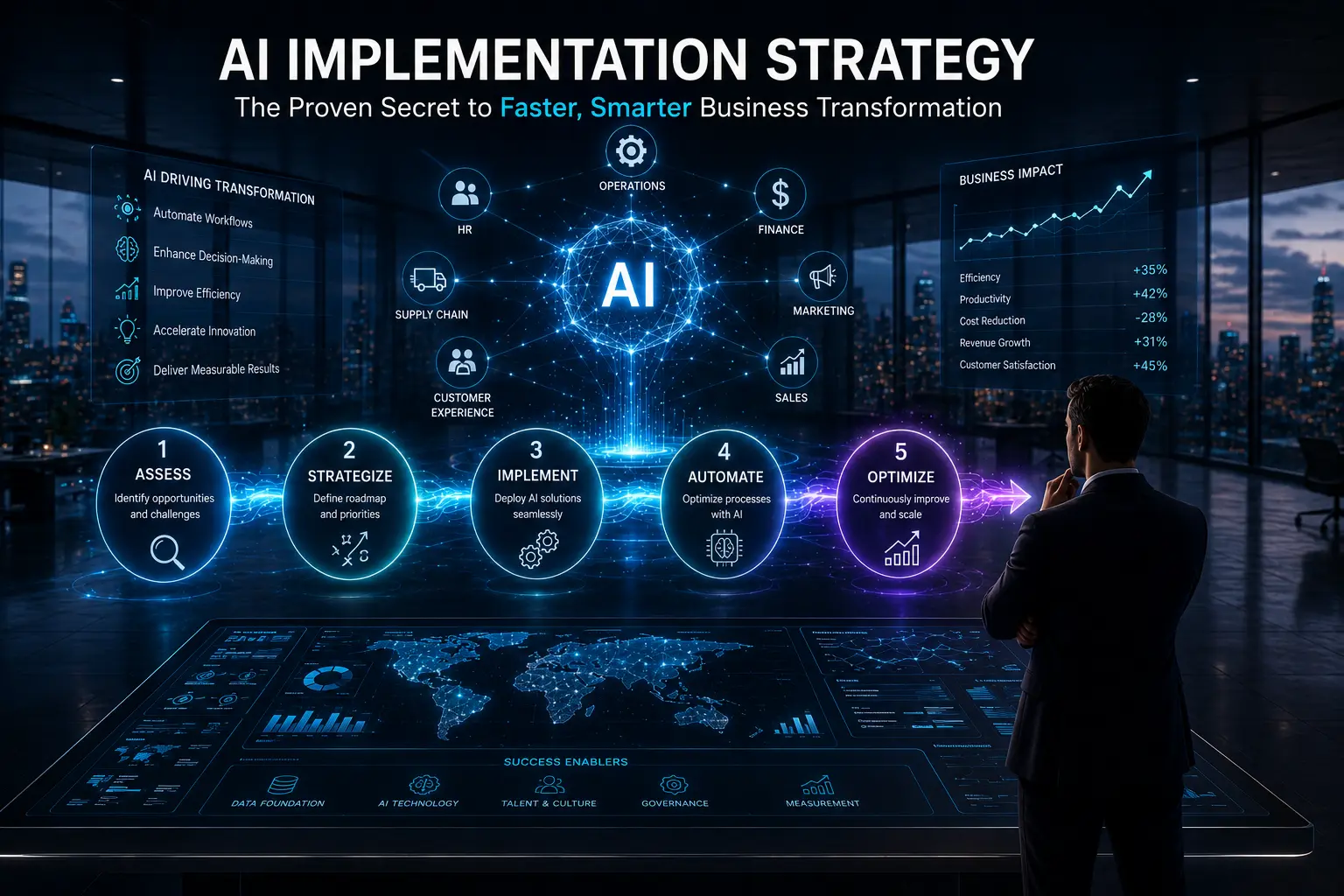
What Is an AI Implementation Strategy and Why Does It Matter?
An AI implementation strategy is a structured plan that connects every AI technology decision directly to specific, measurable business outcomes — revenue growth, cost reduction, risk management, or competitive differentiation — and defines the sequence, data infrastructure requirements, organizational change management needs, and success metrics governing implementation before a single tool is evaluated or purchased. The distinction between organizations that have this plan and those that do not shows up immediately in how they begin: organizations with a genuine strategy start by defining the problem; organizations without one start by evaluating software.
This distinction produces fundamentally different commercial outcomes. A sound AI implementation strategy ensures technology investment is built on validated problem definition, confirmed data readiness, and organizational capacity for change — the three foundational conditions that determine whether any AI deployment delivers value in practice. Without these conditions in place before technology selection begins, even excellent AI platforms deployed by capable teams will consistently underdeliver against the expectations that justified the investment.
The Business Case for Strategy Before Technology Selection
The financial case for investing in a thorough AI implementation strategy before beginning any technology evaluation is built on a straightforward cost calculation. A rigorous AI implementation strategy phase — comprehensive problem definition, data readiness assessment, organizational change planning, and success metric definition — is almost always a small fraction of the total implementation investment. Discovering mid-implementation that foundational conditions were not met typically costs as much or more than the entire implementation investment to that point, plus the additional work required to correct direction once development is already underway.
Zerotens’ engagements consistently reveal that clients who previously attempted AI adoption without this foundational work have not simply lost money on failed implementations. They have also eroded the organizational confidence that would have supported more ambitious future initiatives — making the strategic failure more expensive in the long run than the immediate financial loss alone suggests.
The Compounding Advantage of Strategic Discipline
Beyond preventing avoidable costs, a genuine AI implementation strategy creates a compounding competitive advantage for Canadian businesses that execute it well. Organizations that sequence their AI investments strategically — beginning with the highest-impact, most implementation-ready applications and using the capability built during those initial implementations to support progressively more ambitious subsequent ones — consistently pull further ahead of competitors still recovering from unstrategic early investments.
A Vancouver business that builds strategic discipline now and executes its first 3 AI implementations successfully will be in a fundamentally stronger competitive position 18 months from now than a competitor that has spent the same total budget on poorly planned AI experiments that delivered neither commercial results nor organizational AI capability. The gap compounds with every implementation cycle.
The Four Failure Patterns an AI Implementation Strategy Prevents
Understanding why AI implementations fail is essential for building an AI implementation strategy that avoids those failures. The most common failure mode is not technical — leading AI platforms are genuinely capable, and the specific tool selected matters far less than the strategic and organizational conditions into which it is deployed. The most common failures are strategic and organizational: problem definition too vague to guide technology selection, data infrastructure insufficient to support planned capability, change management treated as an afterthought, and success metrics defined after deployment rather than before it.
Failure Pattern 1 — Tool Before Problem
The most common failure in AI adoption is selecting a technology before precisely defining the problem that technology is meant to solve. This pattern is particularly common when AI adoption is driven by competitive pressure — when a business leader hears that competitors are using AI and initiates a program in response, without first identifying which specific business problem that program should address. A sound AI implementation strategy reverses this sequence completely, requiring rigorous problem definition and commercial impact quantification before any platform evaluation begins.
Failure Pattern 2 — Data Readiness Assumptions
Almost every AI implementation failure involves a data readiness assumption that proved false. AI capability depends fundamentally on the quality, completeness, and accessibility of the data available to the AI system — and most Canadian businesses significantly overestimate how ready their existing data infrastructure is to support the applications they plan to deploy. A rigorous planning process includes a data readiness assessment that identifies not just whether the required data exists, but whether it is clean, consistently formatted, accessible to AI systems, and present in sufficient volume to support the planned application at the accuracy level the business case requires.
The data readiness assessment frequently reveals that foundational infrastructure work must be completed before AI development can begin — work that was never budgeted for because it was never identified as necessary. Identifying this requirement during the planning phase rather than mid-implementation is one of the most significant practical financial benefits of proper AI implementation strategy.
Failure Pattern 3 — Change Management as Afterthought
AI implementations that succeed technically but fail commercially almost always share one characteristic: organizational change management was treated as something to address after deployment rather than a parallel workstream running from the beginning. Staff who do not understand what the AI system is doing, do not trust its outputs, or do not know how to integrate it into their workflows will work around it rather than with it — and an AI system that is not used does not deliver value regardless of its technical quality or the size of the investment that produced it.
Failure Pattern 4 — Unmeasured Outcomes
AI implementations without predefined success metrics cannot be honestly evaluated after deployment — only rationalized. A well-built AI implementation strategy requires that specific, quantifiable success metrics be defined and baseline measurements captured before any development begins, so that commercial impact can be attributed accurately and the investment justified or redirected based on actual evidence. This measurement discipline is what converts AI implementation from a technology project into a genuine business investment with accountable, reviewable returns.
Building an AI Implementation Strategy That Delivers Results
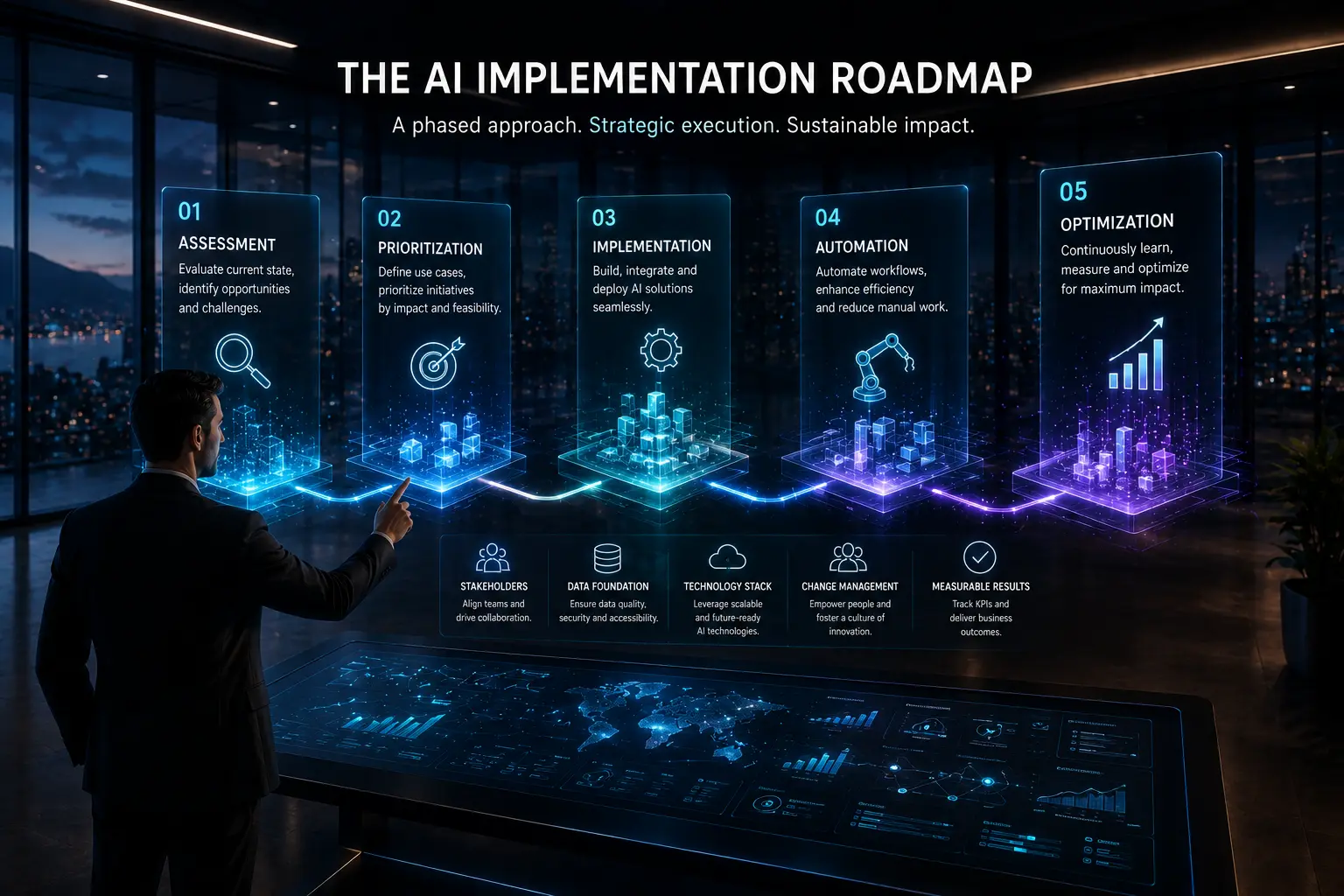
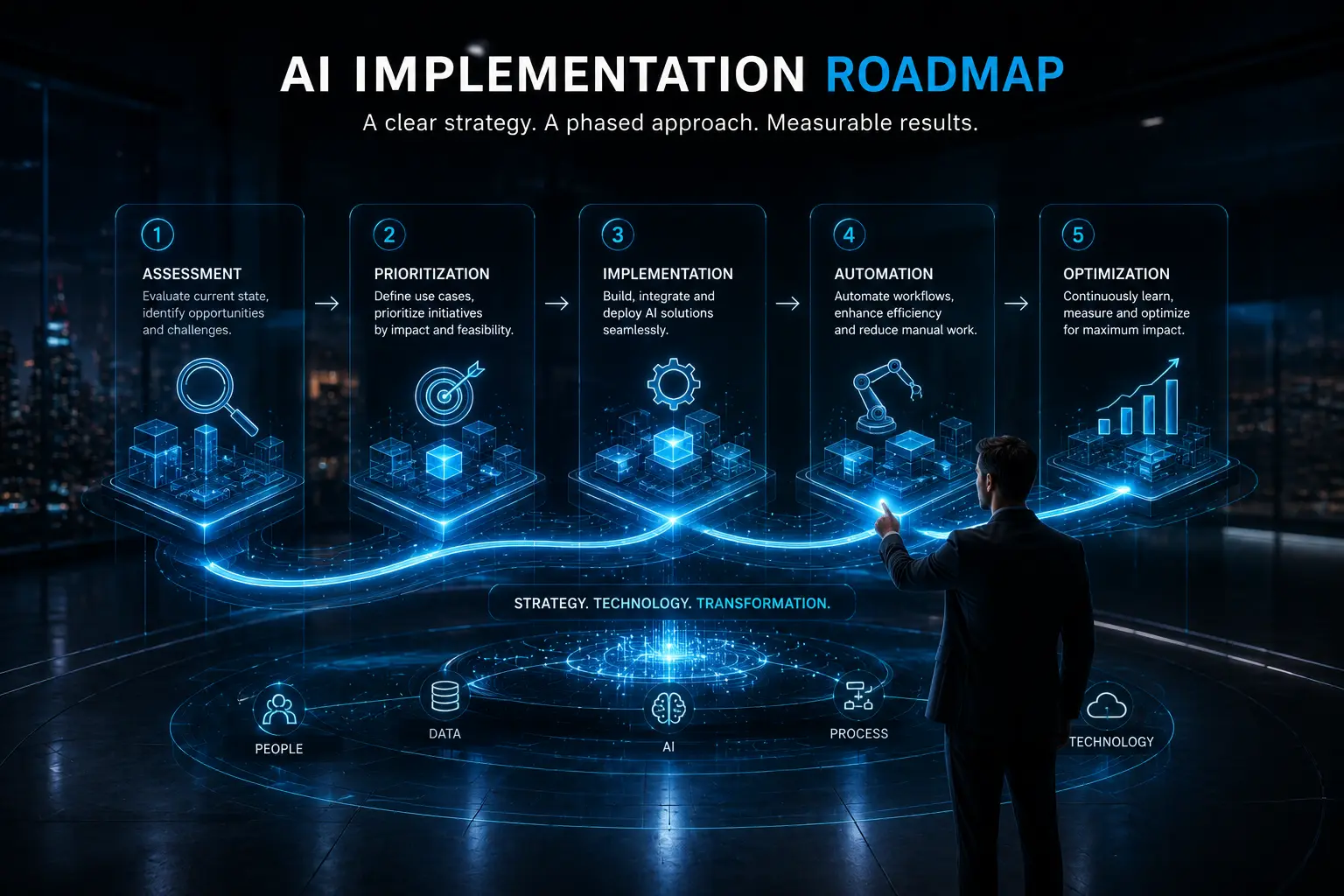
An effective AI implementation strategy progresses through a structured sequence of decisions and activities, each building on the validated outputs of the phase before it rather than proceeding on assumption. Zerotens’ framework for Canadian businesses moves through 5 phases: opportunity identification and prioritization, technology-agnostic solution design, data infrastructure assessment and preparation, phased implementation planning, and measurement framework construction. This AI implementation strategy sequence matters because each phase produces outputs that the subsequent phase requires — and skipping or compressing any phase consistently creates the conditions for the failure patterns described above.
Opportunity Identification and Commercial Prioritization
The opportunity identification phase maps the specific processes, decisions, and customer interactions where AI application would most significantly improve commercial performance — and quantifies that improvement in revenue impact, cost reduction, or risk reduction that can be expressed in financial terms. This quantification is what allows the AI implementation strategy to prioritize investments in a defensible order rather than implementing whatever the technology team finds most interesting or whatever the vendor most aggressively promotes during the sales process.
For Vancouver businesses across professional services, technology, real estate, and distribution sectors, this prioritization phase consistently surfaces 3 to 5 high-confidence, high-impact AI applications that were not previously being pursued — applications overlooked because the organization was evaluating AI through the lens of available technology rather than through the lens of specific business performance gaps that intelligent systems could measurably close.
Technology-Agnostic Solution Design
One of the most important disciplines within a genuine AI implementation strategy is maintaining technology-agnosticism during the solution design phase — designing what the AI system must do before evaluating which platforms or tools can do it. This discipline is structurally resisted by the commercial incentives of the technology market, where vendors benefit from engaging clients early in the evaluation process and shaping solution design around their platform’s capabilities rather than the client’s actual requirements.
Zerotens maintains technology-agnostic solution design as a foundational commitment, ensuring that clients receive platform recommendations reflecting actual requirements rather than vendor relationships. This independence is particularly valuable for Canadian businesses that lack internal AI expertise to evaluate vendor claims critically — and therefore benefit significantly from advisory relationships that are not financially entangled with any technology provider.
Phased Implementation for Managed Risk
An AI implementation strategy that attempts to deploy multiple AI applications simultaneously simultaneously across an organization rarely succeeds — the organizational change management burden, competing demands on technical resources, and coordination complexity consistently exceed organizational capacity. A properly designed AI implementation strategy phases deployment sequentially, beginning with the highest-impact, most implementation-ready application and building organizational capability and confidence through its successful delivery before proceeding to subsequent ones.
This phased approach serves 2 commercial objectives simultaneously. First, it delivers demonstrable results from early implementations that build organizational support and budget confidence for subsequent initiatives. Second, it builds data infrastructure, AI fluency, and implementation process knowledge during early phases that reduces the cost and complexity of later ones — making the overall program progressively more efficient as it advances through the roadmap.
How Zerotens Builds AI Implementation Strategies for Canadian Businesses
Zerotens’ AI implementation strategy practice serves Canadian businesses across the growth spectrum — from Vancouver startups deploying their first AI application to established national organizations undertaking comprehensive AI transformation programs. The common thread across every AI implementation strategy engagement is foundational discipline of problem definition, impact quantification, and organizational readiness assessment before any technology recommendation is made.
Every engagement begins with a discovery phase that maps the organization’s current operations, identifies performance gaps addressable through AI, and assesses the data infrastructure and organizational capability that any deployment must build on. This discovery typically takes 2 to 4 weeks depending on organizational complexity, and produces the AI implementation strategy document governing everything that follows — ensuring substantial development, integration, and change management investments are made in the right direction from the very first week of implementation.
AI Consulting as the Foundation of Successful Implementation
Zerotens approaches AI implementation strategy as an AI consulting engagement before it is a technology engagement — providing expert guidance that allows Canadian businesses to navigate AI adoption decisions with confidence rather than uncertainty. This consulting orientation means involvement typically begins before any technology vendor has been engaged, which is precisely when advisory input delivers the most value: when full flexibility exists to design the right solution for the specific problem rather than adapting an available solution to an approximation of what the business actually needs.
According to the IBM Institute for Business Value, organizations with formal AI governance frameworks and structured implementation strategies consistently report significantly stronger financial returns from AI investment than organizations that approach AI adoption without equivalent strategic discipline — reinforcing the commercial case for investing in a thorough AI implementation strategy before technology selection begins.
Measuring Success and Evolving the Strategy
A Zerotens AI implementation strategy includes a measurement framework defining specific commercial success metrics for each planned AI application, establishing baseline measurements that allow impact attribution, and specifying the review cadence at which strategy assumptions will be tested against actual results. This measurement infrastructure is not bureaucratic overhead — it is the mechanism by which the plan remains connected to commercial reality rather than drifting toward technical achievement divorced from business outcomes.
The AI implementation strategy also includes planned evolution points — scheduled reviews at which the overall approach is reassessed against what has been learned from completed implementations, changes in the external AI technology landscape, and shifts in organizational priorities. An approach built in 2026 will need to evolve as machine learning capability advances, as the organization’s own AI maturity deepens, and as the competitive landscape shifts across every sector in which Canadian businesses operate. ZEROTENS INSIGHT
Let’s Build Something
Smarter Together
AI Agent Development: Future-Proof Your Business with Powerful Autonomous AI Solutions
Common Mistakes Canadian Businesses Make Without a Proper AI Strategy
The most expensive mistake Canadian businesses make in AI adoption is conflating AI experimentation with AI strategy. Running pilots, testing platforms, and exploring use cases all have value — but they are not substitutes for a disciplined AI implementation strategy that connects technology investment to commercial outcomes and organizational readiness. Businesses that mistake exploration for strategy consistently find themselves 18 months into AI spending with no coherent picture of which investments are working, which have failed, and which should be scaled.
Vendor-Led Versus Strategy-Led AI Adoption
A significant proportion of Canadian AI implementations are vendor-led rather than strategy-led — meaning the adoption roadmap was shaped by what a technology vendor was selling rather than by what the business most needed to solve. Vendor-led adoption produces capable technology solving the problems the vendor’s platform was designed to address, which are not always the problems the business most urgently needs to solve. A proper AI implementation strategy reverses this dynamic — and the AI implementation strategy framework by defining requirements independently before engaging any vendor, ensuring platform evaluation is structured around client needs rather than vendor capabilities.
Zerotens has guided numerous Vancouver businesses through reassessing vendor-led AI implementations that were not delivering expected returns, in most cases identifying that the underlying AI technology was sound but that the problem-solution fit was weak because the business case was constructed around vendor demonstration capabilities rather than a genuine organizational needs assessment. Correcting this misalignment after development is significantly more expensive than preventing it through rigorous pre-investment planning.
Scaling Prematurely Before Validating the Approach
Another common and costly mistake is scaling AI deployment before validating that the initial implementation actually works as expected in production conditions — with real users, real data quality variations, and real edge cases that controlled pilots never expose. An AI implementation strategy that is working correctly includes explicit validation gates between pilot and production, and between initial production and broader organizational scaling, where measured evidence of commercial performance is required before additional investment is committed to expanding the deployment.
These validation gates are not bureaucratic delays — they are the mechanism that prevents the compounding cost of scaling an implementation that has not actually been proven in practice. The businesses that execute a rigorous AI implementation strategy and validate at each stage consistently reach full-scale capability faster at each stage rather than those that moved fastest from pilot to enterprise deployment.
The Future of AI Transformation for Canadian Businesses
The most significant development shaping the evolution of AI adoption for Canadian businesses over the next 2 to 3 years is the emergence of agentic AI — autonomous systems capable of executing complete multi-step business workflows with minimal human intervention. As this capability matures and becomes commercially accessible, the scope of what a sound AI implementation strategy must address will expand significantly: from optimizing individual AI-assisted decisions to designing complete AI-managed workflows that operate autonomously across entire business processes.
Canadian businesses that have built strong strategic discipline through their current generation of AI implementations will be substantially better positioned to capture agentic AI capabilities than those attempting to jump from no coherent strategy directly to autonomous AI workflows. The data infrastructure, organizational AI fluency, measurement discipline, and strategic governance processes built through successful current-generation implementations are the same foundational conditions that agentic AI deployments will require.
Positioning for Long-Term AI Advantage
Zerotens designs every AI implementation strategy with the organization’s long-term AI transformation trajectory in mind, not just the immediate requirements of the first 1 or 2 applications. This means building data architectures that can support more sophisticated AI applications than the current implementation requires, designing integration layers that can accommodate additional AI systems without fundamental rebuilding, and building organizational AI governance structures that can scale as the breadth of intelligent systems deployment across the organization expands over time.
For Vancouver businesses competing against both domestic rivals and better-resourced US organizations, this long-term strategic positioning represents one of the most important uses of the planning engagement. The businesses that build AI capability with a 3 to 5 year horizon in mind — rather than solving only for the next immediate implementation — consistently establish more durable and more competitively significant advantages than those optimizing only for the next quarter’s deliverable.
FAQ — AI Implementation Strategy
What is an AI implementation strategy?
An AI implementation strategy is a structured plan connecting AI technology decisions to specific business outcomes — covering opportunity identification, technology selection, data readiness, change management, and success measurement before any development begins. It ensures every AI investment serves a clearly defined commercial purpose.
Why do businesses need an AI implementation strategy?
Without a structured AI implementation strategy, businesses frequently select tools before defining the problems they need to solve — resulting in capable technology that fails to deliver measurable returns because the foundational commercial, data, and organizational conditions for value delivery were never established before development began.
What are the stages of an effective AI implementation plan?
An effective plan progresses through opportunity identification and prioritization, technology-agnostic solution design, data readiness assessment, phased implementation planning with validation gates, and measurement framework construction — each phase building on confirmed outputs from the previous one rather than on untested assumptions.
How do you measure AI implementation success?
Success requires establishing specific baseline metrics before implementation begins, then tracking commercial outcomes — revenue impact, cost reduction, or efficiency gains — directly attributable to each AI deployment. Metrics defined after deployment cannot reliably distinguish AI impact from other concurrent business changes.
How does Zerotens build AI implementation strategies?
Zerotens begins with organizational discovery and opportunity quantification, maintains technology-agnostic solution design throughout the strategy phase, provides AI consulting guidance independent of any vendor relationships, and builds measurement frameworks into every engagement — delivering commercial results rather than technology for its own sake.
Ready to turn AI into a strategic business advantage? Connect with Zerotens to build a customized AI implementation strategy that aligns technology, data, and business goals—ensuring every AI investment delivers measurable results and long-term growth.
Conclusion
An AI implementation strategy is the foundational investment that determines whether AI adoption becomes a genuine competitive advantage for Canadian businesses or an expensive series of experiments that generate lessons rather than returns. For Vancouver businesses in 2026, the discipline of building a rigorous plan before beginning technology selection is the single most reliable predictor of whether AI investment will deliver compounding commercial value or join the long list of technology initiatives that underdelivered against their initial promise.
Zerotens builds AI implementation strategies for Canadian businesses that prioritize commercial outcomes, organizational readiness, and measurable success from the first planning conversation. Every technology recommendation serves a clearly defined business purpose rather than a general aspiration toward AI adoption. The organizations that invest in this strategic discipline consistently outperform those that rush to technology — because a sound plan converts AI potential into AI performance.
If your business is ready to invest in artificial intelligence that delivers measurable results rather than impressive demonstrations, an AI implementation strategy built with Zerotens is exactly where that journey begins.