
Introduction
Data analytics consulting is the discipline that separates Canadian businesses making decisions from Canadian businesses making the right decisions — and in 2026, that gap is worth more than any single marketing campaign, technology investment, or operational initiative a growing organization can pursue. Every business generates data. Customer interactions, marketing performance, operational metrics, financial flows, and user behavior all produce signals that contain the answers to the questions every leadership team is asking: where is growth coming from, where is it leaking, and where does the next strategic move need to land?
The problem is not a shortage of data. The problem is the absence of a coherent data analytics consulting framework that transforms raw data into the structured, actionable business insights that drive confident decisions. Most growing Canadian businesses sit on data warehouses full of untapped intelligence — running on gut instinct and lagging reports while the answers to their most pressing strategic questions exist, uncollected and uninterpreted, in systems they already own.
In Vancouver’s competitive business landscape, where technology adoption rates are among the highest in Canada and data-literate competitors are making faster, sharper decisions every quarter, the cost of operating without a professional data analytics consulting framework is not theoretical — it is measurable in market share lost, campaigns misfired, and opportunities missed because the intelligence to act on them arrived too late or not at all.
According to PwC’s Global Data and Analytics Survey, data-driven organizations are 3 times more likely to report significant improvements in decision-making than those relying on intuition and conventional reporting. Data analytics consulting is how Zerotens builds that capability into Canadian businesses — systematically, measurably, and at a pace that delivers strategic advantage before competitors close the gap. (PwC Global Data and Analytics Survey)

Why Data Analytics Consulting Is a Competitive Advantage
Data analytics consulting delivers competitive advantage through a mechanism that most businesses underestimate until they experience it directly: decision velocity. The speed at which an organization can move from business question to confident answer — backed by clean data, structured analysis, and meaningful visualization — determines how quickly it can act on market opportunities, correct course on underperforming initiatives, and allocate resources to the activities generating the highest return.
In the absence of data analytics consulting, decision velocity is constrained by the quality of available reporting. Most growing Canadian businesses rely on a combination of native platform reports — Google Analytics, CRM dashboards, accounting software exports — that were designed to answer the platform’s own questions rather than the strategic questions the business actually needs answered. A marketing team that wants to understand the true customer acquisition cost across all channels, including offline touchpoints, cannot answer that question from Google Analytics alone. A CEO who wants to understand which customer segments are driving lifetime value growth cannot find that answer in a standard CRM report.
Data analytics consulting builds the cross-platform, cross-functional analytics infrastructure that makes these questions answerable — connecting data sources, standardizing metrics, and delivering the unified business intelligence that leadership teams need to make decisions with confidence rather than approximation.
The Data Maturity Gap in Canadian Business
The competitive advantage created by data analytics consulting is amplified in the Canadian market by a structural reality: most Canadian businesses at the growth stage are operating well below their data maturity potential. A 2025 survey by the Information and Communications Technology Council of Canada found that fewer than 30% of Canadian mid-market businesses have implemented a formal analytics strategy — meaning that 70% of the competitive landscape is making decisions with incomplete, inconsistent, or simply unanalyzed data.
For Vancouver businesses competing in industries where margins are tight and customer acquisition costs are rising — e-commerce, professional services, SaaS, real estate technology — this data maturity gap represents a direct revenue opportunity. Every competitor operating without a professional data analytics consulting framework is leaving intelligence on the table that a data-mature organization can use to outpace them. Zerotens has built its data analytics consulting practice specifically to help Canadian businesses close this gap faster than their competitors — and to make the resulting analytical advantage a sustainable, compounding organizational capability.

Analytics Strategy as a Business Growth Lever
An analytics strategy is not a reporting plan. It is a deliberate architecture that connects the data an organization collects to the decisions that drive its growth — and data analytics consulting is the discipline of building that architecture with precision. Zerotens approaches analytics strategy development as a strategic exercise before it becomes a technical one: defining the key performance indicators that reflect genuine business health, identifying the data sources that feed those indicators, and designing the reporting infrastructure that surfaces insights at the moment and in the format decision-makers need them.
For Canadian businesses where data is currently dispersed across multiple platforms without integration — a scenario Zerotens encounters consistently across Vancouver’s technology, retail, and professional services sectors — an analytics strategy audit frequently reveals that the organization is measuring what is easy rather than what is important. Clicks are measured because platforms report them automatically. Customer lifetime value is not measured because no one has built the data pipeline that calculates it. Data analytics consulting reorients the measurement architecture toward the metrics that matter — and builds the infrastructure to make them available in real time.
How Data Analytics Consulting Improves Marketing Performance
Marketing is the business function where data analytics consulting delivers its most immediately visible commercial impact — and where the gap between data-driven and intuition-driven decision-making is most directly reflected in revenue outcomes. Digital marketing generates enormous volumes of performance data: impression rates, click-through rates, conversion rates, cost per acquisition, return on ad spend, email engagement, organic search performance, and social media metrics across every channel and campaign the organization operates.
The challenge is not collecting this data — every platform collects it automatically. The challenge is connecting it into a coherent analytics framework that answers the question every marketing leader needs answered: which of these activities is actually driving revenue, and which is consuming budget without commercial return? Without data analytics consulting, most marketing teams answer this question with a combination of last-click attribution models and platform-native reporting — a methodology that consistently overstates the value of bottom-funnel digital touchpoints and understates the contribution of awareness-stage and offline activities.
Multi-Touch Attribution and True Marketing ROI
Data analytics consulting transforms marketing performance measurement through multi-touch attribution modeling — the analytical discipline of assigning credit to every touchpoint in the customer journey rather than the last one before conversion. For Canadian businesses running integrated marketing programs across search, social, email, content, and offline channels, multi-touch attribution frequently produces a fundamentally different picture of marketing ROI than last-click models provide.
Zerotens has consistently found, across data analytics consulting engagements with Vancouver-based e-commerce and SaaS clients, that last-click attribution models overstate paid search ROI by an average of 40% — because they assign conversion credit to the bottom-funnel click while ignoring the awareness content, email nurture sequence, and organic search touchpoints that built the buying intent that made that click possible. When multi-touch attribution is implemented as part of a data analytics consulting framework, budget reallocations to higher-impact upper-funnel channels consistently produce 15 to 25% improvements in total marketing ROI within 2 campaign cycles.
For British Columbia businesses investing significant budgets in digital marketing — a category that includes the majority of Zerotens’ Vancouver client base — this improvement represents material revenue impact from an analytical intervention rather than an increase in marketing spend.
Performance Measurement Across the Full Customer Lifecycle
The most advanced application of data analytics consulting in marketing contexts extends performance measurement beyond the acquisition funnel into the full customer lifecycle — connecting marketing investment to customer retention, expansion, and lifetime value rather than stopping at the initial conversion event.
Zerotens builds performance measurement frameworks that track the commercial journey from first touch through acquisition, onboarding, retention, and expansion — making the relationship between marketing activity and long-term customer value visible for the first time in organizations that have previously measured marketing by conversion volume alone. This lifecycle view consistently identifies that the highest-lifetime-value customers acquired through certain channels — content marketing, referral programs, organic search — have significantly lower acquisition costs and longer retention periods than customers acquired through paid channels, even when the paid channels appear to deliver more conversions in short-term reporting.
Data analytics consulting that captures this full-lifecycle picture transforms not just how organizations measure marketing but how they allocate marketing investment — shifting budget toward the channels that build the most durable, most valuable customer relationships rather than the channels that optimize most efficiently for a single conversion event.

The Business Value of Data Analytics Consulting
The business value delivered by data analytics consulting operates across every function of an organization — not just marketing. Finance, operations, product development, customer success, and human resources all generate data that, properly structured and analyzed, produces the business insights that improve decisions, reduce costs, and accelerate growth. The organizations that treat data analytics consulting as a cross-functional capability rather than a marketing tool extract compounding value that single-function analytics implementations cannot approach.
Zerotens structures every data analytics consulting engagement around a business value mapping exercise that identifies the specific decisions in each organizational function where better data would produce better outcomes — and quantifies the commercial impact of making those decisions correctly versus incorrectly at the organization’s current scale. This exercise consistently reveals that the most valuable analytics opportunities in a growing Canadian business are not in the functions where data is most abundant but in the functions where decisions are most consequential and data quality is most lacking.
Dashboard Development
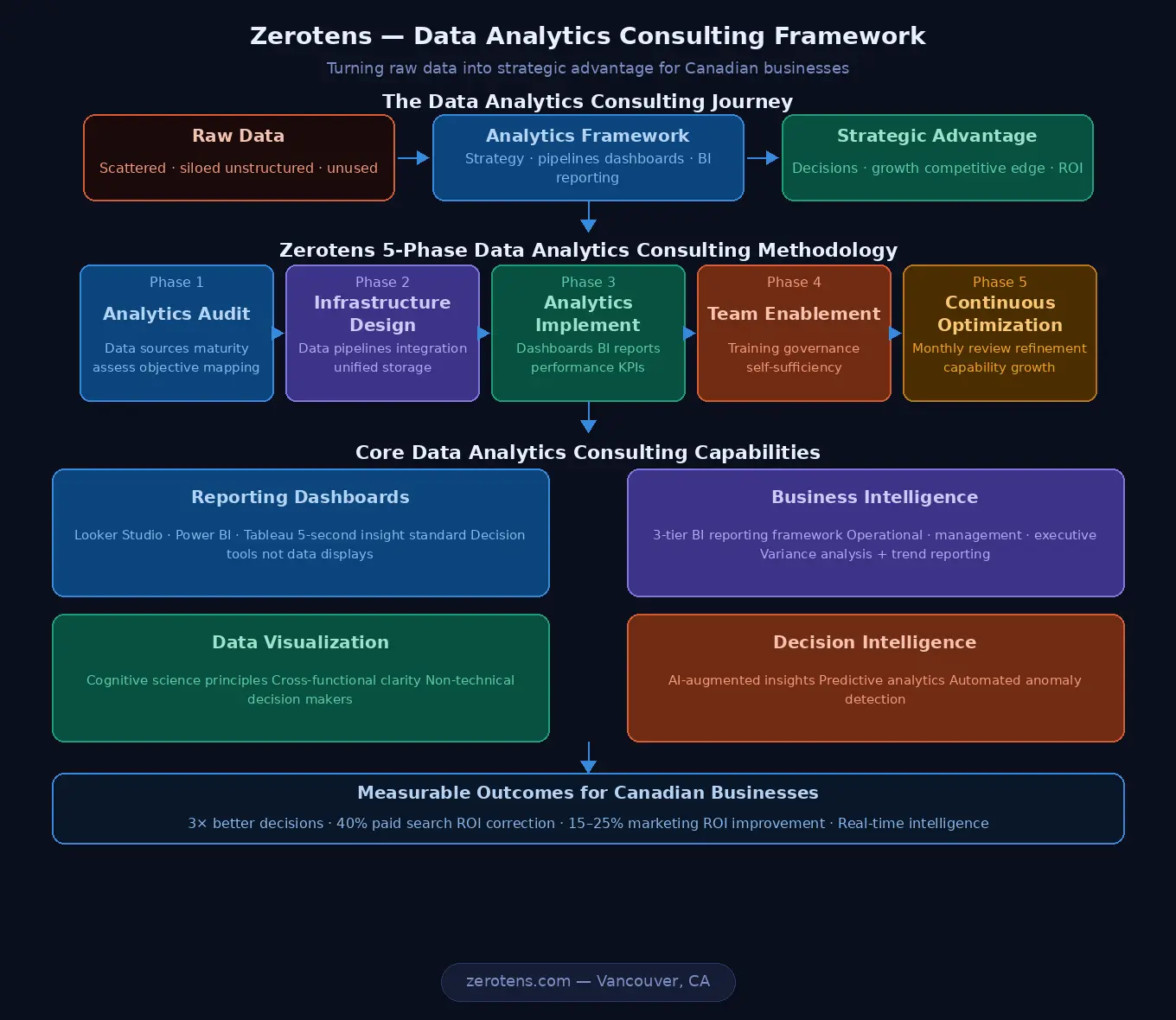
Reporting dashboards are the primary interface between a data analytics consulting framework and the humans who use it to make decisions — and the quality of dashboard design determines whether analytical intelligence is actually absorbed and acted upon or simply viewed and ignored. Zerotens builds reporting dashboards as decision tools rather than data displays — designing every dashboard around the specific decisions its users make and the specific questions those decisions require answers to.
The distinction matters enormously in practice. A data display shows metrics. A decision tool answers questions. A marketing dashboard that displays impressions, clicks, and conversion rates is a data display — it tells the user what happened but not what to do. A data analytics consulting dashboard that shows which campaign is generating revenue above target, which is consuming budget below efficiency threshold, and what action the data suggests for each is a decision tool — it surfaces the insight and points toward the response.
Zerotens builds reporting dashboards in tools including Looker Studio, Power BI, and Tableau — selected based on the client’s existing technology stack, team capability, and integration requirements. Every dashboard is built to the standard that a non-technical decision-maker can extract actionable business insights without analytical support — because a data analytics consulting framework that requires a data scientist to interpret for every meeting has not delivered self-sufficient analytical capability to the organization.
For Vancouver businesses where leadership teams are moving fast and analytical resources are limited, this self-sufficiency standard is the difference between a data analytics consulting investment that changes how decisions are made and one that produces beautiful reports that no one has time to interrogate.
Business Intelligence Reporting
Business intelligence reporting is the structured, recurring analytical output that keeps organizational leadership aligned with performance reality — and the foundation of the decision intelligence capability that data analytics consulting builds for Canadian businesses. Where reporting dashboards provide real-time visibility, business intelligence reporting provides the contextual, comparative, and trend-based analysis that transforms current performance data into forward-looking strategic insight.
Zerotens designs business intelligence reporting frameworks that deliver 3 tiers of analytical output. The first tier is operational reporting — daily and weekly performance summaries that keep functional teams informed about the metrics relevant to their immediate decisions. The second tier is management reporting — weekly and monthly business intelligence that gives leadership teams visibility across functions, with variance analysis, trend identification, and performance against strategic targets. The third tier is executive intelligence — monthly and quarterly analytical narratives that translate data into strategic recommendations, connecting performance trends to market context and organizational capacity.
This tiered business intelligence architecture ensures that data analytics consulting delivers value at every level of the organization simultaneously — from the marketing manager optimizing a campaign in real time to the CEO making a capital allocation decision based on a 12-month trend analysis. For Canadian businesses where the same leadership team is often operating across all 3 of these analytical horizons simultaneously, the clarity and coherence of a professionally designed business intelligence framework is itself a competitive advantage.
Building a Data-Driven Organization Through Data Analytics Consulting
The ultimate objective of data analytics consulting is not a set of dashboards or a reporting framework — it is an organizational culture where data is the default input to every significant decision, where analytical capability is distributed across functions rather than concentrated in a single team, and where the feedback loop between action and measurement is tight enough to drive continuous improvement at the pace the market demands.
Building this culture requires more than technology implementation. It requires the organizational change management that data analytics consulting at the Zerotens level incorporates as a standard component of every engagement — working with leadership teams to define what data-driven decision-making looks like in their specific organizational context, training functional teams on the analytical tools and frameworks that serve their specific decisions, and establishing the governance structures that ensure data quality, consistency, and accessibility across the organization over time.
NEW POSSIBILITY
Let’s Build Something Smarter Together
Enterprise AI Solutions: The Costly Mistake Most Growing Businesses Still Make

Data Visualization as Organizational Communication
Data visualization is the translation layer between analytical output and human understanding — and data analytics consulting that neglects visualization design produces insights that are technically correct but practically inaccessible to the decision-makers who need them. Zerotens applies data visualization principles drawn from cognitive science and information design to ensure that every analytical output produced for Canadian clients communicates clearly, efficiently, and without the interpretive burden that poorly designed data presentations impose.
The practical standard Zerotens applies to data visualization within every data analytics consulting engagement is what the team calls the 5-second test: a decision-maker should be able to identify the most important insight in any data visualization within 5 seconds of viewing it, without analytical training or contextual briefing. Visualizations that fail this test are redesigned — because a visualization that requires explanation is not a communication tool, it is a puzzle.
For Vancouver businesses where executive time is scarce and meeting cycles are short, this 5-second standard transforms how analytical output is consumed and acted upon — accelerating the decision velocity that data analytics consulting is ultimately designed to maximize.
How Zerotens Implements Data Analytics Consulting Solutions
Zerotens’ data analytics consulting implementation follows a structured 5-phase methodology that takes Canadian organizations from analytical baseline through to fully operational, self-sufficient data intelligence capability — built to serve the organization’s specific commercial objectives rather than a generic analytics template.
Phase 1 is the analytics audit and strategy phase — assessing the organization’s current data sources, measurement practices, and analytical maturity against its strategic objectives. Phase 2 is infrastructure design — building the data pipelines, integration architecture, and storage systems that consolidate organizational data into a unified, queryable foundation. Phase 3 is analytics implementation — developing the reporting dashboards, business intelligence reports, and performance measurement frameworks that surface insights for specific organizational decisions. Phase 4 is enablement — training the teams who will use the analytics infrastructure daily, establishing governance protocols, and ensuring that self-sufficient analytical capability is embedded across the organization. Phase 5 is continuous optimization — monthly analytics reviews, dashboard refinement, and capability expansion as the organization grows and its analytical requirements evolve.
Decision Intelligence for Vancouver’s Growth Businesses
Decision intelligence — the practice of combining data analytics consulting, machine learning, and behavioral science to improve the quality and consistency of organizational decision-making — represents the frontier of what Zerotens delivers to its most analytically mature Canadian clients.
For Vancouver businesses that have moved through the foundational phases of data analytics consulting and established reliable reporting and business intelligence infrastructure, decision intelligence represents the next level of analytical competitive advantage — AI-augmented insights that not only describe what has happened and why, but recommend what should happen next based on pattern recognition across the organization’s full historical dataset.
Zerotens has delivered decision intelligence capabilities for clients across British Columbia’s technology, professional services, and e-commerce sectors — integrating predictive analytics, automated insight generation, and AI-powered anomaly detection into data analytics consulting frameworks that evolve from reporting tools into genuine strategic intelligence systems. The organizations that reach this level of analytical maturity are not just making better decisions than their competitors — they are making decisions their competitors cannot yet see the need to make.

FAQ — Data Analytics Consulting Explained
1. What is data analytics consulting? Data analytics consulting is the professional service of building the strategy, infrastructure, and analytical frameworks that transform raw business data into actionable intelligence. It encompasses analytics strategy, dashboard development, business intelligence reporting, data visualization, and performance measurement — delivering decision intelligence that improves business outcomes at every organizational level.
2. How does data analytics consulting improve business decisions? Data analytics consulting improves business decisions by replacing intuition and lagging reports with real-time, cross-functional business insights grounded in clean, connected data. Organizations with mature analytics strategies are 3 times more likely to report significant improvements in decision-making — because they are answering the right questions with the right data at the right moment.
3. What tools are used in data analytics consulting? Zerotens’ data analytics consulting practice uses tools including Google Analytics 4, Looker Studio, Microsoft Power BI, Tableau, BigQuery, and custom data pipeline solutions — selected based on the client’s existing technology stack, budget, and analytical requirements. Every tool selection is driven by what best serves the organization’s specific decision intelligence needs.
4. What is the difference between analytics and business intelligence? Analytics examines data to understand what happened and why. Business intelligence structures that analysis into recurring, comparative reporting that tracks performance against strategic targets over time. Data analytics consulting integrates both — combining real-time analytical capability with structured business intelligence reporting to deliver a complete decision intelligence framework.
5. How does Zerotens provide data analytics consulting services? Zerotens delivers data analytics consulting through a 5-phase methodology: analytics audit and strategy, infrastructure design, analytics implementation, organizational enablement, and continuous optimization. Every engagement begins with a commercial outcome definition — ensuring the analytical framework delivers measurable business value aligned to the specific strategic objectives of each Canadian client.
Conclusion
Data analytics consulting is the capability that transforms data from a byproduct of business operations into the primary driver of business strategy — and for Canadian businesses competing in markets where decision velocity, marketing precision, and operational intelligence determine competitive outcomes, this transformation is no longer optional. The organizations that build professional data analytics consulting frameworks today are making decisions their competitors cannot yet make, at a speed their competitors cannot yet match, with a confidence their competitors cannot yet afford.
Zerotens builds data analytics consulting solutions that connect analytics strategy, reporting dashboards, business intelligence, data visualization, and decision intelligence into unified frameworks calibrated to the specific commercial realities of Canadian businesses, from Vancouver’s technology corridor to national organizations managing data complexity at enterprise scale. The result is not just better reporting. It is a fundamentally more intelligent organization, one where every significant decision is grounded in the business insights that data-driven capability makes available.
If your business is generating data but not extracting the strategic advantage it contains, data analytics consulting is exactly what closes that gap.