
Introduction
A data-driven SEO strategy is the difference between a business that ranks consistently and one that publishes content and hopes for the best. In 2026, search engines are more intelligent, more personalized, and more competitive than at any point in their history — and the brands winning search visibility are not the ones producing the most content. They are the ones producing the right content, at the right time, for the right audience, informed by data at every step of the process.

Traditional SEO operated on instinct and approximation. Keyword research meant identifying high-volume terms and building content around them. Success was measured in rankings, and rankings were pursued through a combination of on-page optimization and link building that prioritized quantity as often as quality. This approach worked in a simpler search environment — but it is systematically failing in one shaped by RankBrain SEO algorithms, AI-powered intent analysis, and answer engine models that evaluate content by the quality of its responses rather than the density of its keywords.
For Canadian businesses competing across Vancouver’s technology sector, Toronto’s financial services market, and the national e-commerce landscape, the gap between intuition-based SEO and a genuine data-driven SEO strategy is measurable in traffic, leads, and revenue. Businesses that have made the transition report not just higher rankings but more qualified traffic, lower cost per acquisition, and content assets that compound in value over time rather than depreciating as algorithm updates render their keyword-stuffed predecessors obsolete.
This article explains what a data-driven SEO strategy is, why it matters more in 2026 than it ever has, and how Zerotens builds data-intelligent search campaigns for Canadian businesses ready to compete at the highest level.

Data-Driven SEO Strategy — The Future of Intelligent Search
A data-driven SEO strategy replaces assumption with evidence at every stage of the search optimization process — from the initial identification of target keywords through the production of content, the measurement of performance, and the continuous refinement of both. It is not a set of tactics applied to a website. It is a systematic methodology for making search decisions that are grounded in real user behavior, real search engine signals, and real business performance data rather than industry conventions or creative intuition.
The search landscape that makes a data-driven SEO strategy essential in 2026 is fundamentally different from the one that shaped SEO practice a decade ago. Google’s search algorithm now incorporates over 200 ranking factors, processes natural language queries with transformer-based AI models, and personalizes results based on individual user behavior patterns, geographic location, and device context. The manual, intuition-led SEO approaches that were adequate for an earlier, simpler search environment cannot navigate this complexity reliably — and the businesses that rely on them are experiencing the consequences in declining organic visibility and rising paid acquisition costs.
RankBrain SEO and the Intelligence Behind Modern Search
RankBrain SEO — Google’s machine learning system for interpreting search queries and matching them to relevant content — is one of the most important developments in search engine history for businesses building a data-driven SEO strategy. Introduced in 2015 and continuously refined since, RankBrain processes queries that Google has never seen before — which accounts for approximately 15% of all daily searches — by interpreting their meaning based on contextual understanding rather than literal keyword matching.
The implications for content strategy are significant. A data-driven SEO strategy designed for RankBrain SEO does not simply target the keywords users type — it targets the intent behind those queries, the related concepts that give them context, and the answers that would most satisfactorily address the need they express. Content built on this understanding consistently outperforms content built on keyword targeting alone — because RankBrain rewards relevance and comprehensiveness, not keyword frequency.
For Zerotens’ Canadian clients, RankBrain SEO shapes every content decision in the data-driven SEO strategy process. Query intent analysis, entity mapping, and semantic content architecture are standard components of every SEO engagement — ensuring that content performs not just for the keywords it targets but for the full range of related queries that share the same underlying user intent.

Content Analytics as the Foundation of Data-Driven Decisions
Content analytics is the measurement infrastructure that transforms SEO from a creative discipline into a data-driven one — and it is a non-negotiable foundation of every data-driven SEO strategy Zerotens builds for Canadian businesses. Without content analytics, SEO decisions are made in the dark: content is published, rankings are monitored, and the relationship between what was produced and what performed remains opaque.
Content analytics illuminates this relationship completely. By tracking the performance of every piece of content across dimensions including organic traffic, engagement depth, conversion rate, keyword ranking movement, backlink acquisition, and search impression data, a data-driven SEO strategy builds a continuously expanding evidence base for every subsequent content decision. The topics that attract qualified traffic are identified and expanded. The content formats that generate backlinks are replicated. The keyword clusters that drive conversion — not just traffic — become the foundation of the next content cycle.
Zerotens implements content analytics infrastructure as the first step of every data-driven SEO strategy engagement — integrating Google Analytics 4, Google Search Console, Semrush, and Ahrefs into a unified performance dashboard that gives Canadian clients real-time visibility into the commercial performance of their organic search investment.
Why Every Modern Brand Needs a Data-Driven SEO Strategy
The case for a data-driven SEO strategy in 2026 is not philosophical — it is financial. Canadian businesses investing in SEO without a data foundation are spending budget on content production, technical optimization, and link building without reliable evidence that those investments are targeting the right opportunities or producing the right outcomes. The result is SEO spend that generates activity without generating return.
A data-driven SEO strategy reverses this dynamic by grounding every investment decision in performance evidence. The keywords targeted are the ones data confirms represent genuine commercial opportunity — not just high search volume. The content produced addresses the questions data reveals Canadian users are actually asking — not the questions the marketing team assumes they are asking. The technical priorities addressed are those data identifies as the actual barriers to search performance — not the generic checklist items that traditional SEO audits produce.
The AEO Optimization Dimension
AEO optimization — Answer Engine Optimization — is the dimension of a data-driven SEO strategy that addresses the most significant structural shift in search behavior currently underway. As AI-powered search interfaces including Google’s AI Overview, Bing Copilot, and Perplexity AI increasingly return direct answers rather than lists of links, the ability to structure content so that it is selected as the authoritative answer to a specific query is becoming as commercially important as traditional ranking.
A data-driven SEO strategy that incorporates AEO optimization uses data to identify the specific questions target audiences ask — in the exact phrasing they use — and structures content to answer those questions with the directness, concision, and authority that AI engines require to select a source confidently. For Canadian businesses in competitive markets where zero-click searches now account for over 65% of Google queries, AEO optimization is not an optional enhancement to a data-driven SEO strategy. It is a core revenue protection measure.
Zerotens builds AEO optimization into every data-driven SEO strategy it delivers — using People Also Ask data, voice search query analysis, and featured snippet gap identification to map the full question landscape of each client’s topic space and produce content specifically engineered to capture direct answer selection across every major AI search platform.
Keyword Prediction — Competing Before the Competition
Keyword prediction — the data-driven identification of search terms that are growing in volume and relevance before they reach peak competition — is one of the most commercially valuable capabilities of a genuine data-driven SEO strategy. Most SEO approaches target keywords at or near their peak — when competition is highest, ranking difficulty is greatest, and the window of opportunity for a new entrant to gain significant organic share is narrowest.
A data-driven SEO strategy built on keyword prediction positions Canadian businesses for search terms while they are still in their growth phase — when competition is lower, ranking is more achievable, and the business that establishes authority earliest captures the dominant share of traffic as volume grows. Zerotens uses trend analysis tools including Google Trends, Semrush Keyword Magic, and proprietary AI-assisted search signal monitoring to identify these emerging opportunities for Canadian clients — consistently delivering keyword positions that would be unavailable if pursued 6 to 12 months later.
For Vancouver technology companies, Canadian e-commerce brands, and B2B service providers targeting national markets, keyword prediction within a data-driven SEO strategy framework represents a structural competitive advantage — the ability to compete for tomorrow’s high-value search terms today, before the market has recognized their significance.
The Core Elements of a Data-Driven SEO Strategy
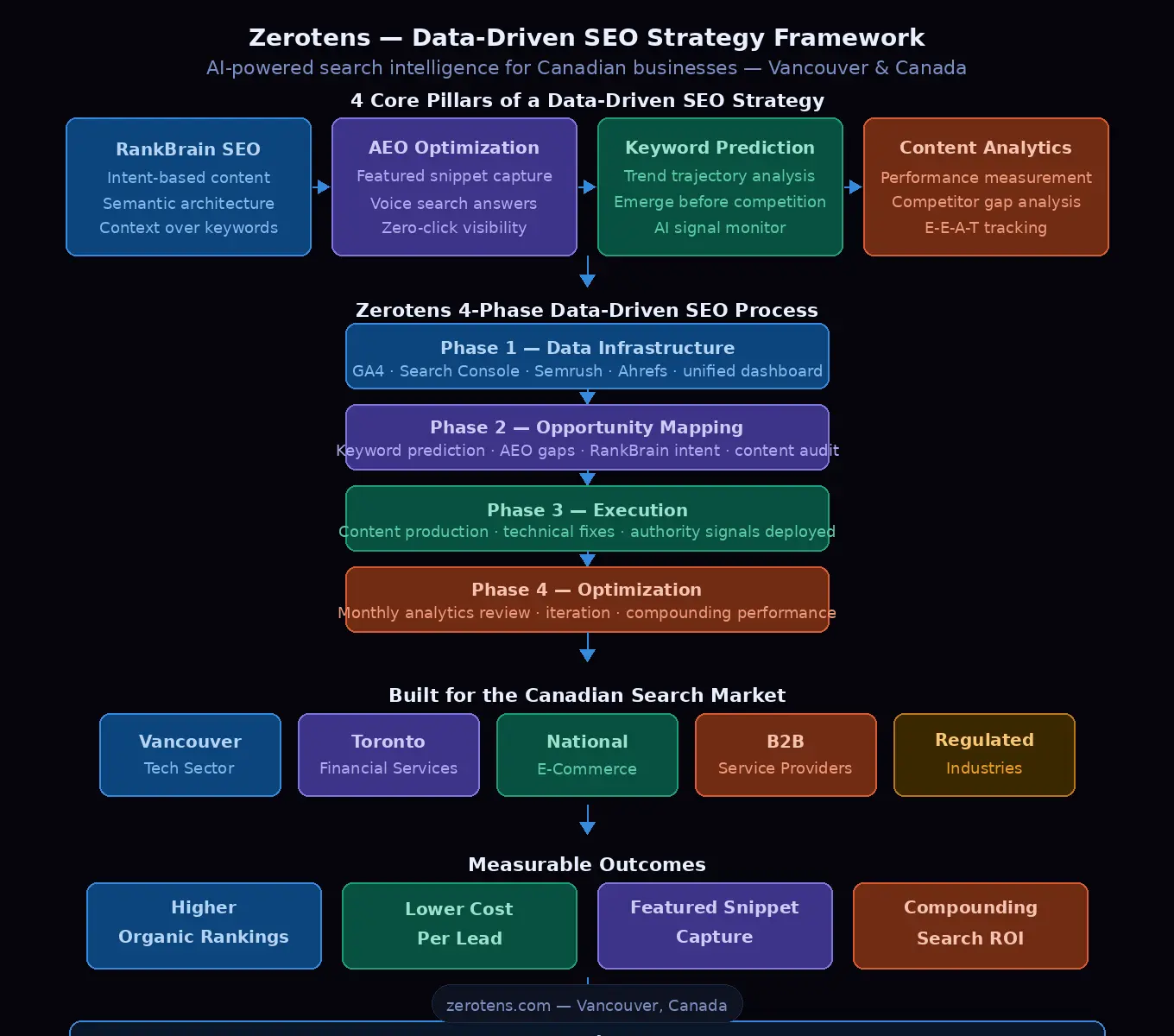
A data-driven SEO strategy is built from 4 integrated elements — each one feeding the others with evidence that makes the whole system progressively more precise and effective over time. Zerotens implements all 4 as standard components of every SEO engagement it delivers for Canadian clients.
Search Intent Mapping
Search intent mapping is the process of identifying not just what users search for but why they search for it — the underlying need, question, or decision that motivates each query. A data-driven SEO strategy built on intent mapping produces content that satisfies user needs comprehensively rather than simply containing the right keywords — and content that satisfies needs comprehensively is the content that RankBrain SEO rewards with sustained ranking performance.
Zerotens conducts intent mapping as a foundational element of every data-driven SEO strategy — categorizing every target keyword by intent type, identifying the content format most likely to satisfy each intent category, and building content architecture that addresses the full spectrum of user needs within each topic cluster. For Canadian B2B companies whose buyers research extensively before committing — often conducting 12 or more search sessions before making contact — this intent-mapped content architecture ensures Zerotens’ clients are present and authoritative at every stage of the buyer’s research journey.

Technical SEO Data Analysis
Technical SEO data analysis — the measurement and optimization of the technical factors that determine how search engines crawl, index, and rank a website — is a critical but frequently underinvested component of a data-driven SEO strategy. Content quality and keyword targeting cannot compensate for technical barriers that prevent search engines from accessing, understanding, and evaluating a website’s content reliably.
Zerotens conducts comprehensive technical SEO audits as part of every data-driven SEO strategy engagement — analyzing Core Web Vitals performance, crawl budget efficiency, index coverage, structured data implementation, internal linking architecture, and mobile usability across the full client website. The audit output is a prioritized remediation plan in which every technical fix is ranked by its likely impact on search performance — ensuring that technical SEO investment is directed toward the changes that deliver the greatest measurable return.
For Canadian businesses whose websites have accumulated technical debt through years of content additions, platform changes, and design updates without systematic technical review, this audit process consistently identifies significant ranking opportunities that content investment alone could never unlock — because the content was already present but technically inaccessible to search engines.
How Zerotens Builds Smarter SEO Campaigns with AI Data
Zerotens’ data-driven SEO strategy framework integrates AI-powered data analysis at every stage of the search optimization process — moving beyond the manual, intuition-led approaches that characterized earlier SEO practice and into a systematic, evidence-based methodology that delivers consistent, measurable, and compounding search performance for Canadian businesses.
The framework operates in 4 phases. Phase 1 is data infrastructure — establishing the measurement systems, analytics integrations, and baseline performance benchmarks that make every subsequent decision evidence-based. Phase 2 is opportunity mapping — using content analytics, keyword prediction, RankBrain SEO analysis, and AEO optimization gap identification to build a prioritized search opportunity landscape. Phase 3 is execution — producing and publishing content, implementing technical fixes, and building authority signals in the sequence that data identifies as highest-impact. Phase 4 is optimization — using performance data from live campaigns to continuously refine targeting, content quality, and technical configuration in monthly iteration cycles.
Predicting Search Trends for Maximum Visibility
The forward-looking dimension of a data-driven SEO strategy — the ability to anticipate search behavior before it peaks rather than responding to it after competition has intensified — is where AI-powered data analysis delivers its most distinctive commercial value. Zerotens uses machine learning-assisted trend analysis to identify search topics gaining momentum across Canadian markets before they appear on the radar of conventional keyword research tools.
This keyword prediction capability is built on a combination of data sources — Google Trends trajectory analysis, social media conversation monitoring, news cycle correlation, industry publication keyword tracking, and proprietary search signal databases — synthesized through AI analysis to surface emerging search opportunities with the specificity and timing precision that manual analysis cannot achieve at scale.
For a Vancouver-based SaaS company Zerotens recently engaged, keyword prediction within the data-driven SEO strategy framework identified 18 emerging search terms in the client’s product category — terms gaining consistent monthly search volume growth but not yet reflected in competitor content strategies. Publishing authority content for these terms 4 months ahead of peak competition produced first-page rankings for 14 of the 18 terms before any competitor had published competitive content — delivering organic traffic at a fraction of the cost that ranking for those terms would require 6 months later.
This is the commercial case for a data-driven SEO strategy at the Zerotens standard: not just better SEO but smarter SEO — search investment that compounds in value because it is always positioned ahead of the curve rather than chasing it.
NEW POSSIBILITY
Let’s Build Something Smarter Together
Why Data Analytics for Marketing Is the Backbone of High-Performance Campaigns

AI-Powered Content Analytics for Canadian Markets
Content analytics at the AI-assisted level that Zerotens applies to every data-driven SEO strategy engagement goes beyond standard performance measurement into predictive content intelligence — using machine learning to identify patterns in content performance data that human analysis would miss or identify too slowly to act on competitively.
Zerotens’ content analytics system analyzes every piece of content published by a client and by their top-ranking competitors — identifying the structural patterns, topic combinations, content length distributions, and semantic characteristics associated with top-performing content in each target keyword category. These patterns feed directly into content briefs for new production — ensuring that every piece of content a Zerotens data-driven SEO strategy produces is built on the specific characteristics that data identifies as performance-driving rather than the generic best practices that produce average results.
For Canadian businesses in regulated industries — financial services, healthcare technology, legal services — content analytics also tracks E-E-A-T signal performance, identifying the specific author credentials, citation patterns, and content structures that correlate with Google’s assessment of trustworthiness and expertise in these sensitive categories. A data-driven SEO strategy that incorporates this level of sector-specific performance intelligence produces content that does not just rank initially but maintains its ranking through algorithm updates that consistently reward genuine expertise signals over generic optimization techniques.
FAQ — Data-Driven SEO Strategy Explained
1. What is a data-driven SEO strategy? A data-driven SEO strategy uses performance data, content analytics, and AI-powered search analysis to make every SEO decision — from keyword targeting to content production — based on evidence rather than assumption. It consistently outperforms intuition-based SEO because it targets the right opportunities at the right time with the right content.
2. How does Zerotens use data for SEO optimization? Zerotens integrates Google Analytics 4, Search Console, Semrush, and AI-powered trend analysis into a unified data-driven SEO strategy framework — using content analytics, keyword prediction, RankBrain SEO analysis, and AEO optimization to build search campaigns that deliver measurable, compounding organic growth for Canadian businesses.
3. What’s the difference between SEO and AEO? Traditional SEO optimizes for search engine rankings and click-through traffic. AEO optimization — Answer Engine Optimization — optimizes content to be selected as the direct answer by AI search engines and voice assistants. A complete data-driven SEO strategy incorporates both — using SEO to establish authority and AEO optimization to capture zero-click search visibility.
4. How does AI improve keyword research? AI-powered keyword prediction analyzes search trend trajectories, social conversation signals, and competitor content gaps to identify emerging search opportunities before they peak. A data-driven SEO strategy built on AI keyword research positions Canadian businesses for high-value terms while competition is still low — delivering rankings that would be significantly harder to achieve if pursued 6 to 12 months later.
5. Why is a data-driven SEO strategy essential? In 2026, search engines evaluate content with AI-powered intelligence that rewards relevance, intent satisfaction, and genuine expertise over keyword optimization alone. A data-driven SEO strategy is essential because it is the only approach that can reliably navigate this complexity — making decisions based on evidence rather than assumption in a search environment where assumption-based SEO is systematically underperforming.
Conclusion
“As AI technologies continue to evolve, some businesses are looking ahead to how they might integrate them into their operations. Businesses were asked whether they plan to adopt software or hardware using AI over the next 12 months. In the second quarter of 2025, nearly one in five (17.9%) businesses reported plans to adopt AI software, while 6.0% reported plans to adopt AI hardware. (statcan)”
A data-driven SEO strategy is not an advanced option for large enterprises with substantial marketing budgets — it is the minimum viable approach for any Canadian business that depends on organic search to generate traffic, leads, and revenue in 2026. The search environment has become too intelligent, too competitive, and too consequential to navigate without the data infrastructure, AI-powered analysis, and systematic evidence-based decision-making that a genuine data-driven SEO strategy provides.
Zerotens builds data-driven SEO strategies that combine RankBrain SEO intelligence, AEO optimization, keyword prediction, and content analytics into unified search growth systems — delivering measurable organic performance improvements for Canadian businesses across Vancouver, Toronto, and every market where search visibility translates directly into commercial advantage. The businesses that invest in a data-driven SEO strategy today are building search assets that compound in value over time. Those that do not are falling further behind with every algorithm update, every zero-click search result, and every piece of competitor content that a better-informed strategy produces.
If your organic search performance is not compounding the way your business needs it to, the answer is a data-driven SEO strategy — and Zerotens is where that strategy begins.
Let’s Build Something Smarter Together → zerotens.com/contact-us