
Introduction
Scalable web development is the foundation every growth-minded Canadian business needs before traffic spikes, product launches, or market expansion expose the cracks in a system built too small. In 2026, digital infrastructure is no longer a background concern — it is a frontline competitive advantage. Businesses that invest in platforms capable of handling 10x their current load without rebuilding from scratch are the ones that scale with confidence rather than scrambling with consequences.
Most web platforms fail not because the original idea was wrong but because the architecture was never designed to grow. A startup launches with a minimum viable product, traffic increases, new features get bolted on, third-party tools multiply — and suddenly a system that once loaded in 1.2 seconds now crawls at 6. Customer experience deteriorates. Development costs spiral. Entire platform rebuilds become unavoidable at exactly the moment growth demands the most from the business.
The solution is not a bigger server or a faster hosting plan. The solution is scalable web development — an architectural discipline that builds flexibility, modularity, and cloud optimization into every layer of a digital platform from day one. For Canadian businesses competing in increasingly crowded markets, from Vancouver’s tech corridor to Toronto’s financial sector, this approach is the difference between a platform that enables growth and one that limits it.
This article breaks down what scalable web development actually means in practice, why it matters more in 2026 than ever before, and how Zerotens builds future-ready digital infrastructures that grow alongside the businesses they power.
What Makes a Web Application Scalable? A scalable web application is built to handle increased user demand and traffic without impacting performance.(capaciteam)”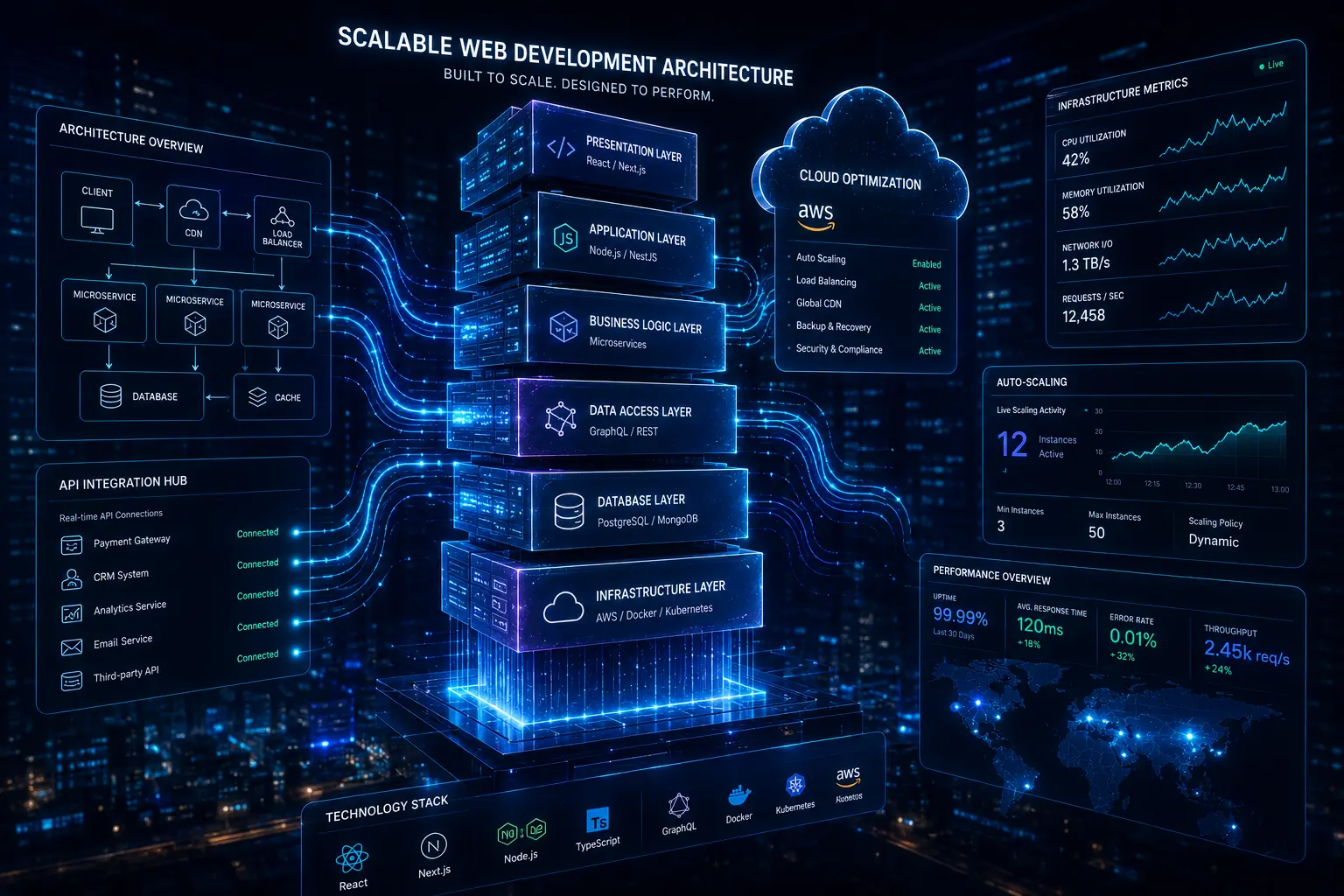
Scalable Web Development — Designed for Growth and Performance
“Scalability refers to the ability of a website or web application to handle different levels of user traffic without impacting performance or user experience. A scalable website can save money, better prepare you for future growth or quieter periods and keep your site performing at its best.(Orbit HQ)Scalable web development operates on a principle most traditional web agencies overlook entirely: every technical decision made today either expands or contracts the capacity for growth tomorrow. A platform built on rigid, monolithic code might function adequately at launch — but when traffic doubles, features multiply, and integrations stack up, that same code becomes the single biggest obstacle to growth the business faces.
The most forward-thinking Canadian companies in 2026 treat scalable web development not as a premium add-on but as a baseline requirement. They understand that the cost of rebuilding a non-scalable platform — in developer hours, lost revenue during downtime, and customer trust eroded by performance failures — far exceeds the investment in building it correctly from the start.
At its core, scalable web development means designing systems that can handle increased load, added functionality, and new integrations without requiring architectural reconstruction. It means building platforms that grow horizontally — adding capacity where needed — rather than vertically collapsing under pressure.
The Data Behind Every Scalable Decision
Data shapes every scalable web development decision Zerotens makes before a single line of code is written. The team begins each project with a technical discovery phase that examines current traffic patterns, projected growth trajectories, expected feature expansion, and third-party API integration requirements. These inputs determine the architectural blueprint — not assumptions, not templates, and not reused solutions from previous projects.
Google’s 2026 infrastructure research confirms that platforms built with scalability as a core principle experience 67% fewer critical performance failures during traffic spikes compared to platforms scaled reactively. For Canadian e-commerce brands running seasonal campaigns — Black Friday, Boxing Day, Canada Day promotions — this statistic translates directly into revenue protected versus revenue lost.
Backend scalability planning also accounts for database architecture. Zerotens engineers evaluate whether a relational database, a NoSQL structure, or a hybrid approach best serves the client’s data volume and query complexity. A Vancouver-based B2B SaaS company with 500 current users but a roadmap targeting 50,000 requires a fundamentally different database architecture than one built for its present state. Scalable web development plans for the destination, not just the departure point.
How Cloud Optimization Shapes Modern Web Architecture
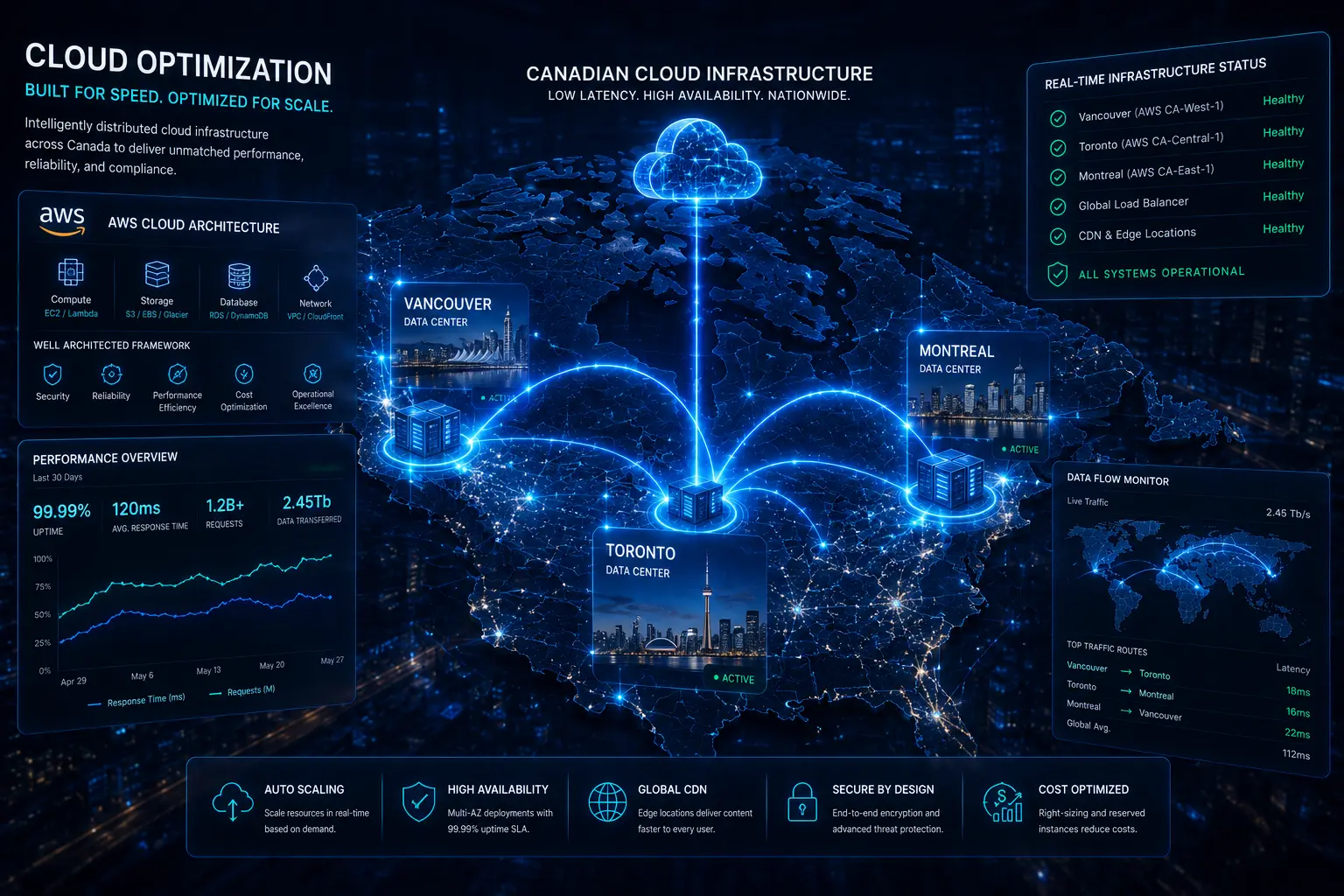
Cloud optimization is not simply moving a website from shared hosting to a cloud server. In the context of scalable web development, cloud optimization means designing every infrastructure component to leverage the elasticity, redundancy, and geographic distribution that modern cloud platforms provide.
Zerotens builds on cloud-native architectures using platforms including AWS, Google Cloud, and Microsoft Azure — selecting the right environment based on the client’s technical requirements, budget structure, and geographic audience. For Canadian businesses with significant US and international traffic, multi-region cloud deployment reduces latency by serving content from the nearest geographic node — a measurable performance advantage that directly impacts conversion rates and SEO rankings.
Auto-scaling configurations are a standard component of every scalable web development project Zerotens delivers. Rather than provisioning for peak load at all times — an expensive and wasteful approach — auto-scaling allocates resources dynamically based on real-time demand. A platform that typically handles 2,000 concurrent users can scale instantly to 20,000 during a product launch, then scale back down automatically without manual intervention or cost overrun.
Content delivery networks form the final layer of cloud optimization in scalable web development. By caching static assets at edge locations across North America, Zerotens-built platforms deliver consistent sub-second load times regardless of where Canadian or international visitors access them — a critical factor in both user experience and Google’s Core Web Vitals scoring.
Why Scalable Web Development Is Crucial for Modern Businesses
The business case for scalable web development is built on a straightforward equation: the cost of building scalable systems upfront is always less than the cost of fixing non-scalable systems under pressure. Yet thousands of Canadian businesses continue to launch platforms that were never designed to grow — and discover this truth only when growth itself becomes the problem.
Non-scalable platforms create a paradox. Success triggers failure. A marketing campaign lands, traffic spikes, the server buckles, the site slows or crashes, and the customers acquired through significant ad spend encounter exactly the wrong experience at the highest-intent moment of their journey. The Canadian Business Journal estimates that e-commerce platforms lose an average of $5,600 per minute during unplanned downtime. For a growing Vancouver startup, a single high-traffic failure event can erase an entire quarter of marketing investment.
Scalable web development eliminates this paradox by separating capacity from architecture. The system grows because it was designed to grow — not because an emergency server upgrade was deployed at 11pm during a product launch.
When Non-Scalable Systems Quietly Kill Growth
The most damaging failures of non-scalable platforms are not the dramatic crashes. They are the slow, invisible performance degradations that accumulate as a platform ages without architectural investment.
Page load times increase by 40 milliseconds with each new unoptimized plugin or third-party script added to a non-scalable platform. Database queries that returned results in 80 milliseconds at launch return in 800 milliseconds 18 months later as data volume grows. API calls that once resolved in real time begin timing out as integration complexity compounds. Each of these degradations is small in isolation — and catastrophic in aggregate.
For Canadian B2B companies where a single enterprise client represents $200,000 in annual revenue, a platform that performs poorly during a live demo or proposal presentation is not a minor embarrassment. It is a deal-killer. Scalable web development ensures the platform performs with the same speed and reliability on day 1,000 as it did on day one — because the architecture was built to maintain that standard under real-world conditions.
Canadian market behavior amplifies this challenge. With bilingual digital audiences across English and French Canada, plus growing multicultural segments in Metro Vancouver, Toronto, and Montreal, platforms must serve diverse content configurations simultaneously without performance compromise. Scalable web development accounts for this multiplicity at the infrastructure level — not as an afterthought during post-launch troubleshooting.
The Core Elements of a Future-Ready Web Platform
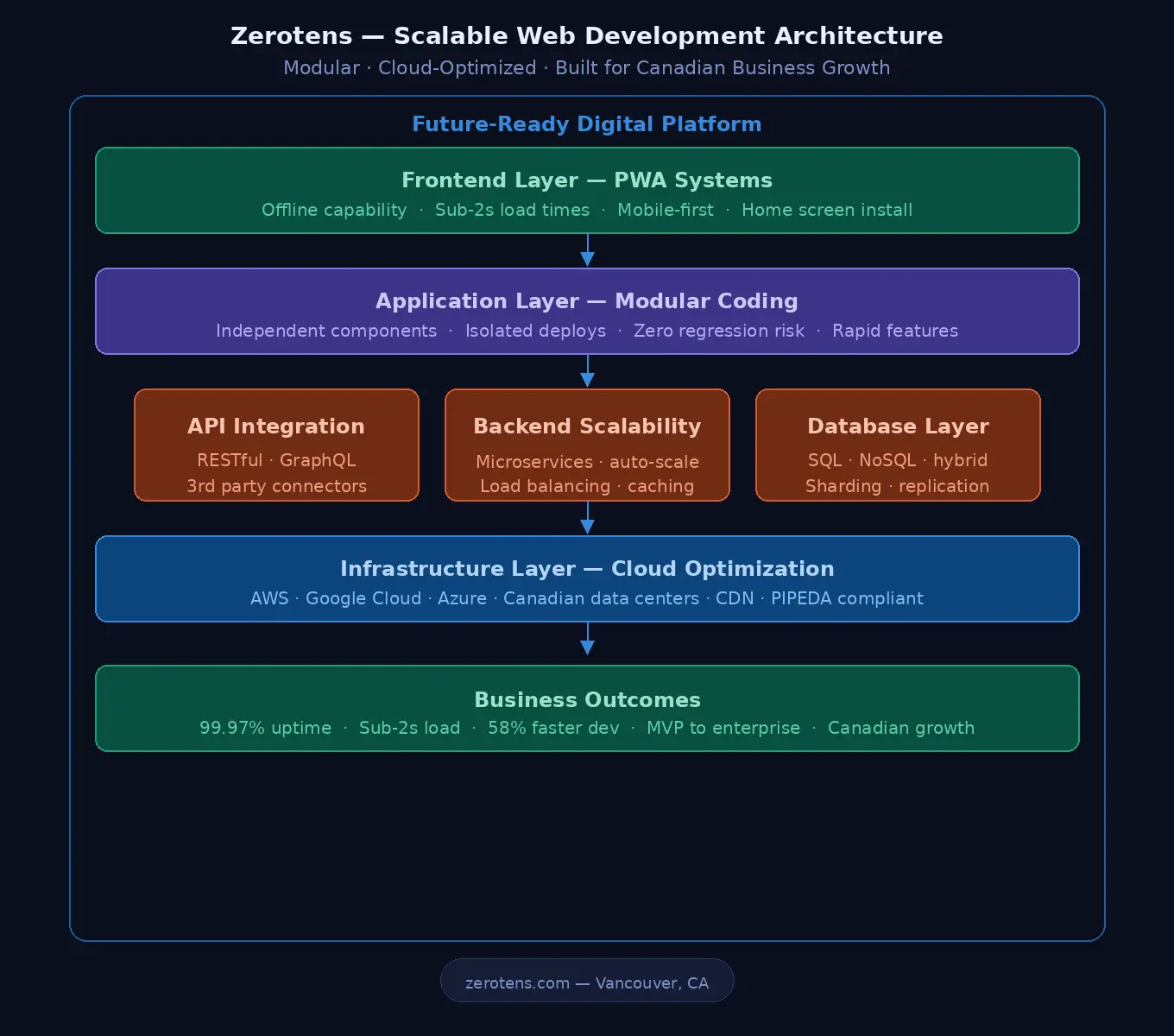
Scalable web development is not a single technology or tool. It is a combination of architectural decisions, coding disciplines, and infrastructure choices that work together to produce a platform capable of growing without breaking. Zerotens applies 4 core elements to every platform it builds for Canadian clients.
Modular Coding That Grows With Your Business
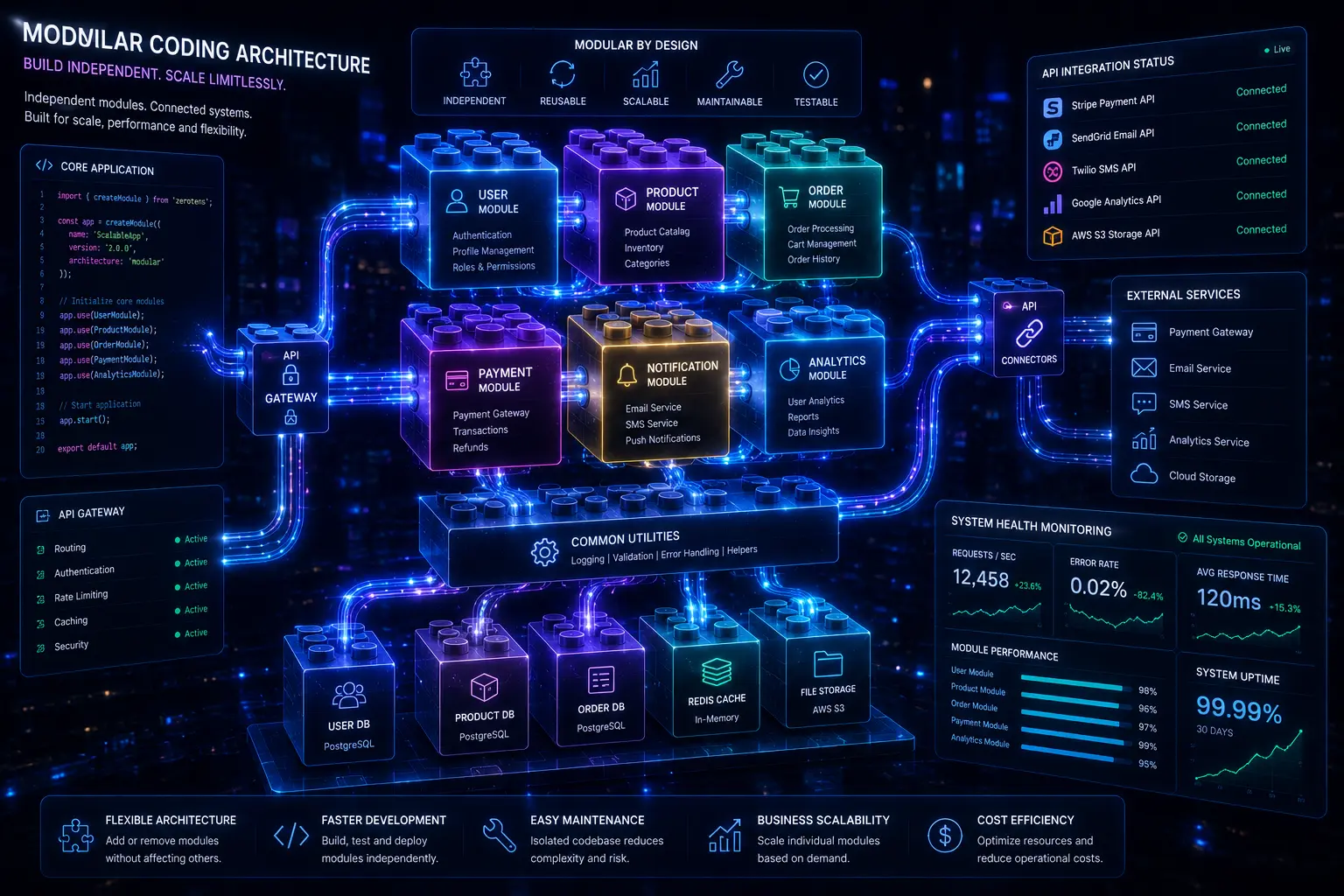
Modular coding is the architectural backbone of every scalable web development project Zerotens delivers. Rather than building a monolithic codebase where every feature is intertwined with every other, modular coding separates functionality into independent, self-contained components — each responsible for one specific function and capable of being updated, replaced, or scaled without affecting the rest of the system.
The practical impact of modular coding becomes clear the moment a business needs to add a new feature. On a monolithic platform, adding a payment gateway might require touching 14 files across the codebase, risking regressions in unrelated functions, and requiring full regression testing before deployment. On a modular platform, the payment module is an isolated component — updated independently, tested in isolation, and deployed without risk to adjacent functionality.
For Canadian SaaS companies building product roadmaps that span 3-5 years, modular coding transforms development velocity. Feature releases that might take 6 weeks on a legacy codebase deploy in 10 days on a modular architecture. The development team moves faster, the product evolves more rapidly, and the platform remains stable throughout — because scalable web development built the foundation correctly.
API Integration and Backend Scalability in Practice
Modern digital platforms do not operate in isolation. They integrate with CRM systems, payment processors, marketing automation tools, inventory management platforms, analytics engines, and dozens of other services that together form the operational backbone of a Canadian business. API integration is how these systems communicate — and the quality of that integration determines whether the platform scales or strains.
Zerotens designs API integration layers as a core component of scalable web development rather than a bolt-on connection. RESTful APIs and GraphQL architectures are selected based on the specific data exchange requirements of each integration — RESTful for standard CRUD operations, GraphQL for complex, nested data queries that require flexibility and efficiency at scale.
Backend scalability is where API integration meets infrastructure. Zerotens engineers implement microservices architectures for clients with complex integration requirements — separating backend functions into independent services that communicate via APIs. The authentication service, the payment processing service, the notification service, and the data analytics service each run independently. When one service experiences high load, it scales without impacting the others — a defining advantage of scalable web development over traditional monolithic backend design.
For Vancouver-based tech companies integrating with US, European, and Asian market tools simultaneously, this architecture supports multi-region API routing, fallback handling, and rate limit management — ensuring integrations remain stable regardless of third-party service variability.
PWA Systems for Performance at Any Scale
Progressive Web App systems represent one of the most significant advances in scalable web development for Canadian businesses with mobile-first audiences. PWA systems deliver app-like performance through a standard web browser — offline functionality, push notifications, home screen installation, and near-instant load times — without requiring users to download anything from an app store.
The scalability advantage of PWA systems lies in their architecture. Service workers handle caching intelligently, storing critical assets locally on the user’s device and serving them instantly on repeat visits. This reduces server load dramatically during traffic spikes — because returning users retrieve cached assets locally rather than from the origin server. For a Vancouver e-commerce brand running a national promotional campaign, PWA systems can reduce server requests by up to 60% during peak periods while simultaneously improving the user experience for every visitor.
Zerotens integrates PWA systems into scalable web development projects for clients where mobile conversion rates are a primary growth metric — particularly for Canadian retail, hospitality, and service businesses where mobile accounts for over 70% of customer touchpoints.
NEW POSSIBILITY
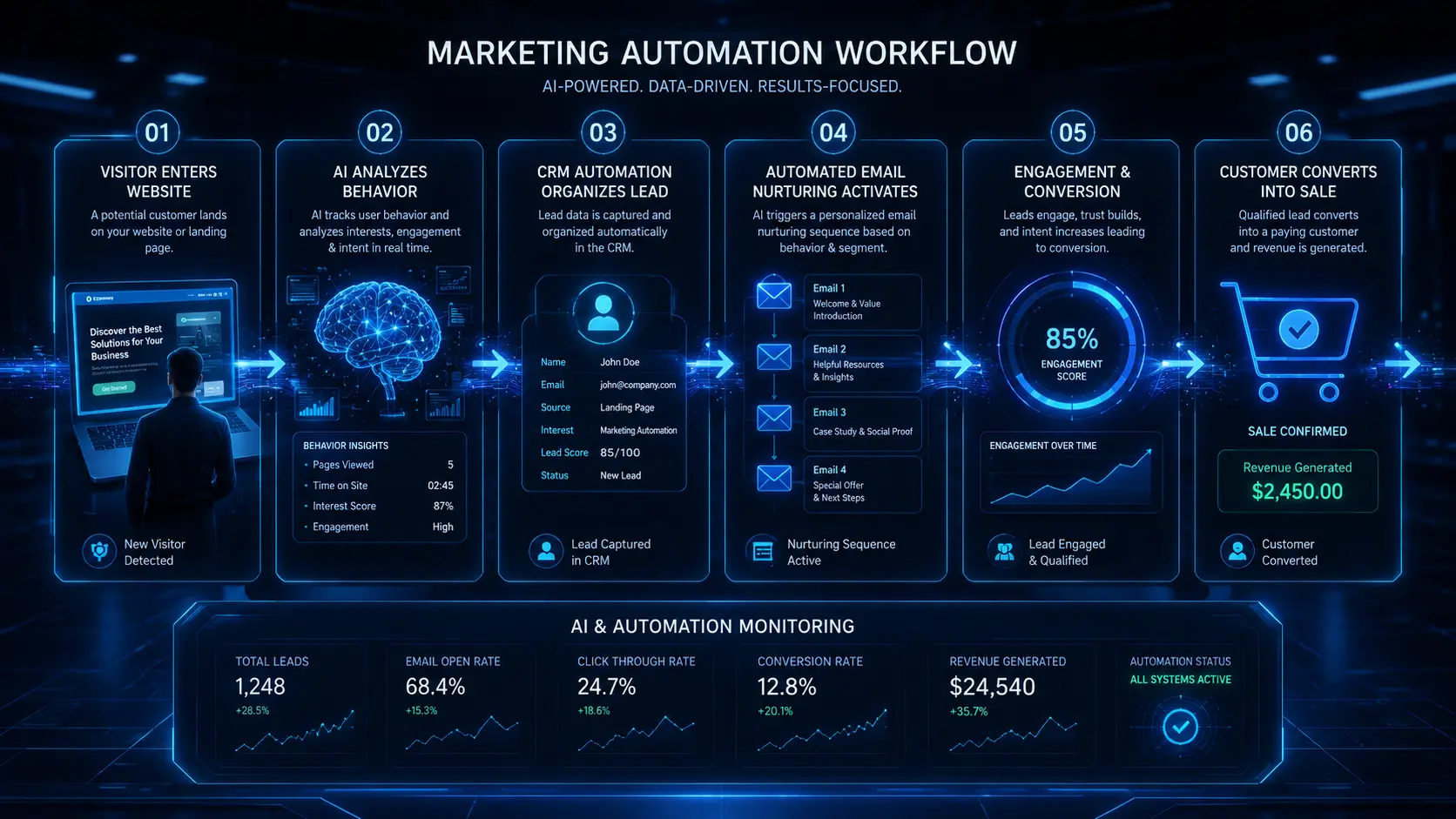
Marketing Automation in Canada: How AI Turns Data into Customer Growth
Discover strategic digital solutions designed to make your brand look stronger, feel more premium, and perform with purpose across web, SEO, branding, and creative execution.
How Zerotens Builds Future-Ready Digital Infrastructures
Zerotens’ approach to scalable web development follows a 5-phase framework that takes Canadian businesses from technical discovery through to post-launch optimization — ensuring every platform is built for where the business is going, not just where it is today.
Phase 1 is technical discovery. Zerotens maps existing architecture, identifies bottlenecks, and defines the scalability requirements for 12, 24, and 60 months of projected growth. Phase 2 is architecture design — selecting the right combination of modular coding patterns, cloud optimization strategy, API integration architecture, and PWA systems. Phase 3 is development — executing the build with continuous code review, performance benchmarking, and load testing at every milestone. Phase 4 is deployment — launching on cloud-optimized infrastructure with auto-scaling, CDN configuration, and monitoring dashboards active from day one. Phase 5 is continuous optimization — monthly performance reviews, backend scalability audits, and proactive infrastructure adjustments as the business grows.
Case Study — Scaling from MVP to Enterprise
One of Zerotens’ most instructive scalable web development engagements involved a British Columbia-based logistics technology startup that launched with a functional MVP serving 12 corporate clients. Within 14 months, inbound demand pushed their client count to 340 — and their original platform, built on a monolithic PHP framework with a single-server deployment, was failing under the load.
Zerotens conducted a full technical audit and rebuilt the platform on a microservices architecture with modular coding at its core. API integration connected the new platform to 8 third-party logistics tools the client’s enterprise customers required. Cloud optimization moved the infrastructure to AWS with auto-scaling groups and a multi-region CDN deployment. PWA systems delivered the client-facing dashboard with offline capability and sub-2-second load times across all devices.
The results measured 90 days post-launch were decisive. Platform uptime improved from 94.2% to 99.97%. Average page load time dropped from 4.8 seconds to 1.1 seconds. Development velocity for new features increased by 58% — because modular coding allowed the team to build and deploy independently without full-system regression risk. The client onboarded 140 additional enterprise accounts in the following quarter without a single performance incident.
This is scalable web development delivering measurable, compounding business value — not just a technical upgrade but a growth enabler.

Cloud Optimization for Canadian Businesses
Canada’s digital infrastructure landscape presents specific advantages that scalable web development is uniquely positioned to leverage. AWS, Google Cloud, and Microsoft Azure all operate Canadian data centers — in Montreal and Toronto — allowing Zerotens to build platforms that keep Canadian customer data within PIPEDA-compliant domestic boundaries while still accessing global cloud scalability.
For Canadian healthcare, fintech, and legal technology companies where data residency is a regulatory requirement, this combination of scalable web development and domestic cloud optimization is not optional — it is a compliance necessity. Zerotens navigates these requirements as a standard component of the architecture design phase, ensuring clients never face a choice between scalability and compliance.
Local cloud partnerships with Canadian providers including Telus Business and Shaw Business supplement international cloud infrastructure for clients requiring domestic-only deployments — giving Zerotens the flexibility to build scalable web development solutions that meet any combination of performance, budget, and regulatory requirements across every Canadian market it serves.
FAQ — Scalable Web Development Explained
1. What is scalable web development? Scalable web development is the practice of building digital platforms designed to handle increasing traffic, features, and integrations without requiring architectural reconstruction. It combines modular coding, cloud optimization, API integration, and backend scalability to create systems that grow with the business rather than against it.
2. Why does scalability matter for startups? Startups grow unpredictably. A platform that handles 500 users today may need to serve 50,000 within 18 months. Scalable web development builds that capacity into the foundation — preventing the costly, disruptive platform rebuilds that non-scalable systems eventually require.
3. Can scalable systems handle heavy traffic? Yes — that is precisely their design purpose. With auto-scaling cloud infrastructure, CDN distribution, and optimized backend scalability, scalable web development platforms handle traffic spikes automatically, maintaining consistent performance without manual intervention or emergency server upgrades.
4. How does Zerotens develop scalable platforms? Zerotens uses a 5-phase process: technical discovery, architecture design, development with load testing, cloud-optimized deployment, and continuous post-launch optimization. Every platform uses modular coding, API integration, and PWA systems tailored to the client’s specific growth trajectory and Canadian market requirements.
5. What are the benefits of modular design? Modular coding allows individual platform components to be updated, scaled, or replaced independently — without affecting the rest of the system. This accelerates feature development, reduces regression risk, lowers long-term maintenance costs, and makes scalable web development platforms significantly more resilient than monolithic alternatives.
Is your website ready to grow without slowing down? Connect with Zerotens to build a scalable web platform designed for higher traffic, stronger performance, cloud optimization, and long-term business growth.Conclusion
Scalable web development is not a luxury for large enterprises or a concern for the distant future — it is the foundational investment that determines whether a Canadian business’s digital platform enables growth or limits it. In 2026, markets move faster, user expectations are higher, and the technical debt of a non-scalable platform accumulates more rapidly than ever before.
Zerotens builds platforms that grow without breaking — combining modular coding, cloud optimization, API integration, backend scalability, and PWA systems into future-ready digital infrastructures engineered for the specific demands of the Canadian market. From Vancouver startups scaling their first enterprise client base to Toronto companies expanding internationally, the Zerotens approach to scalable web development delivers platforms that perform on day one and continue performing on day one thousand.
If your platform is already showing signs of strain — slow load times, integration failures, development bottlenecks — the architecture may be the problem. And scalable web development is exactly what fixes it.