
Introduction
Answer Engine Optimization is transforming how Canadian businesses get found online — and the brands that understand this shift first will own the next decade of digital visibility. Search has fundamentally changed. Google, Bing, ChatGPT, Perplexity, and Siri no longer simply return a list of links. They deliver direct answers. And if your content is not structured to be that answer, it does not matter how well it ranks — it will not be seen.
“Answer Engine Optimization (AEO) focuses on becoming the source for direct answers in featured snippets, knowledge panels, and AI Overviews.(writers room)”Traditional SEO optimized for position. Page one was the goal. The top 3 results captured the clicks. But in 2026, AI-powered search engines synthesize information from multiple sources and surface one authoritative response — a featured snippet, a voice answer, or an AI-generated summary. The businesses whose content powers those responses win the visibility. Everyone else disappears.
For Canadian businesses competing across industries from Vancouver tech startups to Toronto financial services firms, the implications are immediate. Over 58% of Google searches in 2026 return zero-click results — meaning users get their answer directly on the search results page without ever visiting a website. If your content is not optimized to be that result, your traffic, your leads, and your competitive position erode silently.
The solution is not to abandon SEO. It is to evolve beyond it. Answer Engine Optimization is that evolution — and this guide explains exactly how it works and how Zerotens builds it into every content strategy it delivers for Canadian clients.

Answer Engine Optimization — Redefining Search Visibility
Search engines were built to find. Answer Engine Optimization is built to respond. This distinction sounds subtle — but its implications for digital visibility are enormous. When a user types “best CRM for Canadian small businesses” into Google in 2026, they are not looking for 10 blue links. They are looking for an answer. Google’s AI Overview, Bing Copilot, and Perplexity all know this — and they have restructured their results accordingly.
The shift began with featured snippets. Google introduced position zero — the answer box above all organic results — as an early signal that search was moving from indexing to answering. Voice search accelerated this transition. When a user asks Siri or Google Assistant a question, the device reads one answer aloud. That answer comes from one source. Answer Engine Optimization is the discipline of making your content that source — consistently, across every question your target audience asks.
In 2026, AI search models including ChatGPT Search, Perplexity AI, and Google’s Gemini integration have expanded this dynamic dramatically. These platforms do not rank pages. They synthesize answers from content they consider authoritative, structured, and directly responsive to the user’s query. For Canadian businesses, this means the competition is no longer for page one — it is for the single response that an AI engine selects as the definitive answer.
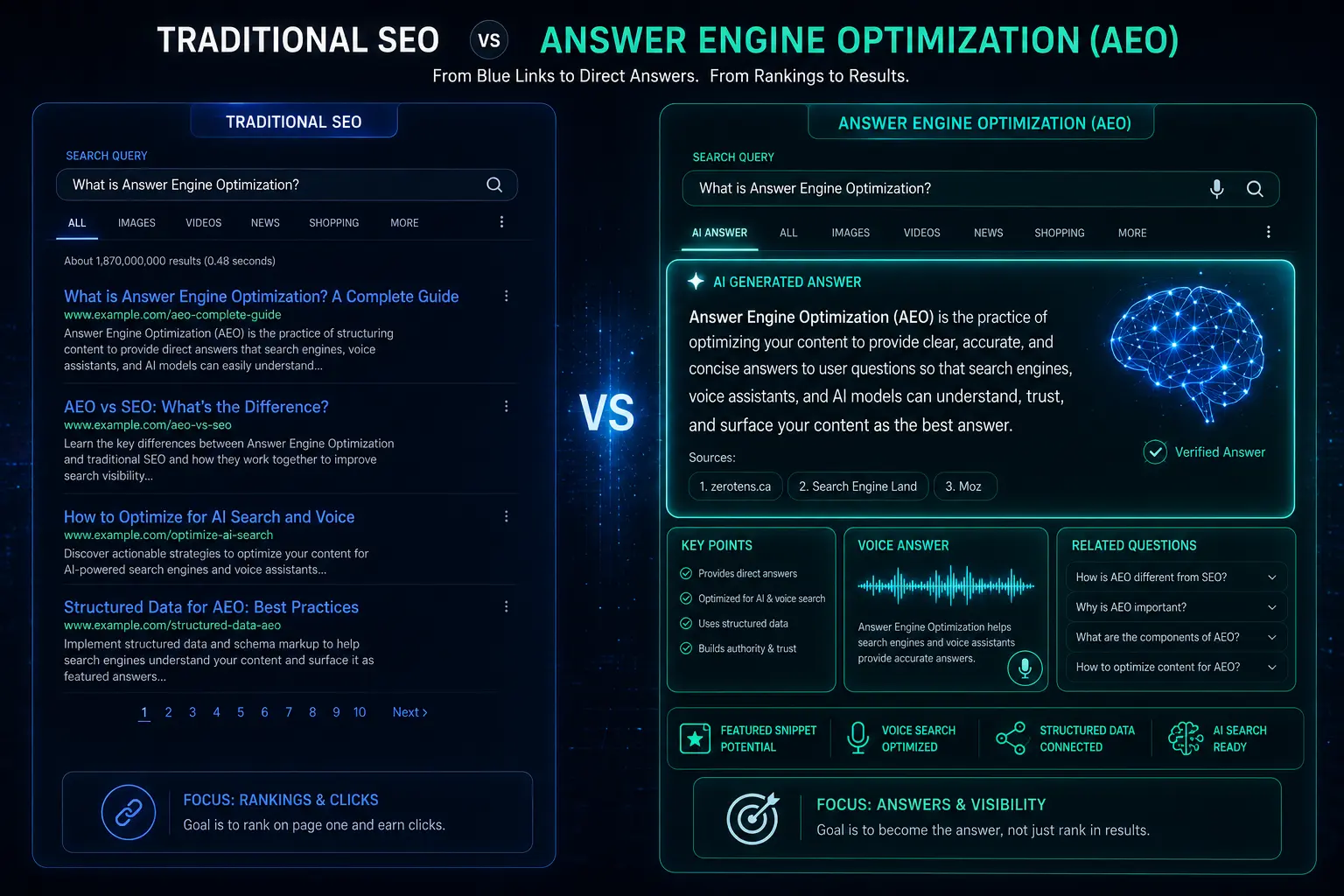
The Data Behind the AEO Shift
The numbers behind Answer Engine Optimization reframe the entire SEO conversation. According to SparkToro’s 2025 Zero-Click Search Study, 65% of all Google searches now end without a single click to an external website. Semrush data confirms that featured snippets receive 35.1% of all clicks on a results page — more than the first organic result below them.
For Canadian businesses investing in content marketing, paid search, and organic SEO without an Answer Engine Optimization strategy layered on top, these numbers represent a growing revenue blind spot. Traffic that should be arriving is being captured by AI-generated answers built from competitors’ content — or from no specific source at all, leaving the business entirely invisible at the moment of highest user intent.
Voice search compounds this urgency specifically for the Canadian market. ComScore projects that over 50% of all Canadian searches will be voice-initiated by the end of 2026. A voice search returns exactly one answer. That answer is almost always pulled from a featured snippet or structured data source. Answer Engine Optimization is the process of ensuring your content is the source those systems select — not your competitor’s.
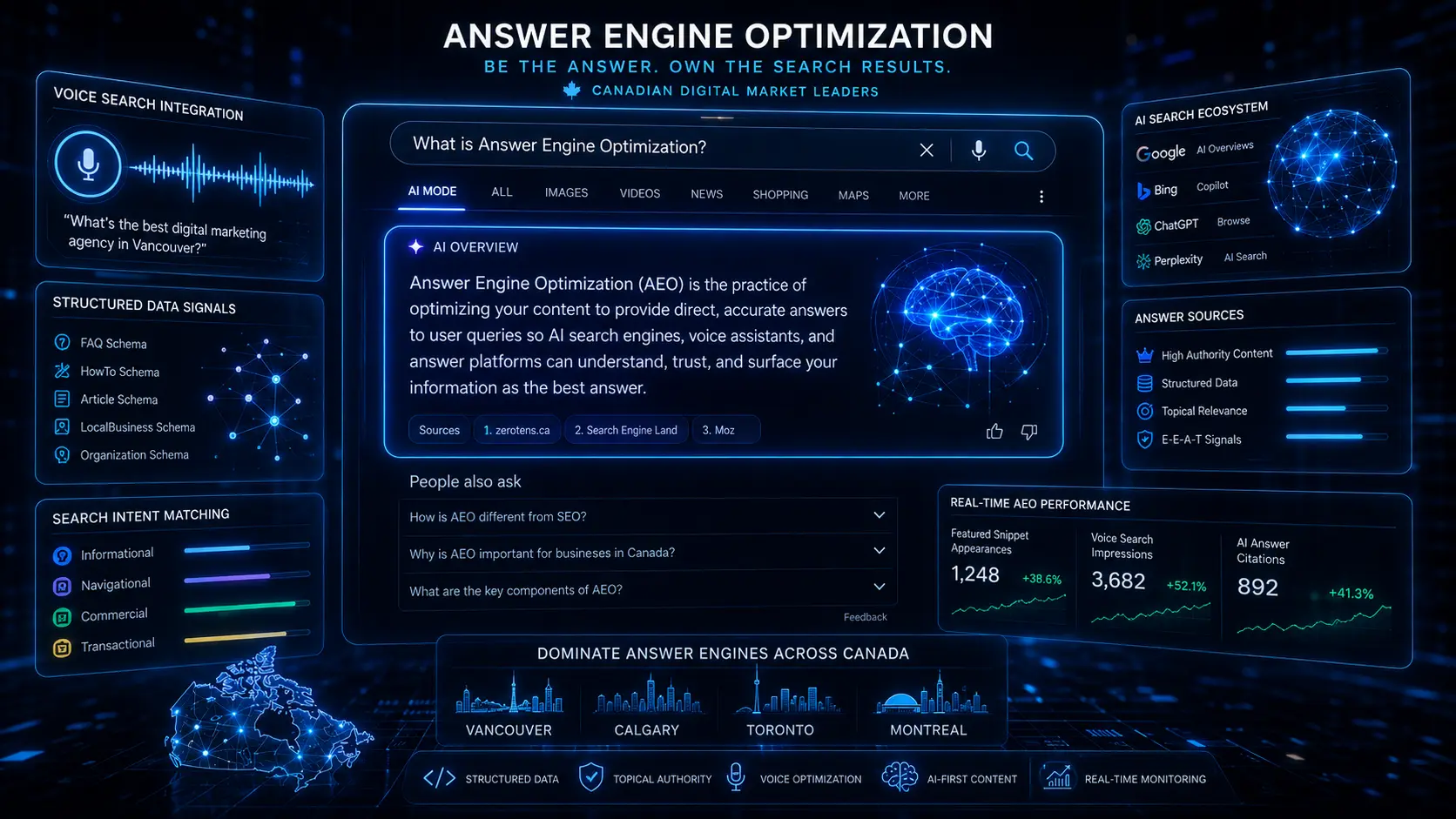
What Is Answer Engine Optimization and Why It Matters
Answer Engine Optimization is the strategic practice of structuring, formatting, and positioning content so that AI-powered search engines, voice assistants, and featured snippet algorithms select it as the authoritative answer to a specific user query. It operates at the intersection of traditional SEO, structured data implementation, conversational content design, and AI search behavior — combining all 4 disciplines into one unified visibility strategy.
Where traditional SEO optimizes for crawlability and keyword relevance, Answer Engine Optimization optimizes for answer quality and response readiness. The question is not “does this page contain the keyword?” It is “does this page directly, clearly, and authoritatively answer the question a user is asking — in a format an AI engine can extract and present?”
This distinction produces fundamentally different content decisions. AEO-optimized content leads with the answer rather than building to it. It uses structured data markup to signal to search engines exactly what type of content is present. It formats information in the lists, tables, and concise paragraph structures that featured snippet algorithms prefer. And it anticipates the specific questions Canadian users ask — not just the keywords they type.
AEO vs SEO — Understanding the Difference
The AEO vs SEO distinction is not a competition — it is an evolution. SEO remains the foundation. Without technical optimization, crawlability, and domain authority, Answer Engine Optimization has no platform to perform on. But SEO alone, without AEO layered on top, leaves enormous visibility on the table in 2026.
| Dimension | Traditional SEO | Answer Engine Optimization |
|---|---|---|
| Goal | Rank on page one | Be the selected answer |
| Format | Keyword-rich content | Question-and-answer structure |
| Target | Search engine crawlers | AI synthesis engines |
| Result | Click-through traffic | Zero-click visibility + authority |
| Voice | Not optimized | Natively voice-search ready |
Canadian businesses that treat AEO vs SEO as either/or miss the point entirely. The brands winning search visibility in 2026 deploy both — using SEO to establish domain authority and Answer Engine Optimization to capture the featured snippets, AI overviews, and voice answers that now dominate the results page.
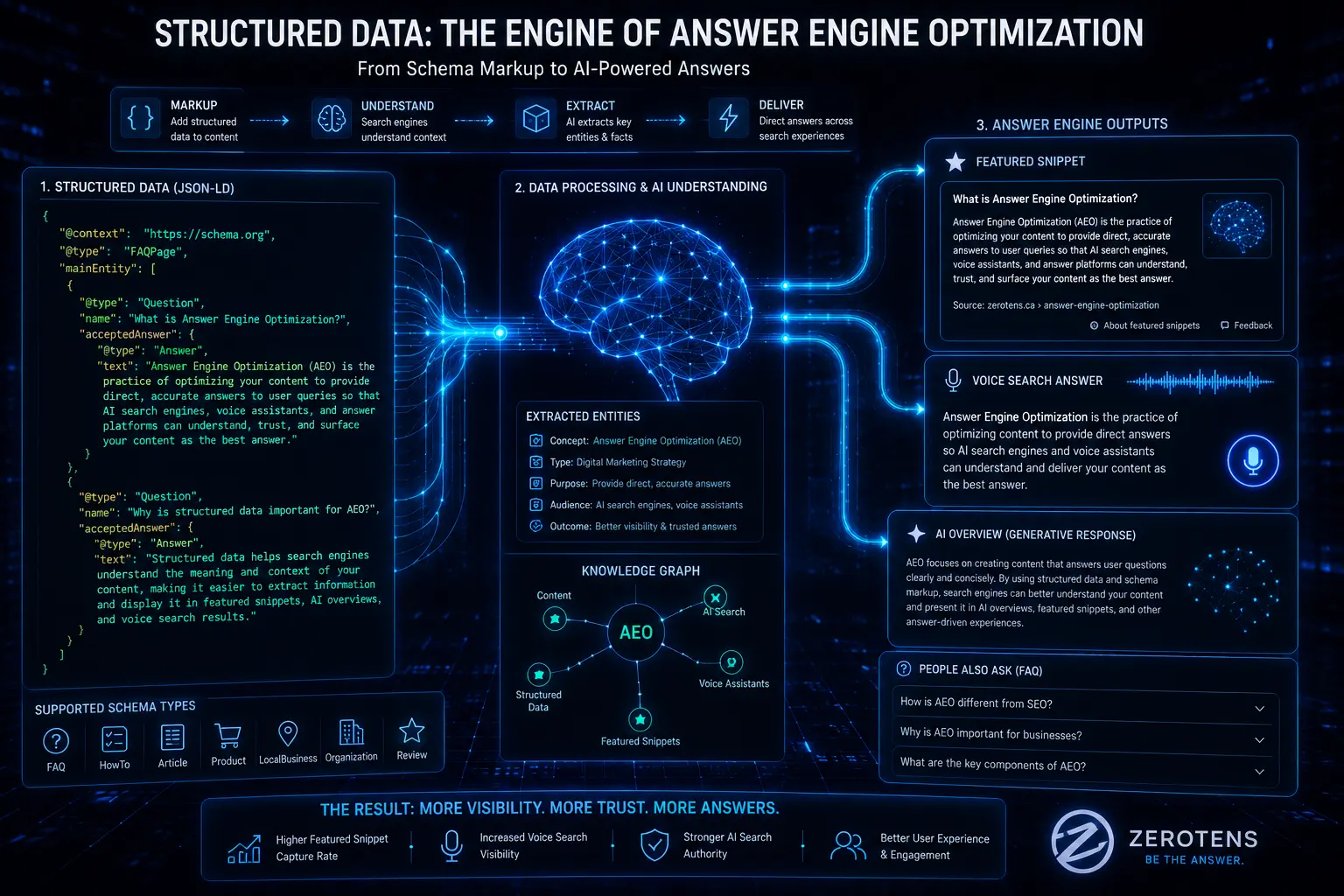
Why Structured Data Is the Engine of AEO
Structured data is the technical backbone of every effective Answer Engine Optimization strategy. Schema markup — the standardized vocabulary that tells search engines exactly what a piece of content is and what it means — is what allows AI search models to reliably extract and present information from a website.
Without structured data, a search engine reads your content as undifferentiated text. With structured data, it reads your content as a precisely labelled collection of answers, products, reviews, events, FAQs, and how-to guides — each tagged with the metadata that enables AI engines to select, cite, and surface them confidently.
Zerotens implements structured data as a standard component of every Answer Engine Optimization engagement — covering FAQ schema, HowTo schema, Article schema, LocalBusiness schema, and BreadcrumbList schema as appropriate to the client’s content type. For Vancouver-based businesses targeting both local and national Canadian audiences, LocalBusiness schema with geo-specific markup delivers measurable improvements in local featured snippet capture within 60 to 90 days of implementation.
The Core Elements of a Winning AEO Strategy
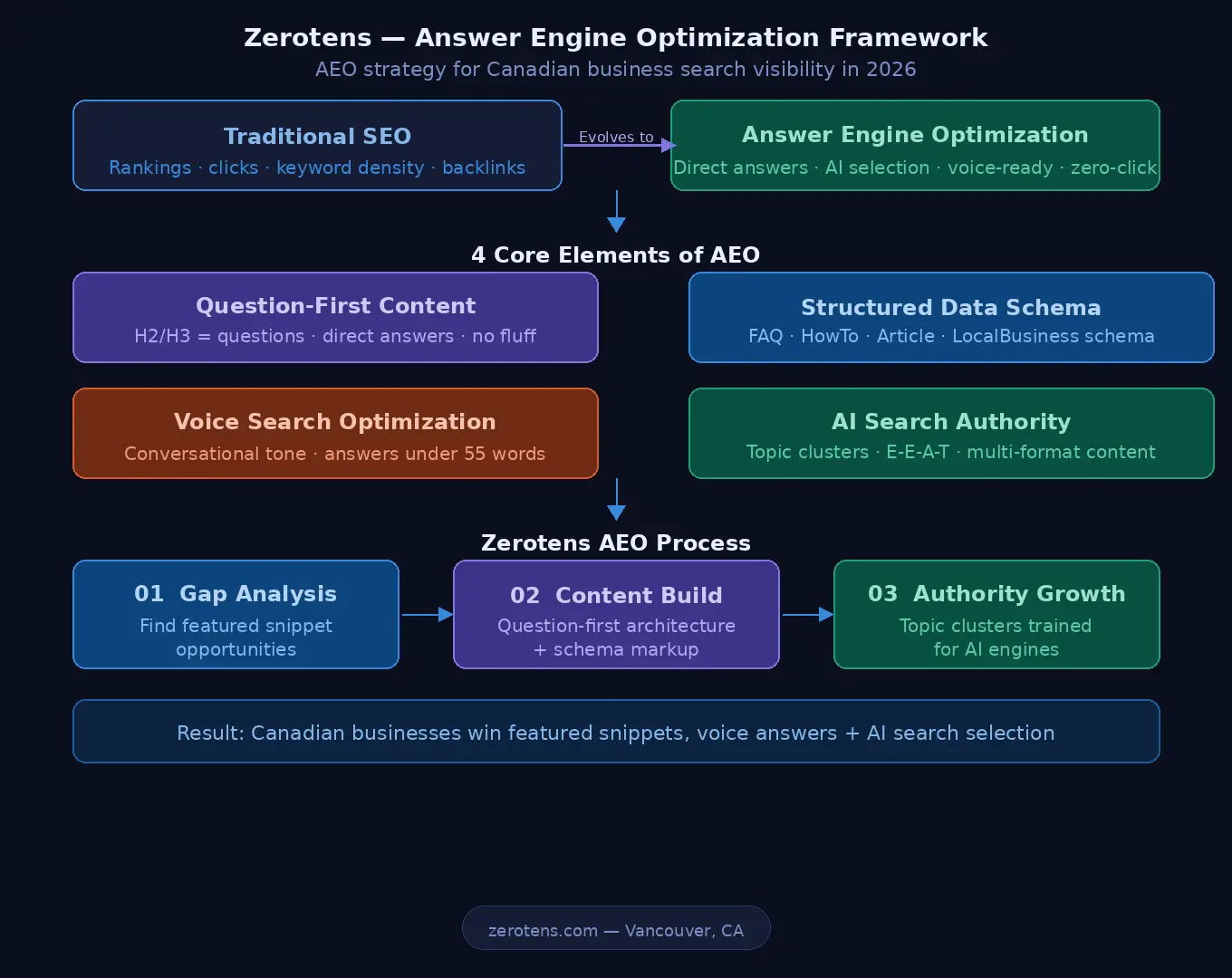
Building an effective Answer Engine Optimization strategy requires 4 core elements working in concert. Zerotens applies all 4 to every client engagement — because partial AEO implementation produces partial results, and partial results in a zero-click search environment means near-zero visibility.
Question-First Content Architecture
Answer Engine Optimization begins with a fundamental reorientation of how content is planned and written. Traditional SEO content starts with a keyword and builds an article around it. AEO content starts with a question — the exact phrasing a Canadian user would speak into a voice assistant or type into an AI search interface — and answers it directly in the opening sentence.
Zerotens conducts question mapping as the first step of every Answer Engine Optimization content project. Using tools including AlsoAsked, AnswerThePublic, and Google’s People Also Ask data, the team identifies the specific questions Canadian users ask about a client’s product, service, or industry. These questions become the structural foundation of every piece of content produced — each H2 and H3 heading is a question, and each section opens with a direct, concise answer before expanding into supporting detail.
This architecture serves 2 purposes simultaneously. It satisfies the AI search models that prioritize direct, structured responses. And it serves the human reader who wants an immediate answer and the option to read more — a combination that reduces bounce rate, increases time on page, and signals content quality to Google’s ranking algorithms.
Voice Search Optimization for Canadian Audiences
Voice search and Answer Engine Optimization are inseparable in 2026. Every voice query is a question. Every voice result is an answer pulled from a single source. Optimizing for voice search means optimizing every piece of content to be that source — written in the natural, conversational language that voice users speak rather than the clipped keyword phrases they type.
Canadian voice search behavior has specific linguistic patterns that Zerotens accounts for in every Answer Engine Optimization strategy. Bilingual query patterns in Quebec markets require French-language AEO implementation alongside English content. Regional terminology differences between Vancouver, Calgary, and Toronto audiences affect how questions are phrased — and therefore how answers must be structured to match them.
Sentence length is a critical voice search optimization variable. AI assistants read answers aloud — and answers longer than 29 words become difficult to follow aurally. Zerotens structures every featured snippet target answer at 40 to 55 words — long enough to be authoritative, short enough to be delivered as a clean voice response. This precision is what separates Answer Engine Optimization from general content improvement.
NEW POSSIBILITY
Let’s Build Something Smarter Together
Marketing Automation in Canada: How AI Turns Data into Customer Growth
How Zerotens Uses AEO to Win Featured Snippets
Zerotens’ approach to Answer Engine Optimization is built on a systematic featured snippet capture process that has delivered measurable results for Canadian clients across sectors including professional services, e-commerce, SaaS, and healthcare technology.
The process begins with featured snippet gap analysis — identifying the questions within a client’s topic space that currently return featured snippets owned by competitors or by AI-generated summaries with no specific source. These gaps represent direct Answer Engine Optimization opportunities: questions Canadian users are asking, answers currently being supplied by someone other than the client, and content that Zerotens can restructure to capture that position.
Each identified gap produces a content brief with a specific answer architecture — the exact question to target, the ideal answer length, the structured data schema to implement, the supporting content to include, and the internal linking structure to reinforce topical authority. For a Vancouver-based professional services firm Zerotens recently engaged, this process identified 34 featured snippet opportunities within the client’s core topic cluster. Within 90 days of implementation, the firm had captured 19 of those positions — producing a 41% increase in organic visibility without a single additional backlink.
Optimizing Content for AI Search Models
AI search models including ChatGPT Search, Perplexity AI, and Google Gemini represent the next frontier of Answer Engine Optimization. These platforms do not use traditional ranking algorithms. They evaluate content based on 3 primary criteria: authority signals, answer clarity, and source diversity. Zerotens builds all 3 into every AEO content strategy.
Authority signals for AI search models are established through consistent, structured content production across a defined topic cluster. A Canadian business that publishes 20 well-structured articles on a specific subject — each implementing Answer Engine Optimization principles, structured data, and question-first architecture — trains AI models to recognize it as an authoritative source on that subject. Zerotens builds these topic clusters strategically, mapping content production to the specific questions AI engines are most likely to synthesize answers for.
Answer clarity is evaluated by how directly and unambiguously a piece of content responds to a specific query. AI search models penalize content that hedges, qualifies excessively, or buries the answer in introductory paragraphs. Zerotens trains content teams on direct answer formatting — leading with the conclusion, supporting with evidence, and closing with context — a structure that serves both AI extraction and human comprehension simultaneously.
Source diversity means AI models prefer to synthesize answers from multiple content formats — paragraphs, lists, tables, and FAQs — within a single authoritative source. Zerotens implements this multi-format structure as standard in every Answer Engine Optimization content piece, ensuring AI engines have multiple extraction points from a single page rather than being forced to pull from competitor sources to complete their answer.
For Canadian businesses in regulated industries — healthcare, finance, legal services — Zerotens adds an additional layer of Answer Engine Optimization focused on E-E-A-T signals: Experience, Expertise, Authoritativeness, and Trustworthiness. These signals are increasingly important to AI search models evaluating which sources to cite in sensitive topic areas, and they require specific content and schema implementations that Zerotens delivers as part of every AEO engagement.
FAQ — Answer Engine Optimization Explained
1. What is Answer Engine Optimization? Answer Engine Optimization is the practice of structuring content so AI-powered search engines, voice assistants, and featured snippet algorithms select it as the authoritative answer to a user’s question. It combines structured data, question-first content architecture, and conversational formatting to win zero-click search visibility.
2. How is AEO different from SEO? SEO optimizes for rankings and click-through traffic. Answer Engine Optimization optimizes for direct answer selection by AI engines and voice assistants. AEO vs SEO is not either/or — AEO builds on an SEO foundation and adds the structured, question-first content layer that captures featured snippets and AI search responses.
3. Why does AEO matter for voice search? Voice search returns exactly one answer per query. That answer is pulled from a featured snippet or structured data source. Answer Engine Optimization ensures your content is the source selected — written in conversational language, structured for direct extraction, and formatted to be delivered clearly in a voice response under 55 words.
4. How can Zerotens optimize content for AEO? Zerotens runs a featured snippet gap analysis, builds question-first content architecture, implements structured data schema, and produces topic cluster content that trains AI search models to recognize Canadian clients as authoritative sources. Results are measurable within 60 to 90 days of implementation.
5. What’s the future of AI-powered search? AI search models will continue replacing traditional link-based results with synthesized answers. By 2027, Gartner projects a 25% reduction in traditional search engine volume as users migrate to AI interfaces. Answer Engine Optimization is the strategy that keeps Canadian businesses visible in this new search environment.
Want your content to become the answer AI search engines choose? Connect with Zerotens to build an Answer Engine Optimization strategy that improves featured snippet visibility, voice search performance, and authority across AI-powered search platforms.Conclusion
Answer Engine Optimization is not a future consideration — it is a present competitive reality for every Canadian business that depends on search visibility to generate leads, traffic, and revenue. The search landscape of 2026 rewards content that answers directly, structures intelligently, and signals authority to AI engines. It does not reward content that simply contains the right keywords.
Zerotens builds Answer Engine Optimization into every content engagement — combining featured snippet capture, structured data implementation, voice search optimization, and AI search authority signals into one unified strategy. The result is content that performs in traditional search, wins featured snippets, and gets selected by AI engines as the authoritative answer for the questions Canadian users ask every day.
If your content is ranking but not converting, visible but not selected, present but not authoritative — the gap between where you are and where you need to be is an Answer Engine Optimization gap. And that is exactly what Zerotens closes.