
Introduction
A marketing intelligence platform is the infrastructure that separates Canadian businesses making marketing decisions on evidence from those making them on instinct — and the gap between these 2 operating modes compounds with every campaign cycle. When budget is allocated based on last quarter’s impression count instead of this quarter’s revenue attribution, when campaign creative is renewed based on team preference instead of audience response data, and when channel investment is defended with traffic metrics instead of customer acquisition cost, the result is marketing spending that is confidently deployed and poorly optimized — generating activity rather than measurable business growth.
The difference between marketing departments that consistently improve their performance and those that cycle through creative refreshes without improving their fundamental economics is almost always a measurement discipline question rather than a creative quality question. Marketing analytics capability determines whether a team can identify which specific combinations of channel, audience, message, and timing are producing revenue — and which are consuming budget without proportional commercial return. Without this capability, every budget cycle is a fresh guess rather than a progressively more informed investment guided by accumulated evidence.
For Vancouver businesses competing across Canadian and North American markets, a marketing intelligence platform has moved from a competitive advantage available to well-resourced organizations into a commercial necessity for any business that wants its marketing function to operate as a revenue driver rather than a cost centre. This article examines what a marketing intelligence platform actually delivers, the specific ROI mechanisms it activates, and how Zerotens builds these systems for Canadian organizations ready to replace guessing with knowing.

What Is a Marketing Intelligence Platform?
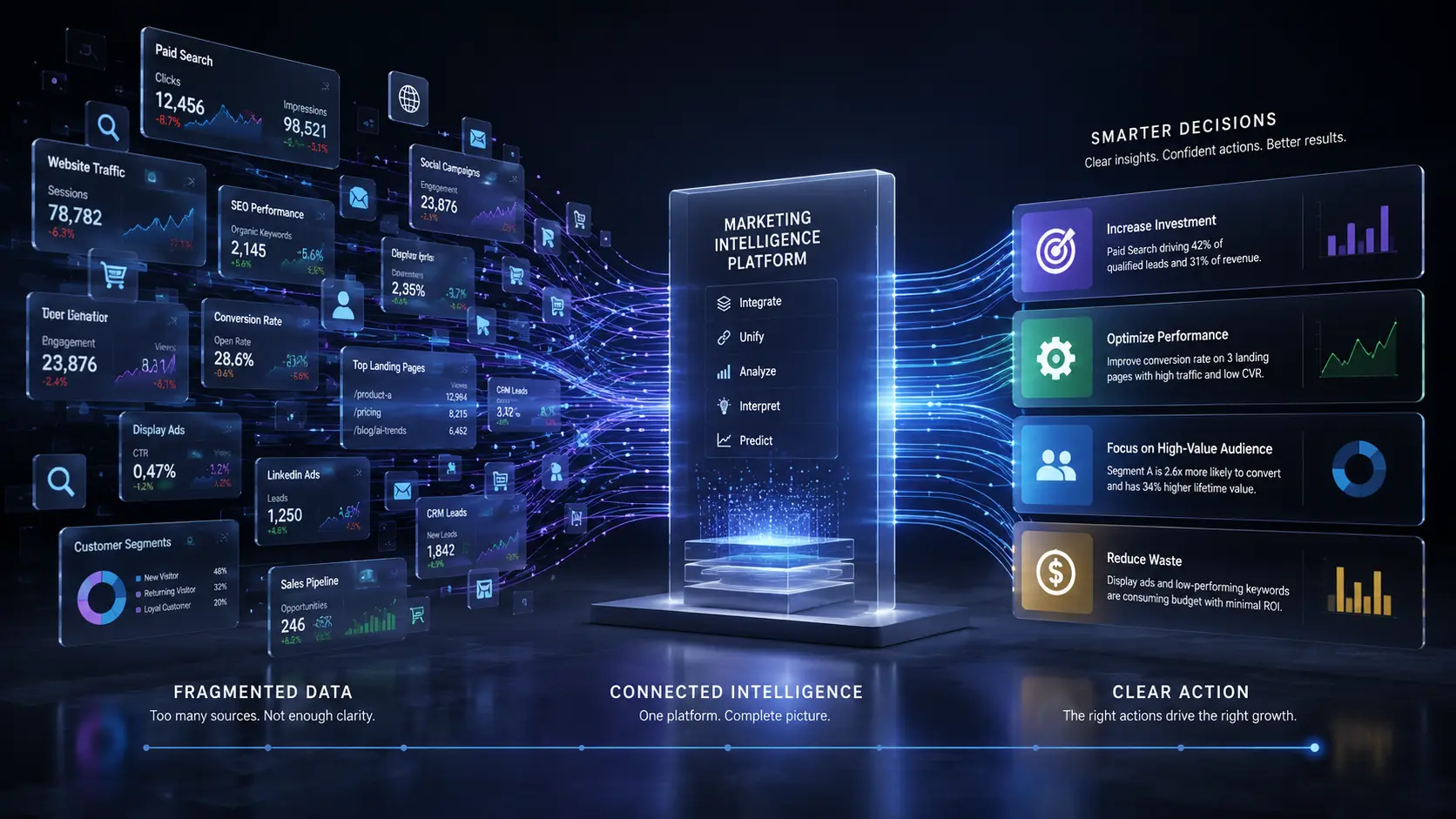
A marketing intelligence platform is an integrated data system that consolidates marketing performance data from every channel and campaign the organization runs — paid search, social media advertising, email, content, SEO, events, and any other marketing activity generating measurable signals — and transforms that consolidated data into the unified, real-time marketing analytics that allow marketing and business leaders to understand what is actually driving commercial outcomes across their full marketing ecosystem. The platform eliminates the data silos that prevent most marketing teams from forming an accurate picture of their marketing performance at any given moment.
The fundamental problem that a marketing intelligence platform solves is data fragmentation — the state most Canadian marketing teams live in, where Google Ads data lives in Google Ads, Meta data lives in Meta Business Manager, email metrics live in Mailchimp or HubSpot, SEO data lives in Search Console, and no single view shows how all of these channels interact to produce the customer acquisition and revenue outcomes the business cares about. A properly designed marketing intelligence platform consolidates every channel’s data into a single analytical environment — allowing marketers to ask questions that no individual channel tool can answer.
Marketing Reporting vs Marketing Intelligence
The distinction between conventional marketing reporting and a genuine marketing intelligence platform is the difference between describing the past and informing the future. Marketing reporting produces retrospective summaries — impressions, clicks, open rates, and conversion counts from the previous period — that confirm what happened without providing actionable guidance about what should happen next. Marketing intelligence integrates these signals with revenue and customer data to produce forward-looking guidance: which campaigns are generating the customers with the highest lifetime value, which audience segments are converting at the highest margin, and where incremental budget investment is most likely to generate proportional revenue return.
Zerotens designs every marketing intelligence platform with this forward-looking function as the primary objective — ensuring that the dashboards, alerts, and analytical outputs the platform produces are structured around the decisions the marketing and business leadership team needs to make rather than around the metrics the data tools happen to make easy to report. This decision-oriented design is what separates platforms that change marketing behaviour from those that generate elaborate reports that marketing teams review, acknowledge, and do not act on differently from how they acted before.
Data Integration and the Unified View
The technical foundation of a marketing intelligence platform is the data pipeline that connects every source of marketing and commercial data into a single analytical environment — typically a cloud data warehouse that receives automated feeds from every marketing channel, CRM, e-commerce platform, and financial system the organization operates. Building this unified data layer is the most technically demanding and most commercially critical component of the implementation — because the intelligence the platform produces is only as complete and accurate as the data infrastructure supporting it.
For Vancouver businesses and Canadian organizations across North America with mature marketing technology stacks spanning multiple channel tools, CRM systems, and analytics platforms, the integration work frequently surfaces data quality and consistency issues that were invisible when each tool was reviewed in isolation. Zerotens conducts a data audit at the outset of every platform engagement, mapping every data source, identifying quality and consistency gaps, and designing the pipeline architecture before development begins — preventing mid-implementation discoveries that compromise both timelines and the eventual quality of marketing analytics the platform produces.

Benefits of a Marketing Intelligence Platform
A marketing intelligence platform delivers its commercial benefits across 3 interconnected dimensions that each improve as the platform accumulates data and the team develops the analytical habits that data availability makes possible. The first dimension is budget efficiency — the elimination of spending on channels, audiences, and campaigns that are consuming budget without generating proportional revenue. The second is speed — the ability to identify underperformance and reallocate budget within days rather than after the full campaign period has expired and results are reviewed at the next quarterly planning meeting. The third is compounding improvement — each campaign cycle producing better results than the last because every decision is guided by accumulated marketing performance evidence.
Marketing dashboards built within a properly designed marketing intelligence platform give marketing leaders real-time visibility into every campaign’s commercial performance rather than the channel-specific metrics that individual tools report. A marketing leader who can see, in a single view, the revenue attributed to every active campaign across every channel — alongside the customer acquisition cost, average deal value, and customer lifetime value generated by each — can make budget reallocation decisions in minutes that would otherwise require days of manual data extraction and analysis.
Customer Insights and Segmentation
Customer analytics capability within a marketing intelligence platform transforms the understanding of audience segments from demographic approximations into precise, behaviour-based profiles informed by actual purchase and engagement history. When a platform can correlate the specific campaigns, content pieces, and channel touchpoints that preceded each customer’s first purchase with the subsequent lifetime value those customers generated, the marketing team gains customer insights that cannot be formed from channel-level data alone — intelligence that directly informs how acquisition budgets should be allocated across segments and channels to maximize lifetime value rather than only first-purchase conversion.
For Canadian B2B businesses where customer lifetime value varies significantly across segment, industry, and acquisition channel, this customer insights dimension of a marketing intelligence platform frequently produces the most commercially significant findings — revealing that the acquisition channels driving the highest inquiry volume are not the same as the channels driving the highest lifetime value customers. Reallocating budget toward channels that consistently generate high-LTV customers rather than high-volume inquiries is the kind of strategic shift that marketing intelligence makes visible and justifiable where channel-level reporting would keep it invisible.
Marketing Performance Improvement Over Time
LET’S CONNECT
Ready to Start a Project?
Tell us what you’re building,
and the ZEROTENS team will help
you shape the next step.
Marketing performance compounds in organizations that operate a marketing intelligence platform consistently — each campaign cycle adding to the accumulated body of evidence about what works for the specific organization’s specific audience in the specific competitive context it operates in. This accumulated evidence is the most valuable asset a marketing function can build, because it is both proprietary and self-reinforcing — the more campaigns run on intelligence rather than instinct, the more accurate and actionable the intelligence becomes for subsequent campaigns.
The compounding improvement trajectory that a marketing intelligence platform enables typically becomes visible within 3 to 4 campaign cycles of consistent operation — the point at which the platform has accumulated enough comparative data to begin distinguishing reliable signal from campaign-to-campaign noise. For Vancouver businesses with quarterly or annual planning cycles, this means the platform typically begins producing its most commercially significant guidance within 6 to 12 months of initial deployment — and continues improving indefinitely as the evidence base grows.

How a Marketing Intelligence Platform Improves Marketing ROI
A marketing intelligence platform improves marketing ROI through a mechanism that is both immediate and compounding: by eliminating the budget allocated to channels, audiences, and creative approaches that are generating activity without generating revenue, and redirecting that budget toward the combinations that are consistently producing the customer acquisitions and revenue growth the business is investing in marketing to create. The immediate ROI improvement comes from budget reallocation. The compounding improvement comes from the progressively more accurate allocation decisions that accumulated marketing performance data enables.
Campaign Analysis
Campaign intelligence at the granular level — understanding not just which campaigns generated the most conversions but which generated the highest-quality customers, the lowest churn rates, and the strongest referral behaviour in the months after acquisition — is the analytical capability that transforms marketing from a cost centre into a revenue engine. A marketing intelligence platform that connects campaign attribution data with CRM and revenue outcomes can answer the question that channel-level metrics never can: of all the budget spent last quarter, which specific allocation produced the customers worth the most to the business over a 2 or 3 year horizon?
Attribution tracking within a marketing intelligence platform is the technical mechanism that makes campaign-to-revenue connection visible — assigning revenue credit to the specific touchpoints in the customer journey that preceded each purchase, across the full multi-touch sequence from first awareness through final conversion. Multi-touch attribution models that distribute credit across the complete customer journey consistently produce more accurate marketing allocation guidance than last-click models that attribute all revenue to the final touchpoint — regardless of how many prior touchpoints built the awareness and consideration that made the final click convert.
Audience Insights
Audience insights from a marketing intelligence platform extend beyond the demographic and interest targeting categories that advertising platforms provide into behavioural intelligence about how specific audience segments engage with content, move through the consideration journey, and respond to specific creative and message approaches. A marketing team with access to this level of audience intelligence can build lookalike acquisition strategies around its highest-value customer profiles rather than its highest-volume customer profiles — a meaningful distinction for any Canadian business where value concentration among top customers is significant.
According to research from McKinsey and Company on data-driven marketing, organizations that deploy unified marketing analytics with multi-touch attribution and customer lifetime value integration consistently report 15 to 20 percent stronger marketing ROI than those relying on channel-level reporting and last-click attribution models — making marketing intelligence platform investment one of the highest-return technology decisions available to Canadian marketing organizations.
Attribution Tracking Across the Full Customer Journey
Attribution tracking across the complete customer journey is the capability that most directly converts a marketing intelligence platform from a reporting tool into a genuine revenue optimization instrument. When every touchpoint in a customer’s path from first brand awareness through final purchase is tracked, credited, and correlated with that customer’s eventual lifetime value, the marketing team can identify not just which campaigns generate conversions but which combinations of upper-funnel awareness, mid-funnel education, and lower-funnel conversion activity consistently produce the customers worth the most to the business — intelligence that guides investment across the complete marketing funnel rather than only at the bottom.
How Zerotens Develops Marketing Intelligence Platforms
Zerotens develops every marketing intelligence platform through a discovery process that begins with the commercial decisions the marketing and business leadership team needs to make rather than with the data sources available to connect. This decision-first approach is the foundational discipline that separates platforms built around business objectives from those built around technical capabilities that generate impressive dashboards the team eventually stops reviewing because the metrics displayed do not connect to the decisions they need to make day to day.
The discovery process maps the specific marketing allocation and optimization decisions the team faces on a weekly, monthly, and quarterly basis — identifying which of those decisions are currently made with insufficient data, which data sources would provide the missing intelligence, and what marketing dashboards and alert systems would deliver that intelligence to the right people in the format they can act on most effectively. This decision-to-data mapping process is what produces a marketing intelligence platform that serves the specific operating reality of each Canadian client rather than a generic analytics environment designed for a hypothetical business with hypothetical decisions.
Technical Architecture and Data Pipeline
Zerotens designs the data pipeline architecture for every marketing intelligence platform with 3 foundational requirements: completeness, reliability, and latency. Completeness means every relevant marketing data source is connected and feeding into the unified data environment — no channel is excluded because its API is inconvenient to connect, and no commercial outcome data is left outside the analytical environment because it lives in a different system. Reliability means every connection operates continuously with automated monitoring and alerting that identifies data gaps before they compromise the quality of marketing performance analysis. Latency means data is available in the platform within the time window that meaningful marketing decisions require.
For Vancouver businesses operating marketing stacks spanning 8 to 15 different tools — common across organizations with mature digital marketing practices — the pipeline architecture Zerotens designs connects every significant data source without requiring the replacement of existing marketing technology investments that are functioning effectively. The marketing intelligence platform is built on top of existing tools rather than instead of them — aggregating and synthesizing their individual outputs into the unified intelligence layer that no individual tool in the stack can provide by itself.
Dashboard Design and Team Adoption
The marketing intelligence platform’s commercial value is realized only when the team uses it to make different and better decisions — making adoption and usability design as commercially important as the underlying data architecture. Zerotens designs marketing dashboards and alert systems for each specific user role within the marketing and leadership team — ensuring that a channel manager sees the granular campaign intelligence their optimization decisions require, while a CMO sees the portfolio-level marketing performance overview their strategic allocation decisions require — without either audience viewing a dashboard designed for the other’s needs.
Post-deployment training and adoption support from Zerotens ensures that every member of the marketing team who should be using the marketing intelligence platform understands how to interpret its outputs, what questions it can answer, and how to integrate its guidance into their daily and weekly decision workflows. This adoption investment is what converts a technical analytics capability into the organizational behaviour change that actually improves marketing ROI in practice rather than in theory.
Future Trends in Marketing Intelligence Platforms
Marketing intelligence platforms are evolving rapidly toward AI-native capability that replaces manual analysis with automated insight generation — shifting the marketing team’s relationship with data from one of extraction and interpretation to one of review and action. The most significant near-term developments include AI-generated campaign performance narratives that summarize what happened and why in natural language, predictive budget optimization models that recommend allocation changes before underperformance becomes visible in manual review, and real-time audience segmentation that adjusts targeting automatically based on live engagement signals rather than static historical segments.
For Canadian organizations making marketing intelligence platform investment decisions now, these near-term AI capability developments have important architectural implications. The data infrastructure, pipeline reliability, and unified data environment built through current platform implementations are the exact foundation that AI-native marketing analytics capability will require — making current investment a direct enabler of future capability rather than a system that will need to be rebuilt when next-generation AI marketing tools become commercially accessible across North American markets.
AI-Driven Customer Analytics
Customer analytics powered by machine learning is already extending beyond retrospective segmentation into predictive audience intelligence — identifying which current customers are most likely to respond to specific campaign approaches, which prospect profiles are most likely to convert at premium price points, and which audience segments are showing early churn signals that targeted re-engagement campaigns should address before they result in lost revenue. These predictive customer analytics capabilities are becoming standard features of enterprise marketing intelligence platforms and will be accessible to organizations of every scale within the next 2 to 3 years.
Real-Time Attribution and Incrementality Testing
Attribution tracking is evolving toward incrementality testing — the ability to measure not just which touchpoints preceded a conversion but whether specific marketing investments actually caused additional conversions that would not have occurred without them. This incrementality capability represents the highest standard of marketing performance measurement currently available, and it is becoming increasingly accessible to Canadian businesses through the cloud-based marketing intelligence platforms that are building incrementality testing into their standard analytical toolsets.
ZEROTENS INSIGHT
Let’s Build Something Smarter Together
Intelligent Document Processing: Automating Document Workflows with AI

FAQ — Marketing Intelligence Platform
What is a marketing intelligence platform?
A marketing intelligence platform is an integrated system that consolidates marketing and commercial data from every channel into a unified analytical environment — producing the marketing analytics, attribution tracking, and campaign performance intelligence that guides budget allocation and marketing strategy decisions.
Why do businesses need a marketing intelligence platform?
Without a marketing intelligence platform, marketing decisions rely on fragmented channel-level metrics that cannot show which combinations of channel, audience, and creative are generating revenue — leading to budget allocation that optimizes activity instead of commercial outcomes.
How does a marketing intelligence platform improve ROI?
By eliminating spending on channels and audiences that generate activity without generating revenue, and redirecting budget toward the combinations consistently producing the highest-value customers. Each campaign cycle guided by the platform produces stronger results than the last.
What data sources connect to a marketing intelligence platform?
Paid search, social media advertising, email platforms, SEO tools, CRM systems, e-commerce platforms, customer data warehouses, and any other source generating marketing or commercial data. Zerotens connects every relevant source for each client into a single unified analytical environment.
How does Zerotens build marketing intelligence platforms?
Zerotens begins with decision mapping — identifying the specific marketing allocation decisions each client needs to make better — then designs the data pipeline, builds marketing dashboards calibrated to each user role, and provides adoption support that converts technical capability into actual decision improvement.
Ready to turn fragmented marketing data into smarter growth decisions? Connect with Zerotens to build a marketing intelligence platform that unifies your channels, reveals what truly drives revenue, and helps your team optimize campaigns and budgets with confidence.
Conclusion
A marketing intelligence platform is the operational infrastructure that determines whether a Canadian business’s marketing function improves systematically with each campaign cycle or repeats the same allocation decisions indefinitely without the evidence to know whether they are working. The organizations that build this infrastructure now are accumulating the marketing performance data, customer insights, and attribution intelligence that will compound in commercial value with every subsequent campaign — progressively widening the performance gap between their marketing outcomes and those of competitors still making decisions without comparable intelligence.
Zerotens builds marketing intelligence platforms for Vancouver and Canadian businesses through a structured engagement that begins with commercial decision mapping, designs data pipelines built for completeness and reliability, and delivers dashboards and adoption support that convert analytical capability into the actual decision behaviour change that improves marketing ROI. Every platform is designed for the specific organization’s specific decisions — not for a generic marketing function that does not exist.
If your marketing decisions deserve to be informed by evidence rather than driven by instinct, a marketing intelligence platform built with Zerotens is exactly where that transformation begins.