
Introduction
Intelligent document processing is the AI-powered capability that eliminates one of the most persistent and costly sources of administrative overhead in Canadian businesses — the manual handling, data entry, and routing of the invoices, contracts, applications, purchase orders, and compliance documents that flow through every organization’s operations daily. Documents arrive in dozens of formats from dozens of sources, each containing structured information that downstream systems and workflows require — and extracting that information manually is slow, error-prone, and scales proportionally with transaction volume in a way that compounds the cost of growth rather than declining with it.
The scale of the document processing challenge across Canadian businesses is larger than most organizations formally recognize. When every supplier invoice requires a staff member to open, read, key data into an ERP or accounting system, route for approval, and file — and when this sequence repeats hundreds or thousands of times per month — the cumulative labour cost, error rate, and processing delay represent a significant drag on both operational efficiency and working capital management. AI document processing that handles this sequence autonomously — reading any document format, extracting relevant fields with high accuracy, routing for exception handling when confidence is low, and integrating extracted data directly into downstream systems — converts this drag into a competitive advantage.
For Vancouver businesses managing high-volume document workflows across finance, procurement, legal, and compliance functions, intelligent document processing has moved from an enterprise-scale technology into a commercially deployable capability accessible to organizations of every size. This article examines what intelligent document processing actually delivers, the specific operational outcomes it generates for Canadian businesses across every document category, and how Zerotens builds these systems to solve real document workflow problems rather than impressive demonstrations that fail in production complexity.
What Is Intelligent Document Processing?
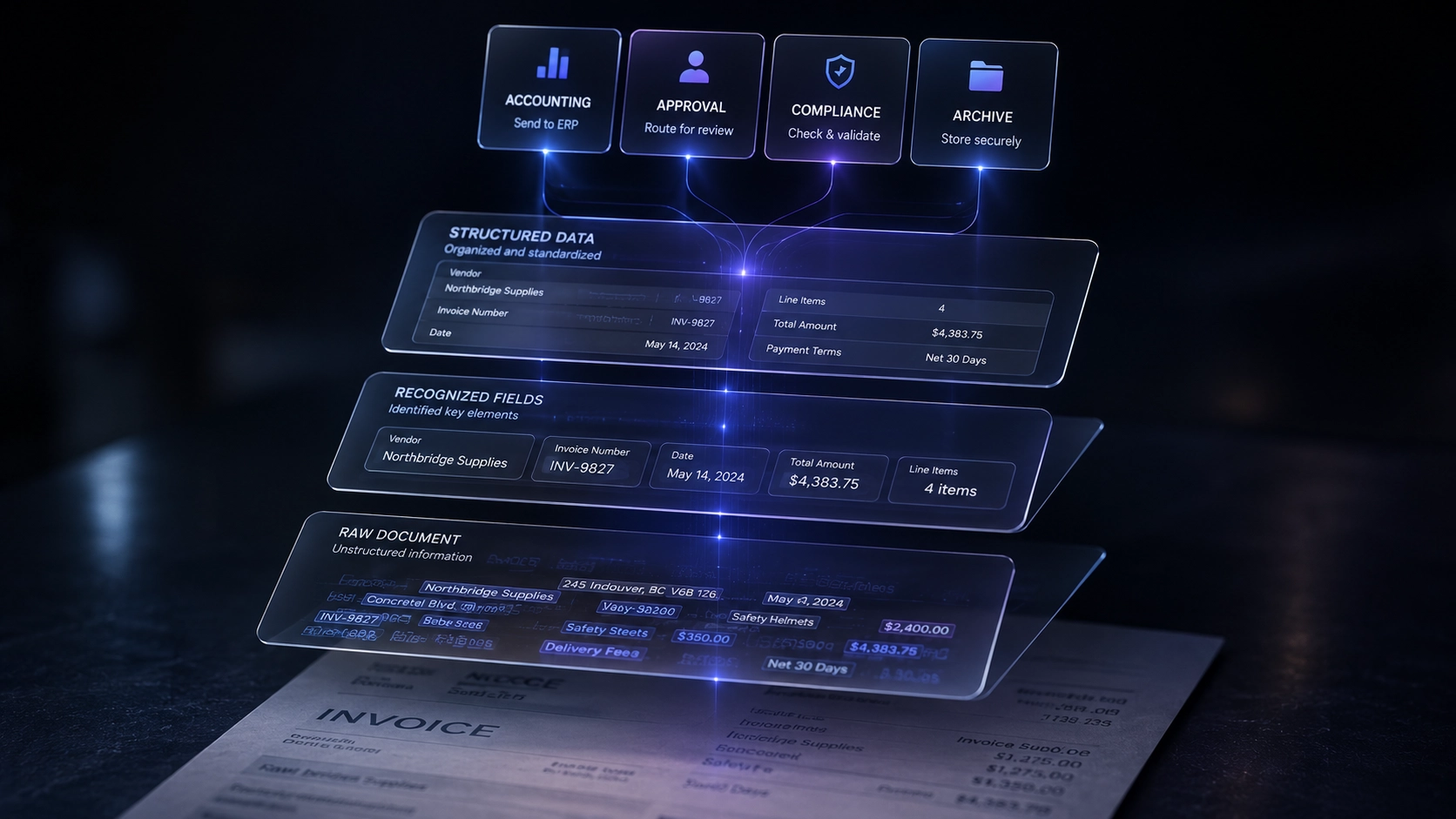
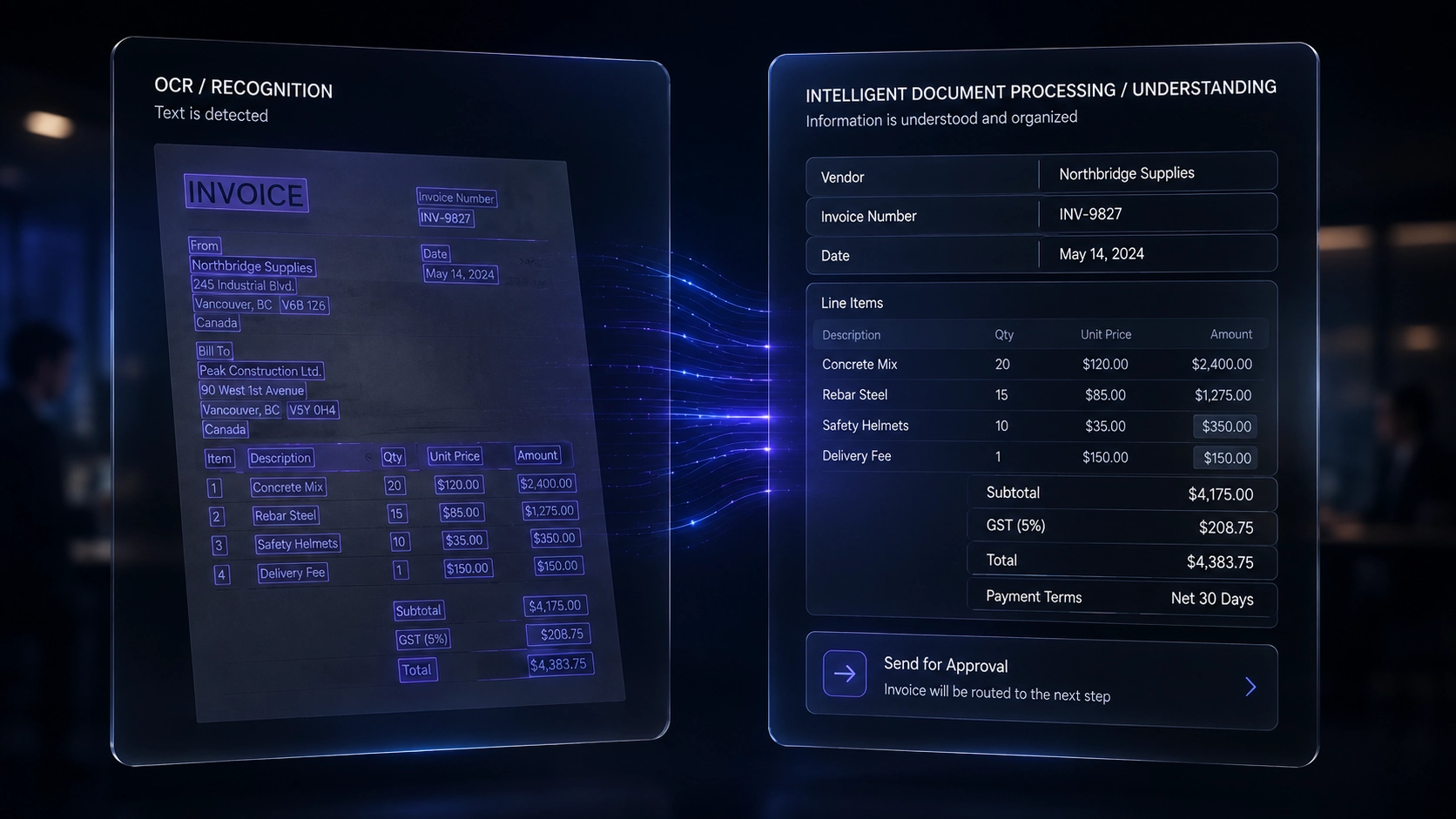
Intelligent document processing is the combination of OCR automation, natural language processing, and machine learning that extracts structured data from unstructured or semi-structured documents — regardless of format, layout, or source — and routes that data into downstream business systems and workflows without requiring manual data entry at any step. This distinguishes it fundamentally from conventional OCR technology, which converts document images to machine-readable text but cannot identify what that text means, which fields it belongs to, or what downstream action it should trigger. Intelligent document processing adds comprehension to recognition — understanding not just what words appear in a document but what those words represent in the context of the specific document type being processed.
The practical difference between conventional OCR and intelligent document processing is commercially significant for Canadian businesses managing varied document inputs. A traditional OCR system configured to process a specific invoice template fails on any invoice that deviates from that template — a different supplier layout, a different field arrangement, a different currency or date format. Intelligent OCR learns the structure and semantic meaning of invoice data across varied supplier formats, extracting vendor name, invoice number, line items, totals, and payment terms accurately regardless of how each specific supplier chooses to lay out their document.
The Technology Stack Behind IDP
Modern intelligent document processing systems combine several AI components that work in sequence to convert raw document inputs into actionable structured data. Computer vision models handle document classification — determining whether an incoming document is an invoice, a contract, a purchase order, or an application form — before passing it to the appropriate extraction model for that document type. Named entity recognition and semantic understanding mod
els then identify and extract the specific data fields the downstream workflow requires, validated against business rules and confidence thresholds before the extracted data is passed to downstream systems.
Document digitization sits at the beginning of this pipeline — converting physical documents, scanned images, and emailed PDFs into the digital format that AI extraction models can process. Zerotens designs the full pipeline for every intelligent document processing engagement — from ingestion and digitization through classification, extraction, validation, and system integration — ensuring that every step of the document workflow is automated coherently rather than addressing individual steps in isolation while leaving manual intervention requirements at the seams between automated components.
IDP vs Traditional OCR: What Actually Differs
The most important distinction between intelligent document processing and traditional OCR automation is adaptability. Traditional OCR requires explicit templates or rules for every document format it processes — when a new supplier uses a different invoice layout, the template must be manually updated before the system can process the new format. Intelligent document processing adapts to new formats through pattern learning — identifying the semantic structure of new document types and extracting the required fields without requiring manual template configuration for each variation.
For Vancouver businesses receiving documents from dozens of suppliers, clients, or regulatory bodies — each using different formats, layouts, and conventions — this adaptability is the difference between an automation system that requires constant maintenance to stay current with format variations and one that handles new document types without manual intervention. The operational savings from eliminating template maintenance overhead frequently represent a significant portion of the total ROI from intelligent document processing deployment.
Benefits of Intelligent Document Processing
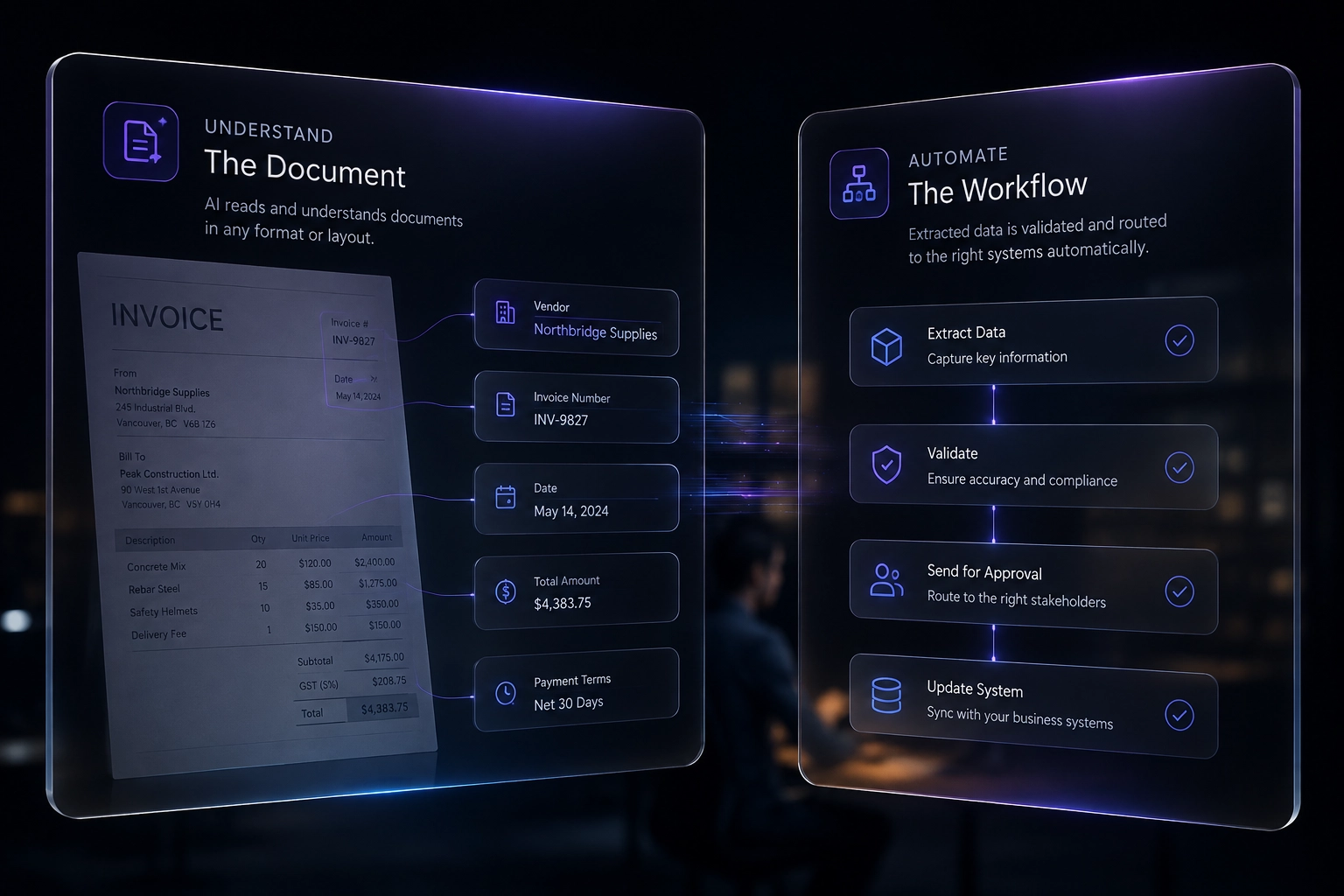
Intelligent document processing delivers its commercial benefits across 4 dimensions simultaneously — speed, accuracy, cost, and scalability — that each compound in value as the volume of documents processed through the system grows. Speed improvement is immediately visible: documents that required 3 to 5 minutes of manual handling per document are processed in seconds. Accuracy improvement follows: machine learning extraction models trained on domain-specific document types consistently achieve accuracy rates of 95% or higher on clean digital documents — meaningfully exceeding the accuracy of manual data entry under volume pressure and deadline conditions.
The cost reduction dimension compounds with transaction volume in the opposite direction from manual processing — the per-document processing cost of an automated system decreases as volume scales, while the per-document cost of manual processing remains flat or increases as volume-related errors and overtime requirements add to the baseline labour cost of each transaction. For Canadian businesses with growing document volumes, this cost trajectory inversion is the most financially significant argument for document automation investment.
Error Reduction and Compliance Improvement
Manual data entry errors in document processing generate downstream costs that are frequently 5 to 10 times the direct cost of the original entry error itself. An incorrect amount keyed from a supplier invoice into an accounts payable system creates an overpayment or underpayment that requires investigation, correction correspondence, credit note processing, and in some cases supplier relationship management — all costs generated by a single keystroke error that intelligent document processing prevents at the source. For Canadian businesses in regulated sectors where document accuracy carries legal and compliance implications, this error prevention value extends beyond operational cost into regulatory risk reduction.
Workflow automation that routes exception documents — and workflow automation at this level — those where AI extraction confidence falls below a defined threshold — directly to human reviewers for verification creates a productive human-AI collaboration model. Human reviewers focus their attention on the genuinely ambiguous cases that require judgment rather than spending equivalent time on every routine document regardless of complexity. This concentration of human attention on exception handling typically reduces the total human processing time required by 70% to 85% while maintaining oversight over the cases where automation confidence is lowest.
Scalability Without Proportional Cost
The scalability advantage of this technology is its most strategically significant benefit for Canadian businesses with growth ambitions. An automated document processing system that handles 1,000 invoices per month handles 10,000 per month at essentially the same per-document cost — with no degradation in speed, accuracy, or throughput regardless of volume. Manual processing scales linearly: 10 times the volume requires approximately 10 times the staffing, with the added complication that document processing staff are typically difficult to hire, train, and retain given the repetitive nature of the work.
For Vancouver businesses and organizations across North America anticipating significant growth, this infrastructure built now eliminates a major scaling bottleneck before it becomes a constraint on operational capacity. The businesses that build this infrastructure during moderate growth periods reach their next growth phase with document processing capacity already in place rather than scrambling to hire and train processing staff after the volume surge has already arrived.
ZEROTENS INSIGHT
Let’s Build Something Smarter Together
Predictive Analytics for Business: Using Data to Make Better Decisions

How Intelligent Document Processing Improves Business Operations
Intelligent document processing improves business operations most visibly in the high-volume document categories — document digitization included — where manual processing creates the greatest bottlenecks — accounts payable processing, contract review and data extraction, loan and insurance application handling, regulatory compliance documentation, and any other document workflow where transaction volumes are high, format variation is significant, and the cost of errors is commercially meaningful. Across each of these categories, AI document processing converts a manual execution bottleneck into an automated throughput capability that improves simultaneously on speed, accuracy, and cost.
Invoice Processing
Invoice processing is the highest-volume and most commercially impactful application of intelligent document processing for most Canadian businesses — combining high transaction frequency across North American supplier networks, significant format variation, and meaningful downstream financial consequences when processing errors occur. An intelligent document processing system for accounts payable receives supplier invoices in any format — PDF, email attachment, scanned physical document, or EDI transmission — extracts vendor identification, invoice number, line items, tax amounts, and payment terms, validates extracted data against purchase orders and contract terms, and routes the validated invoice directly into the ERP or accounting system for payment processing.
The accounts payable teams that have deployed AI extraction for invoice processing consistently report processing time reductions of 75% to 85% per invoice — converting 3 to 5 minutes of manual handling into 20 to 30 seconds of automated processing and exception review. For a business processing 500 invoices per month, this time reduction represents approximately 30 to 40 hours of recovered staff capacity per month — capacity that finance teams can redirect toward analysis, supplier relationship management, and financial planning work that delivers genuine strategic value.
Contract Processing
Contract processing presents a more complex but equally valuable intelligent document processing application — extracting key terms, obligations, dates, and risk indicators from legal documents whose length, complexity, and drafting variation make manual review time-consuming and prone to oversight. Document intelligence models trained on contract corpora can identify and extract renewal dates, termination clauses, liability caps, key obligations, and non-standard terms across diverse contract formats and governing law variations — flagging high-risk provisions for legal review while handling routine extraction automatically.
For Canadian professional services firms, technology companies, and any organization managing significant contract portfolios, document intelligence applied to contract processing reduces the legal review time required per contract, improves consistency of key term identification across the full contract portfolio, and creates a searchable, structured database of obligation and risk data that manual filing systems cannot provide. Zerotens has implemented contract AI document processing systems for Vancouver clients that reduced contract review time by 60% while improving key term capture rates above 95% — performance levels that manual review teams under volume pressure cannot consistently maintain.
How Zerotens Implements Intelligent Document Processing
Zerotens approaches every intelligent document processing engagement through a document workflow discovery phase that maps the specific document types, volume characteristics, format variations, downstream system requirements, and exception handling rules that define the target automation environment before any model development begins. This discovery phase is not a formality — it is the phase where the most commercially important decisions are made about which document categories to automate first, what accuracy thresholds to set for autonomous processing versus human review routing, and which downstream system integrations are required to make extracted data immediately actionable.
The extraction model development phase of every Zerotens engagement begins with training data collection — gathering a representative sample of the actual documents the system will process, annotated with the correct extracted values for each field. This domain-specific training data is what distinguishes models that perform accurately on real Canadian business documents from generic AI extraction models trained on datasets that may not reflect the specific supplier formats, regulatory document conventions, and business terminology relevant to each client’s specific document environment.
System Integration and Workflow Connection
The commercial value of intelligent document processing depends entirely on the quality of its integration with downstream business systems — because extracted data that must be manually transferred from an extraction interface into an ERP, accounting system, or CRM has simply moved the manual step from document reading to data transcription, without eliminating the human handling requirement that document automation is designed to remove. Zerotens builds API integrations between extraction systems and every downstream platform the client operates — ensuring extracted data flows automatically into the systems where it will be used without any manual transfer step between extraction and application.
According to research from McKinsey and Company on AI and automation, organizations that integrate AI extraction directly into operational workflows — rather than deploying it as a standalone tool requiring manual data transfer — consistently report 2 to 3 times stronger ROI from intelligent document processing deployments than those where integration gaps require human handoffs between automated and manual steps.
Accuracy Benchmarking and Continuous Improvement
Every system Zerotens deploys includes an accuracy benchmarking framework that measures extraction accuracy against ground truth across every document field and document type in production — providing continuous visibility into where the system is performing within target accuracy thresholds and where additional model training or rule refinement is required. This monitoring infrastructure is what enables the systematic accuracy improvement that distinguishes intelligent document processing systems that improve over time from those that plateau at their initial deployment accuracy level.
Post-deployment optimization at Zerotens includes quarterly model retraining cycles that incorporate exception documents from production operations into the training dataset — progressively improving accuracy on the edge cases and format variations that challenged the initial model. This retraining approach consistently produces meaningful accuracy gains in the 6 to 12 months following initial deployment, as the model learns from the full diversity of real document inputs it encounters rather than only the training sample it was initially built on.
Ready to eliminate manual document processing and turn high-volume paperwork into automated workflows? Connect with Zerotens to build an intelligent document processing system that extracts, validates, and routes business data automatically—reducing errors, processing time, and operational costs as your organization scales.
Future Trends in Intelligent Document Processing
Intelligent document processing is evolving rapidly across 3 dimensions simultaneously — accuracy, scope, and integration depth — driven by advances in large language model capability, multimodal AI that combines visual and language understanding, and the expanding data infrastructure that enterprise organizations are building as they mature their AI adoption programs. The most significant near-term developments affecting Canadian business document workflows include generative AI-powered document intelligence that can summarize contract provisions in natural language, multimodal models that process mixed text-and-image documents without specialized configuration, and agentic document workflows that handle exception resolution autonomously without routing to human reviewers.
For Canadian businesses making intelligent document processing investment decisions now, the near-term capability trajectory has important architectural implications. The data infrastructure, integration architecture, and organizational automation maturity built through current document automation deployments are the same foundations that next-generation document intelligence capabilities will require — making current investment a direct enabler of future capability for businesses across North America — capability rather than a system that will need to be rebuilt when the next generation of AI document processing technology becomes commercially accessible.
Generative AI and Document Intelligence
Generative AI is extending intelligent document processing beyond extraction into comprehension — producing natural language summaries of complex document content, answering specific questions about document provisions, and identifying material changes between document versions that standard comparison tools cannot reliably detect. For legal, compliance, and financial document workflows where understanding document meaning is as important as extracting document data, this generative AI layer adds a qualitatively new capability dimension to document intelligence platforms.
Intelligent OCR and Handwritten Documents
Intelligent OCR capability is advancing rapidly toward reliable processing of handwritten documents — a document category that has historically required manual transcription because conventional OCR accuracy on handwriting was too low for production use. As handwriting recognition accuracy improves across diverse handwriting styles and document formats, Canadian businesses managing handwritten intake forms, signed agreements, and field documentation will gain access to the same document automation benefits currently available only for typed and printed document categories.
FAQ — Intelligent Document Processing
What is intelligent document processing?
Intelligent document processing is the AI-powered combination of OCR, natural language processing, and machine learning that extracts structured data from unstructured documents — invoices, contracts, applications — and routes it into downstream business systems automatically, without manual data entry at any step.
How does intelligent document processing work?
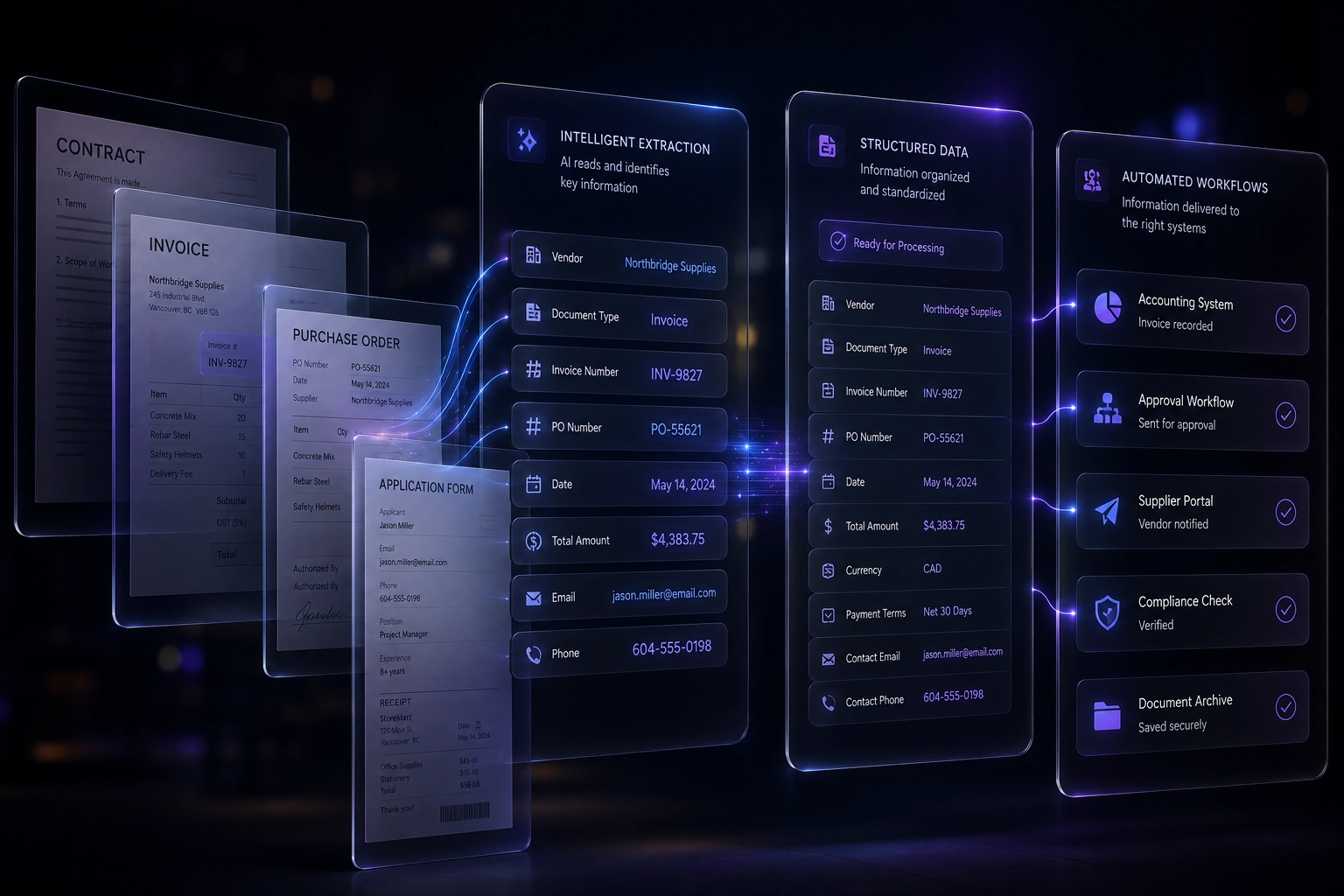
Intelligent document processing classifies incoming documents by type, extracts required data fields using trained AI extraction models, validates extracted data against business rules, routes exceptions for human review, and integrates confirmed data directly into connected ERP, accounting, or CRM platforms without manual transfer.
What is the difference between OCR and intelligent document processing?
Traditional OCR converts document images to machine-readable text. Intelligent document processing adds comprehension — understanding what the text means, which fields it populates, and what downstream action it should trigger — adapting to new document formats without manual template updates.
Which businesses benefit most?
Finance, legal, insurance, healthcare, distribution, and any Canadian business processing high volumes of varied-format documents benefits from intelligent document processing. The ROI grows with transaction volume — the higher the document volume, the stronger the cost reduction and accuracy improvement case for automation.
How does Zerotens build intelligent document processing systems?
Zerotens maps target document workflows before development, builds domain-specific extraction models from client document samples, integrates directly with existing ERP and accounting platforms, and deploys accuracy monitoring with quarterly retraining cycles — ensuring every intelligent document processing system improves continuously after launch.
LET’S CONNECT
Ready to Start a Project?
Tell us what you’re building,
and the ZEROTENS team will help
you shape the next step.
Conclusion
Intelligent document processing is the operational capability that converts one of the most consistent sources of administrative overhead in Canadian business operations into a competitive advantage — processing documents faster, more accurately, and at lower per-document cost than manual operations can achieve at any volume level. The organizations that build this infrastructure now are eliminating a bottleneck that would otherwise constrain their operational scalability at every subsequent growth stage, while simultaneously improving the accuracy and speed of the financial, procurement, and compliance workflows that drive their daily business operations.
Zerotens builds intelligent document processing systems for Vancouver and Canadian businesses through a structured engagement that begins with honest workflow discovery and document audit, develops domain-specific extraction models calibrated to each client’s actual document environment, integrates directly with existing operational platforms without requiring wholesale system replacement, and delivers continuous post-deployment optimization that ensures the system compounds in accuracy and commercial value across every quarter of production operation.
If your organization is ready to convert its document processing overhead into an automated, scalable operational advantage, intelligent document processing through Zerotens is exactly where that transformation begins.